

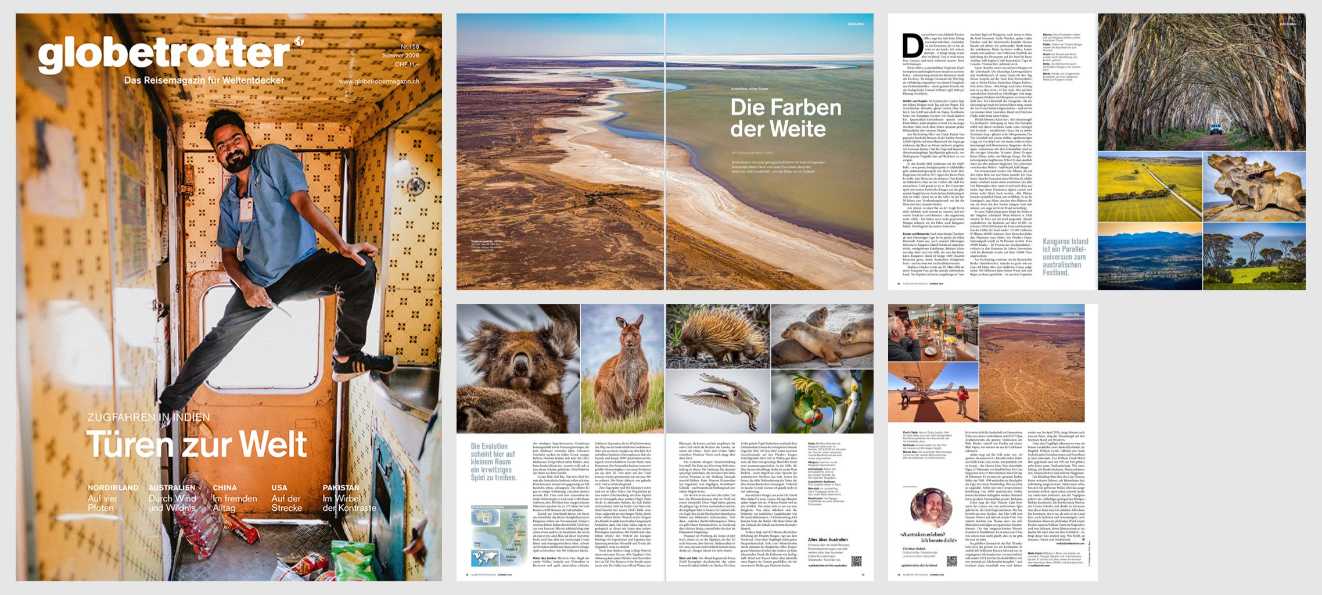
Published in:

Switzerland’s largest travel magazine
7 pages | Text & photos Malte Clavin
Rodin, riesling and a sleeping Ophelia
Broad avenues, front gardens in jacaranda blue, church spires of honey-coloured sandstone on almost every corner – Adelaide once went by the nickname “City of Churches”. It is the only major city in the world entirely framed by a green belt of parkland – a green corset that the city’s founder, Colonel William Light, prescribed by planning decree in 1836.
We step into the Art Gallery of South Australia. Inside, Rodin’s The Thinker catches the eye at once. That is no accident: with more than twenty bronzes, the gallery holds the most significant Rodin collection in the southern hemisphere.
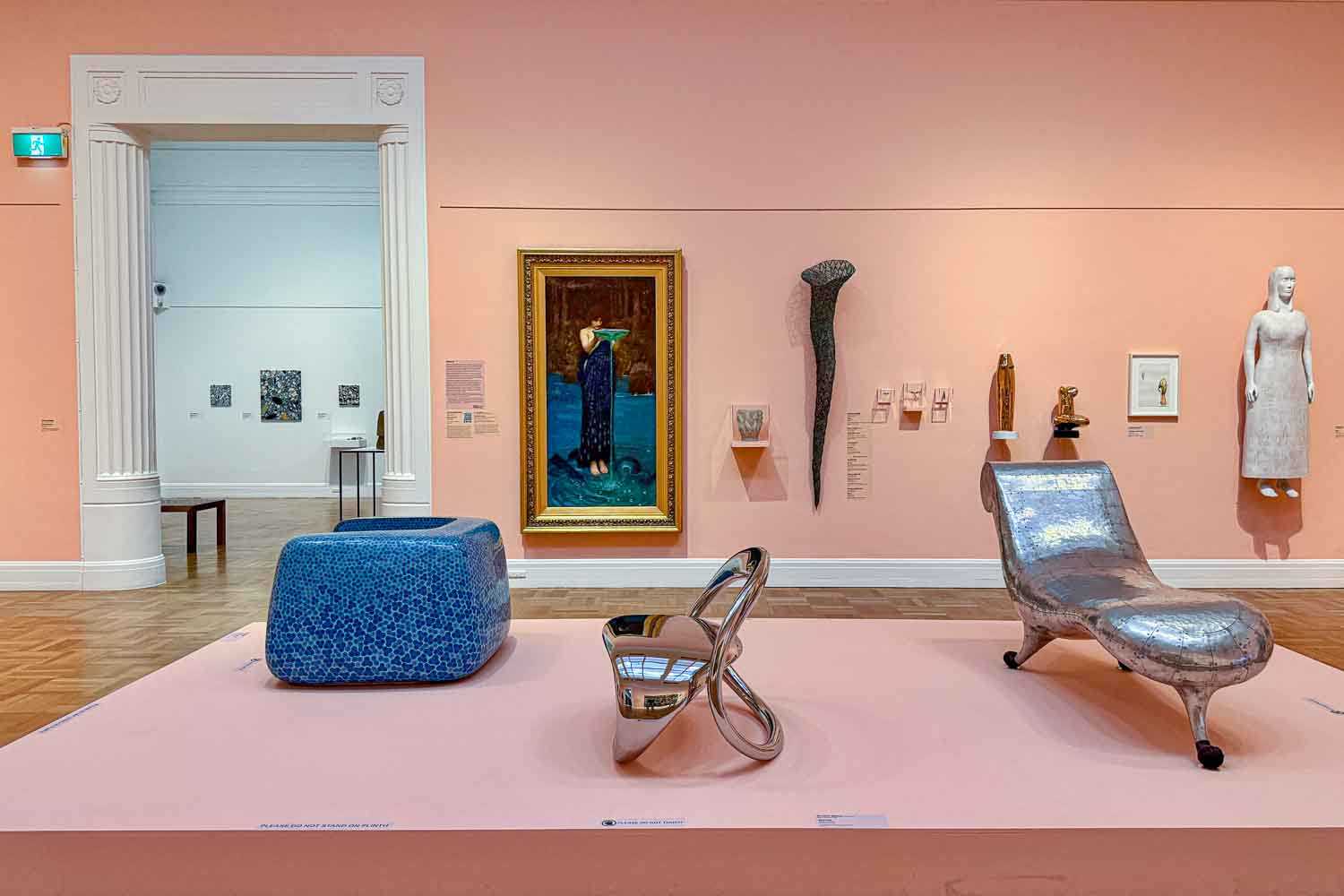
Contemporary seating, chrome-plated sculptures, pink walls – curatorial art at the Art Gallery of South Australia that breaks down boundaries.
But what makes the Art Gallery remarkable is what the curators do with that collection: confrontation. Rodin keeps watch beside contemporary Aboriginal art. British colonial portraits hang above Asian ceramics.
Then a fierce red light pours through an archway: an installation of chrome-plated sculptures against pink walls. The curators do not exhibit. They throw pieces from several centuries and epochs into one room together.
Dew still lies on the paths
The next morning in the Botanic Garden: dew still lies on the paths. An Australian white ibis glides silently across the pond. A dusky moorhen waddles through the reeds – its red frontal shield gleaming as if freshly lacquered.
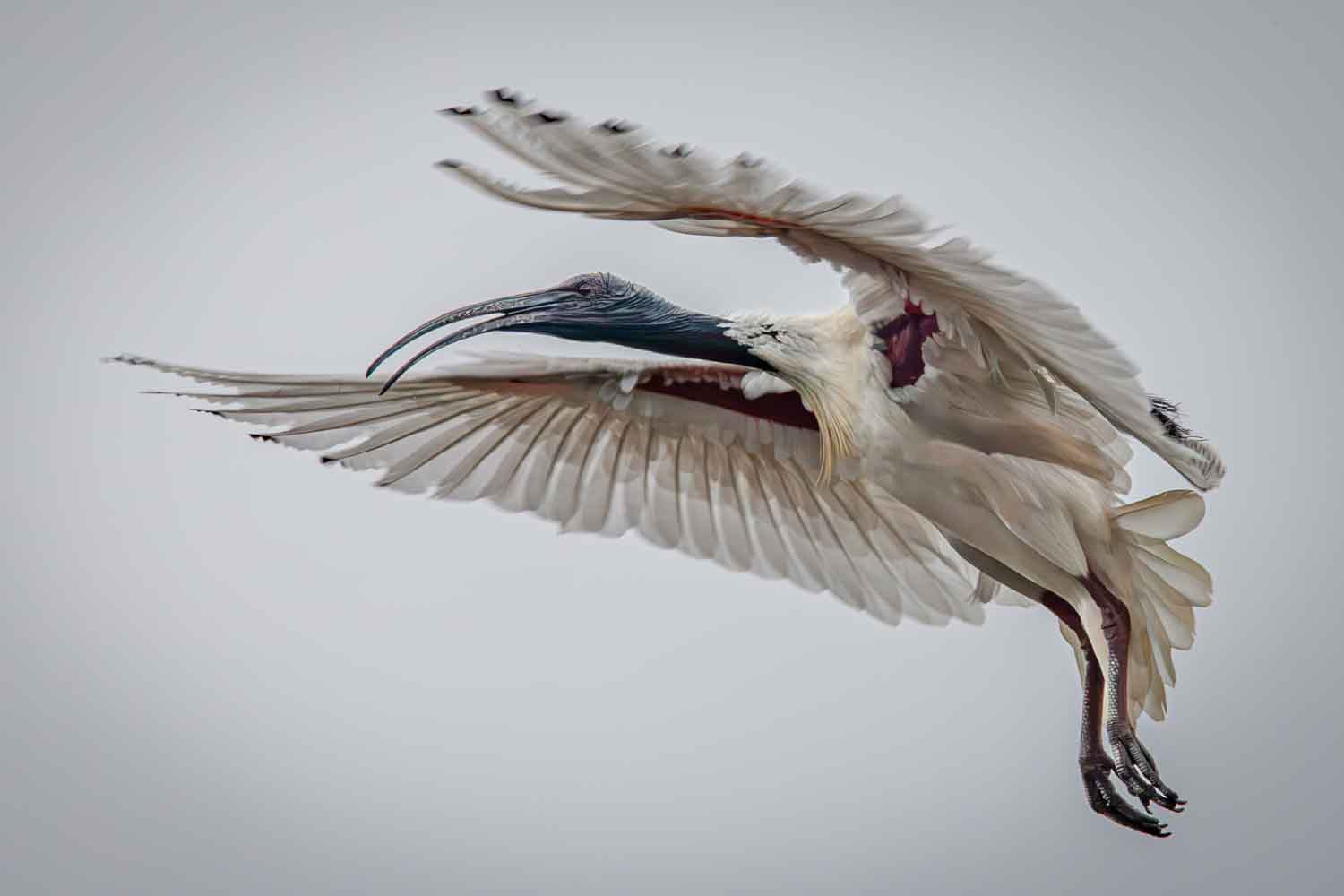
A white ibis in flight.
Then a tree I cannot place. Schefflera actinophylla, I read on the label – Queensland umbrella tree. Its compound leaves, each one as wide as an outstretched arm, splay in all directions and spread green canopies far above our heads.
Beside it a Minni-Ritchi acacia, its bark peeling from the trunk in delicate copper spirals. Adelaide’s Kaurna people used this soft, curled bark as padding and tinder.
In the afternoon, guide Katina Vangopoulos leads us through the streets. In Anster Street she stops in front of a brick wall.
Robot warriors in protective gear, cut razor-sharp from spray
Layer upon layer, an army advances towards you: robot warriors in protective gear, figures with gas-mask visors, every silhouette cut razor-sharp from spray – a work by the Toy Soldiers Crew featuring Fred Rock, turning bare masonry into a colourful chronicle of war.
Further on, in Vardon Avenue, Ophelia sleeps on a wall the size of a house front, her eyes closed, her hair drifting in the water, surrounded by water lilies. Jimmy C needed three days and thousands of layered spray dots to immortalise Shakespeare’s tragic heroine here on brick.
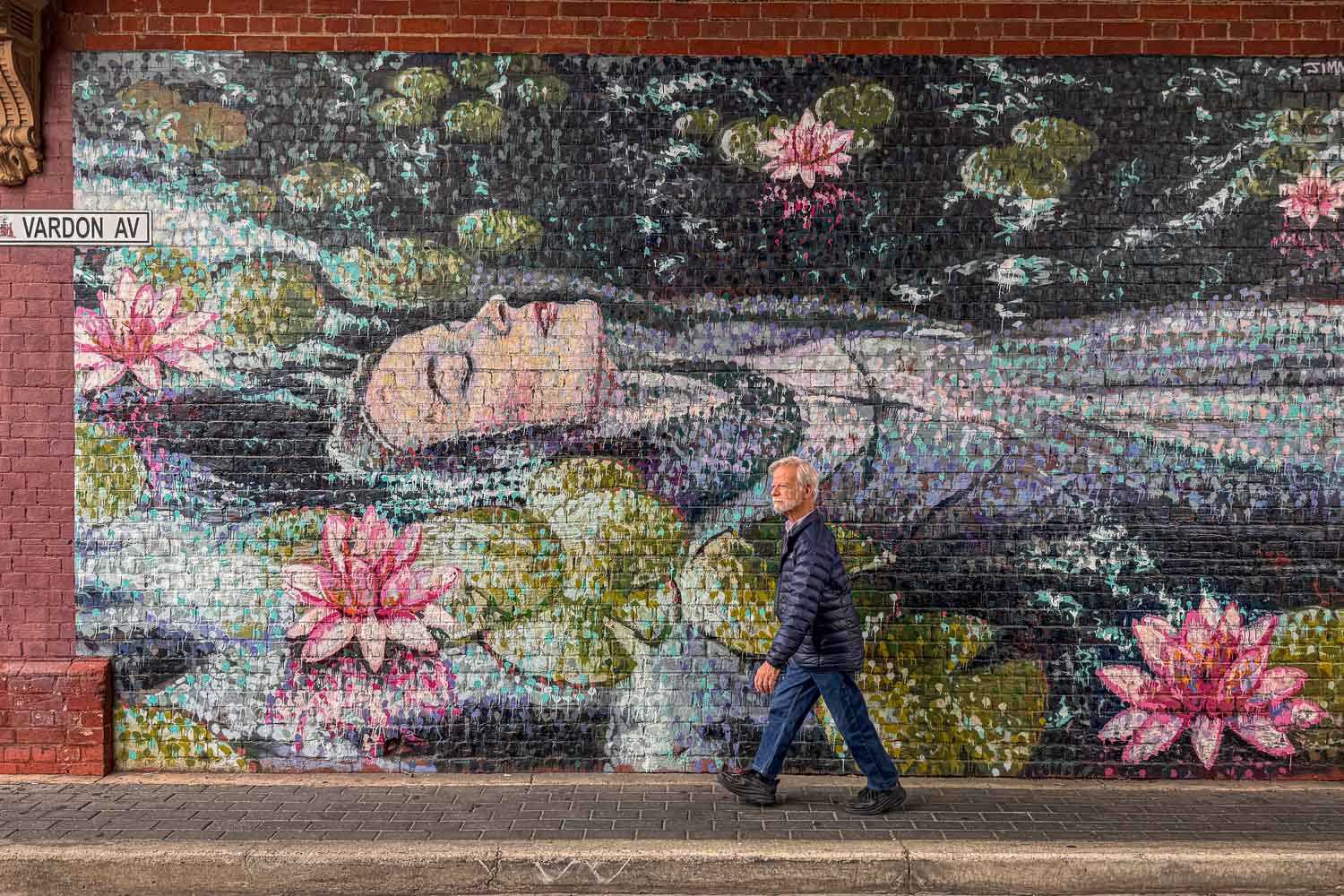
Vardon Avenue, Adelaide: a passer-by drifts past Jimmie C’s Ophelia – Shakespeare’s slumbering tragic heroine, cradled among water lilies.
Then Rundle Mall. Before us the Mall’s Balls – two larger-than-life stainless steel spheres, polished to a high shine, stacked four metres tall. Bert Flugelman designed them in 1977 especially for this square.
Flugelman wanted people to touch them. Wanted children to smear them. Wanted them to grow into the bustle of the mall. And that is exactly what happened.
“Meet me at the balls” – for almost fifty years
A grandfather plays tag with his grandson around the gleaming spheres, both laughing, both reflected in the steel. “Meet me at the balls” – for almost fifty years the formula by which Adelaideans find one another.
In the evening, over a negroni at Fugazzi in Leigh Street, Adelaide passes before Annette and me once more. Yet the land beyond – the unformed, vast, wild – has not spoken yet. Tomorrow we take the ferry to Kangaroo Island. And then the other Australia begins.
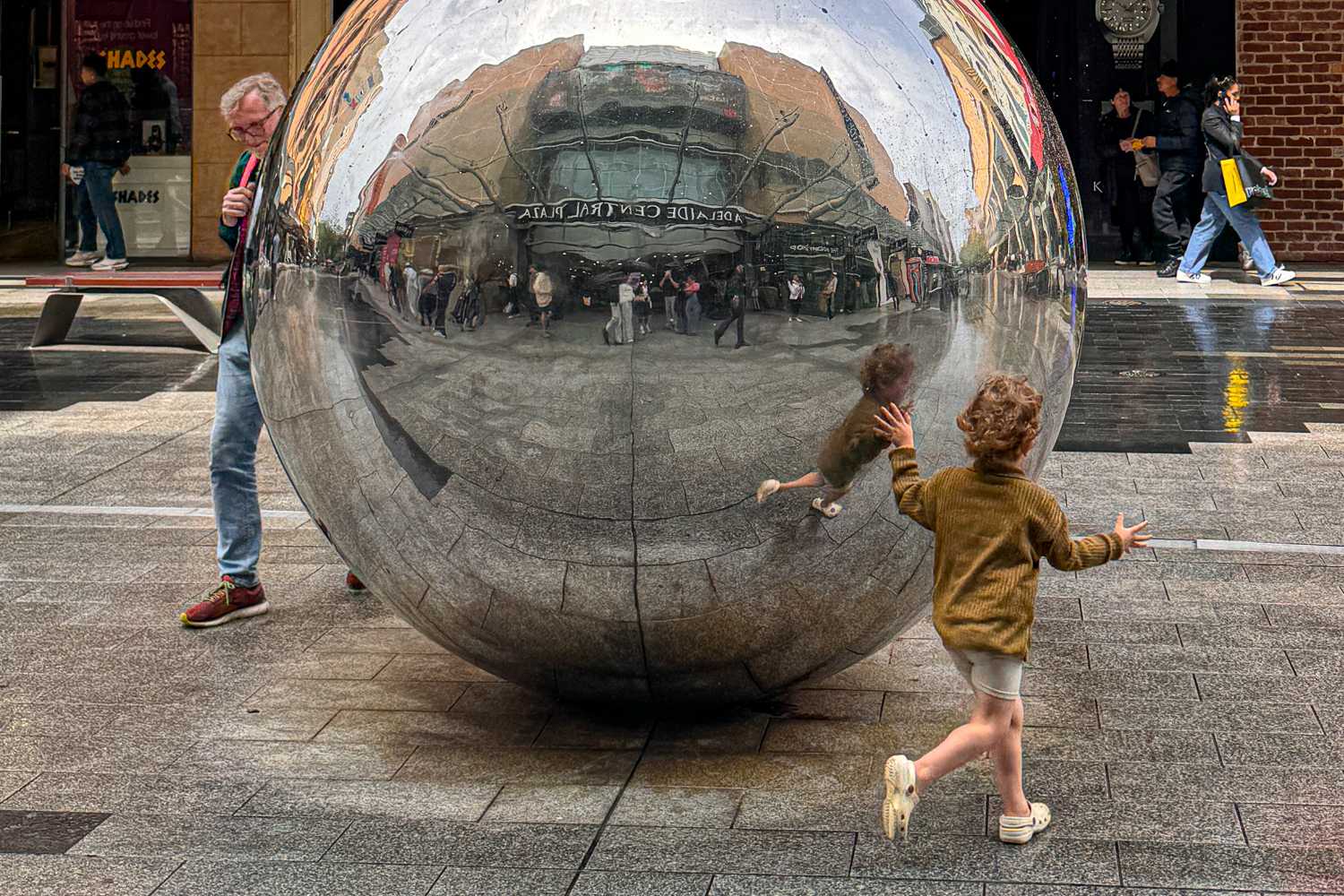
A child runs towards “Mall’s Balls” – Adelaide’s most photographed sculpture in Rundle Mall. Since 1977, the mirrored spheres have served as a meeting place, a landmark and a playground all in one.
The breath of Gondwana
Parking Tetris. There is hardly another way to describe the scene at the Cape Jervis ferry terminal. Dozens of cars roll backwards into the belly of the Sealion 2000 until barely a gap is left. After an hour’s crossing the ferry spits everything out again, our hire car included. Welcome to Kangaroo Island!
Australia’s third-largest island – and a parallel universe
Then sheep on lush green pasture, wind-sculpted eucalypts, the shimmering sea behind them and a silence you can almost hear. Kangaroo Island covers just under 4,400 square kilometres, making it Australia’s third-largest island – and at the same time something of a parallel universe.
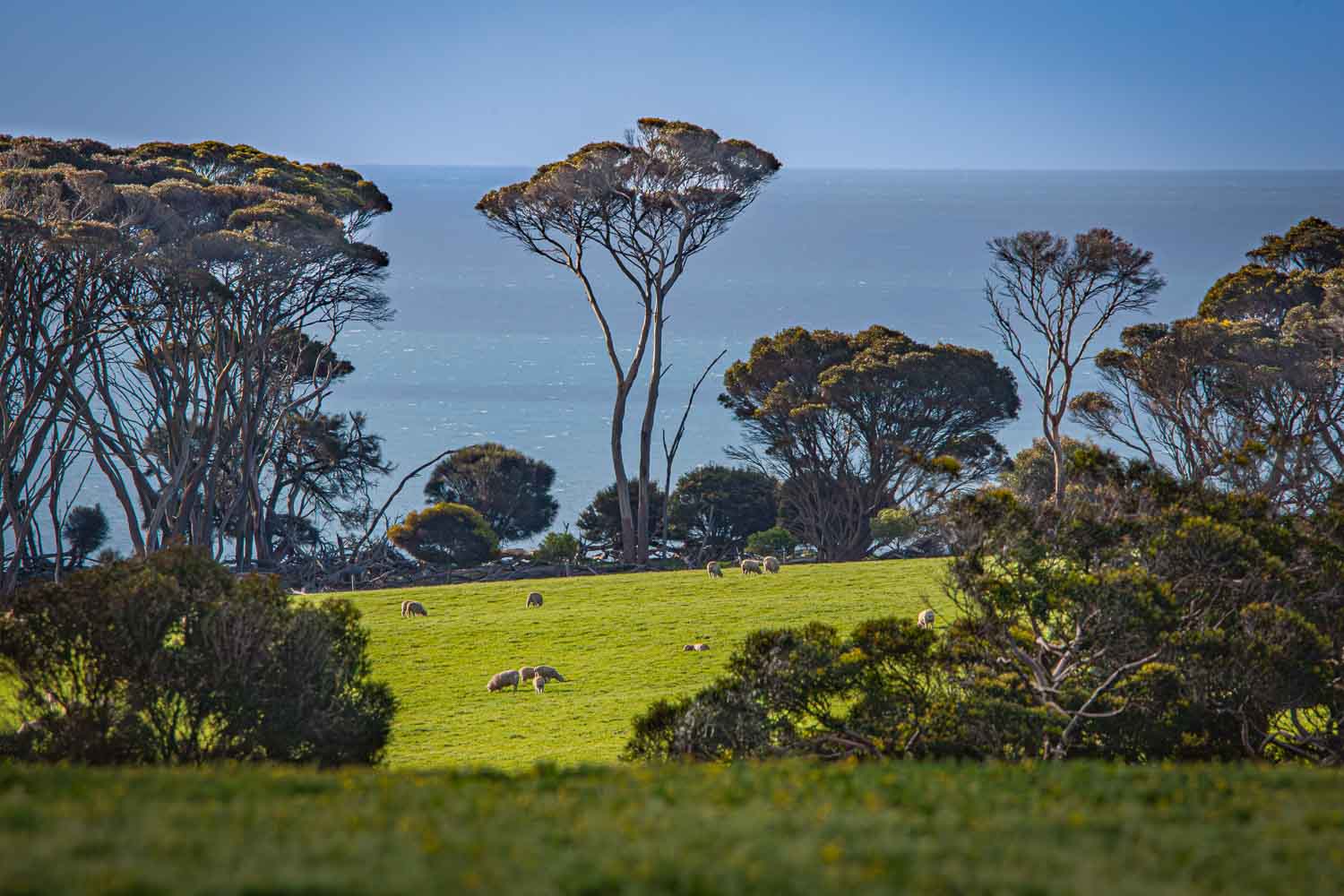
Kangaroo Island: sheep grazing on lush green pastures, wind-sculpted eucalyptus trees, and the shimmering sea beyond – a silence you can almost hear.
Matthew Flinders was the first European to set foot on the then uninhabited land, on 22 March 1802. The 28-year-old captain and his famished crew hunted the kangaroos he would later name the island after.
Six weeks later, Flinders and the French captain Nicolas Baudin met on the open sea. Both had set out to chart the unknown coast, neither knew of the other.
Half English, half French
The encounter was peaceful, and the division of place names across the island is visible to this day: half English, half French. Cape du Couedic. Vivonne Bay. Admirals Arch.
Adam Houchin is waiting outside the Sea Dragon lodge the next morning. The former lorry driver and football coach is our guide for the day.
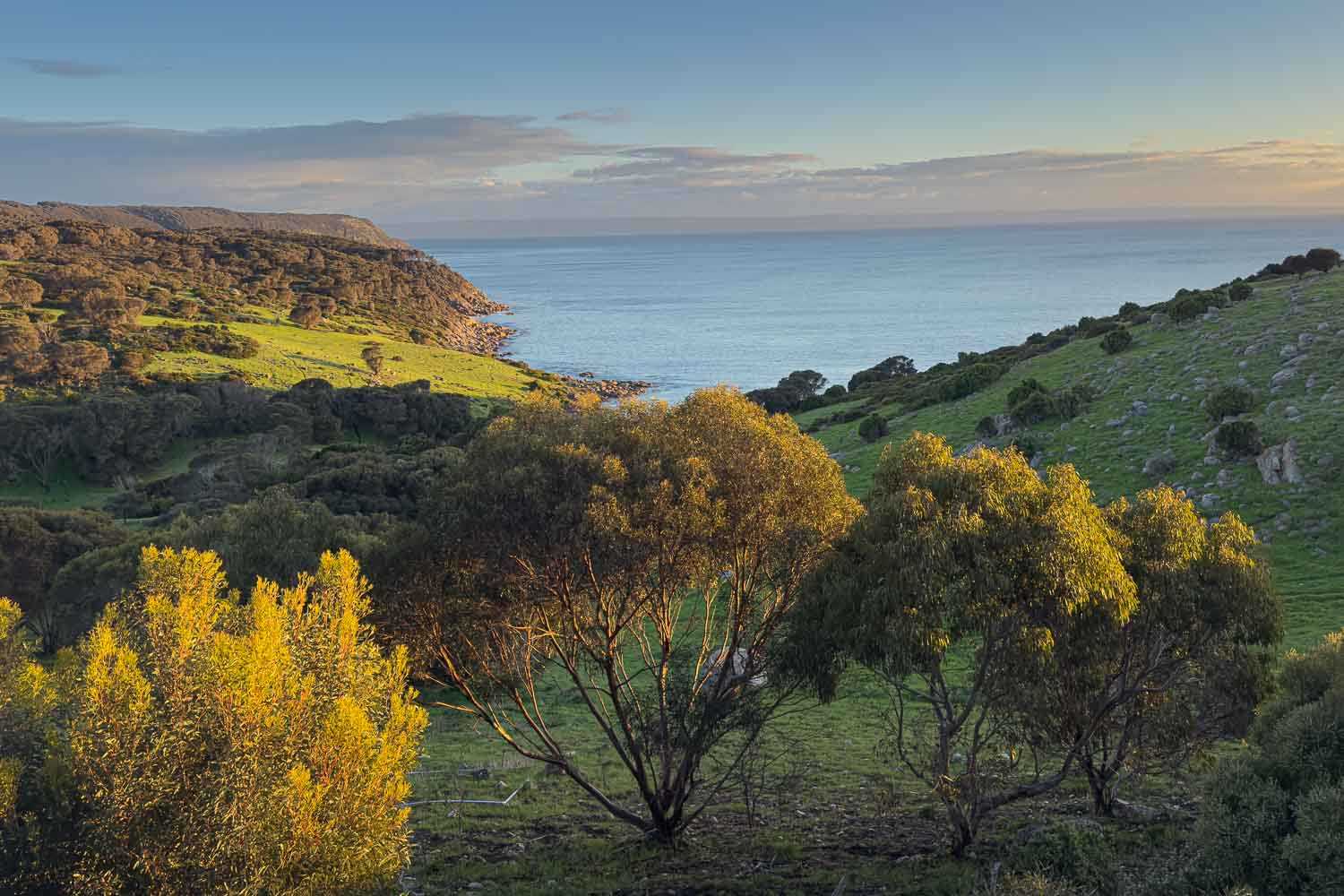
Kangaroo Island, Sea Dragon: The evening sun bathes the acacia trees in golden light – behind them, coastal hills and a calm sea.
“No traffic lights on the island, no roundabouts,” he says, “no foxes, rabbits, dingoes, cane toads.” A short pause. “Sounds like a small thing. It isn’t.”
He is right. What has eaten away at the ecosystem on the Australian mainland – pests and introduced predators – is missing here: a stroke of geographical luck. When sea levels rose after the last ice age around 10,000 years ago, the island was cut off from the mainland – and with it an intact piece of Australia. Roughly a third of its area is protected today.
Suddenly he brakes hard. “An echidna! There, in the bush!” Excitement in the car.
A creature as if from another planet
And there it is: one of them rummaging through dry leaf litter, its cream-yellow spines – modified hairs, up to seven centimetres long – glinting in the morning sun. The animal waddles from leg to leg with a stiff, reptilian gait, a creature as if from another planet.
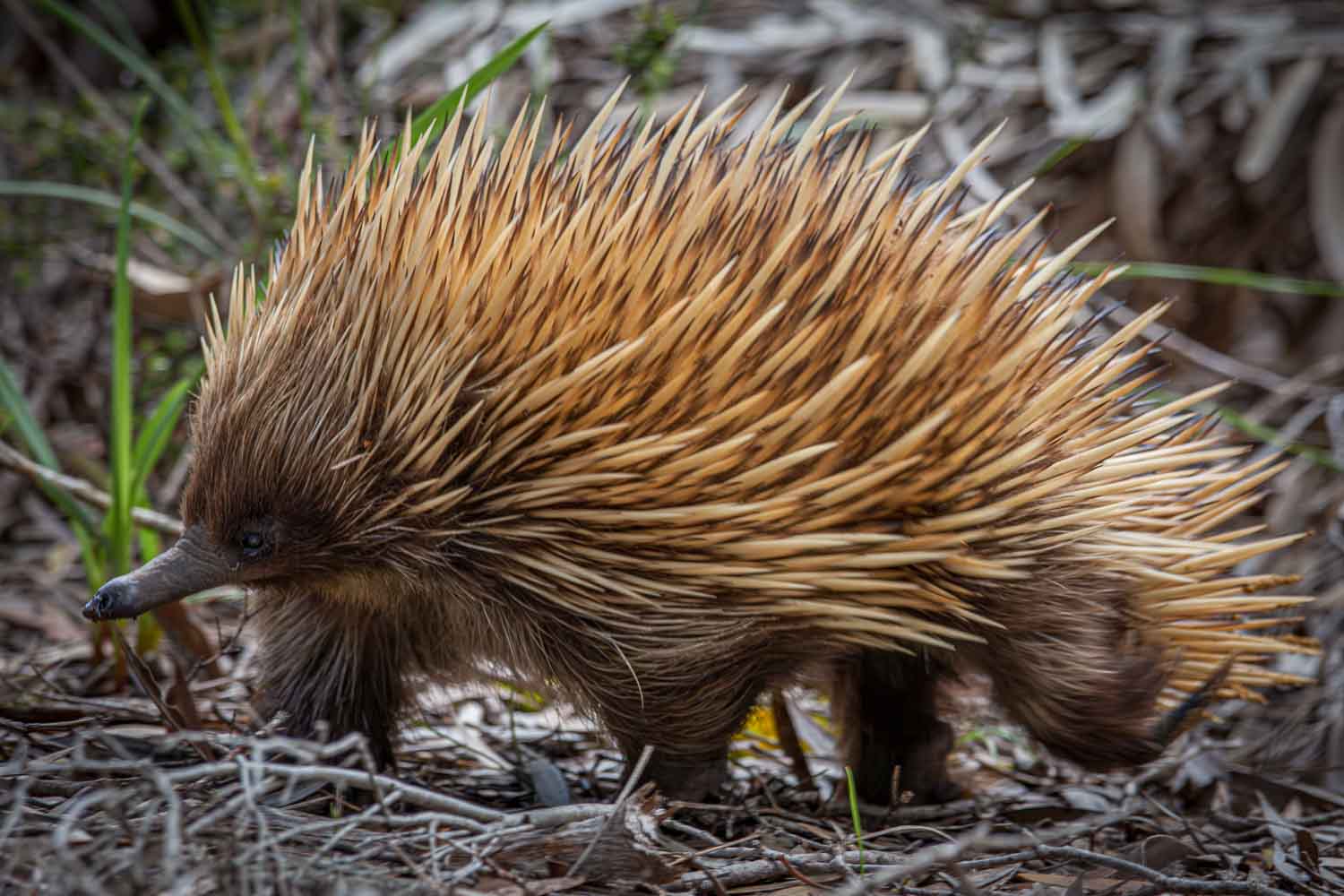
Kangaroo Island: A short-beaked echidna – golden-brown spines, tiny button eye, stoic expression. One of Earth’s last egg-laying mammals.
Echidnas are monotremes: mammals that lay eggs. Together with the platypus they are the only living members of that group.
No teeth, but a sticky tongue up to 17 centimetres long – which gave the genus Tachyglossus its name, Greek for swift tongue. Body temperature sits at just 31 to 32 degrees Celsius, well below that of every other mammal. A being between worlds – half reptile, half mammal.
German has yet to find a fitting name for it
On we go. By the roadside grows a plant that looks like a palm at first glance but, on closer inspection, seems older than anything around it. Xanthorrhoea semiplana – grass tree in English, and German has yet to find a fitting name for it.
Some specimens are three hundred years old, Adam explains, and grow barely a centimetre a year. The flower spike, though, once it shoots straight upwards, covers a centimetre a day and can reach six metres.
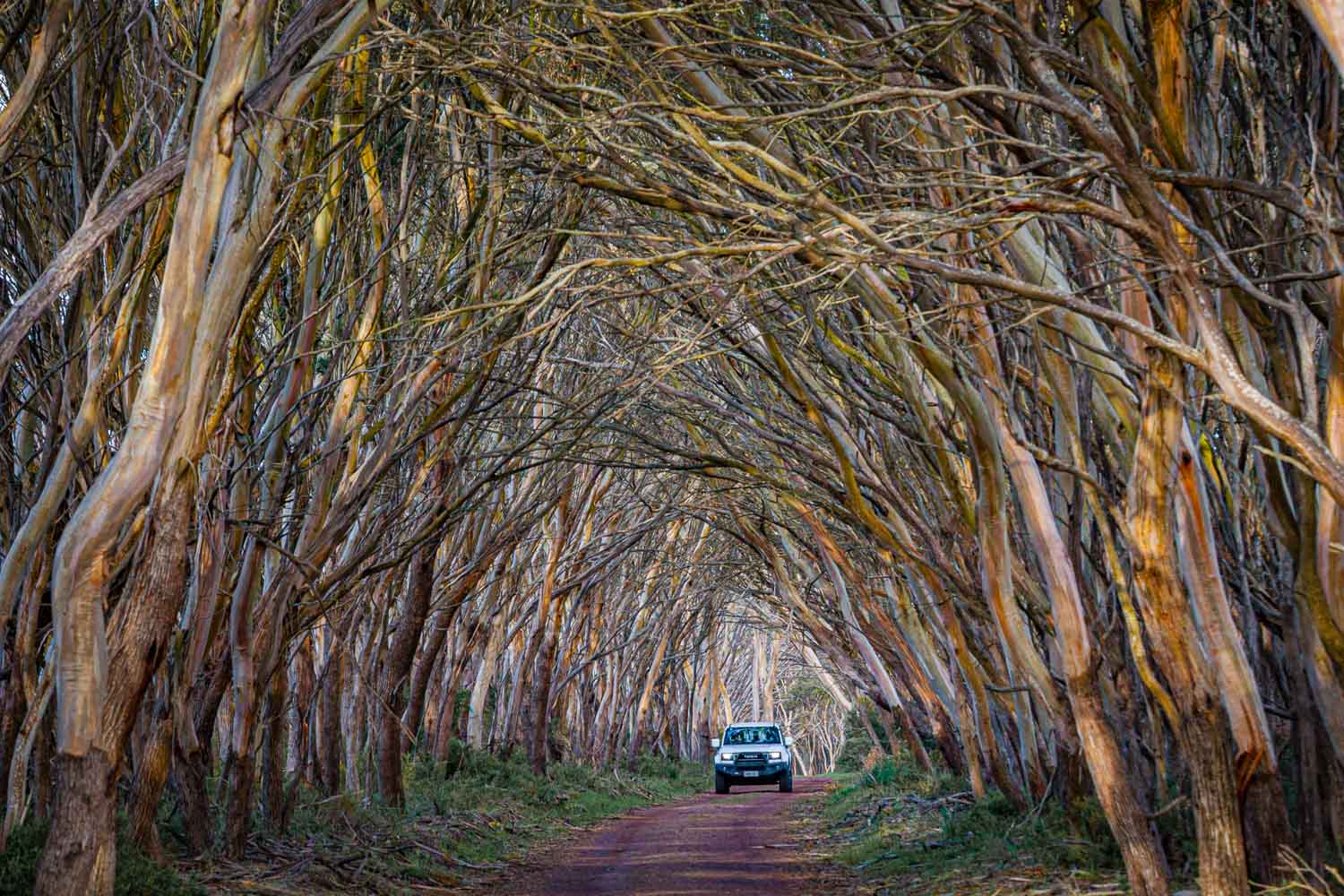
Kangaroo Island: Eucalyptus cneorifolia arches into a natural tunnel.
“The plant actually needs fire in order to flower. It’s its starting signal,” Adam remarks. The old leaves, hanging around the trunk like a skirt, tell you how long ago the last burn was.
In a stand of eucalypts a koala hangs in the fork of a branch, asleep. Then it blinks, looking faintly grumpy about it.
In 1926, eighteen animals were released on the island; the population then exploded to more than 65,000. In the summer of 2019/20 the fires came and burned down almost half the island: 211,000 hectares, 87 houses, 60,000 head of livestock.
82 per cent of the island population died in the fires
Two people lost their lives to the flames, and one national park was 96 per cent destroyed. Around 39,000 koalas – 82 per cent of the island population – died in the fires. Numbers have since recovered to more than 15,000 animals.
In the afternoon: Remarkable Rocks. Granite boulders, some the size of a house, piled 60 metres above the Southern Ocean.
For 500 million years wind, salt and rain have worked on them – peeling them out of the bedrock of the former supercontinent Gondwana and forcing them into shapes no sculptor would have invented.
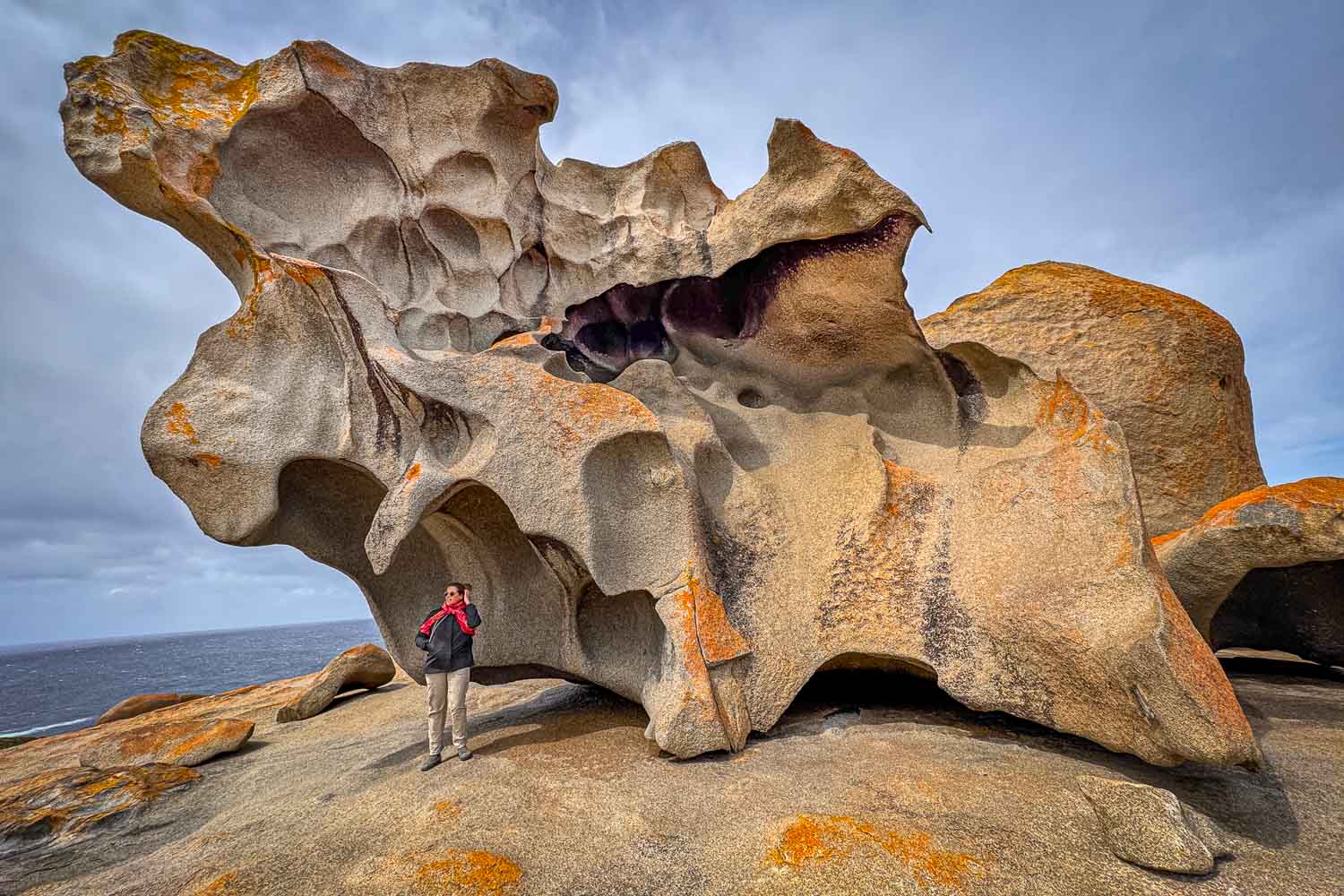
Kangaroo Island: The Remarkable Rocks – sculpted into bizarre shapes by wind and salt water over 500 million years. Annette, standing below, gives a sense of scale.
Black xenoliths sit like foreign bodies in the pale granite, orange lichens spread across the surfaces. Some of the rocks have hollows you can crawl through.
Annette stands in one of these bowls, a whistling wind tearing the hair from her face. Some of the rocks really do look like submarines out of a wild Salvador Dalí painting.
Last stop: Seal Bay. Three Australian sea lions, about five months old, roll down a dune, bite each other’s fur, cuddle, tumble, sniff. The mothers lie some distance away, apparently uninterested.
Twelve minutes without breathing, 275 metres down
The species is threatened with extinction: around 12,000 of these sea lions remain worldwide, about 800 of them here. Adult males dive to depths of 275 metres and can hold their breath for twelve minutes.
The young ones, meanwhile, doze in the sand, eye us, roll down the dune again. Adam watches them go. “Haha, that’s my spirit animal,” he says. “Fishing all day, playing, romping about in the sand!”
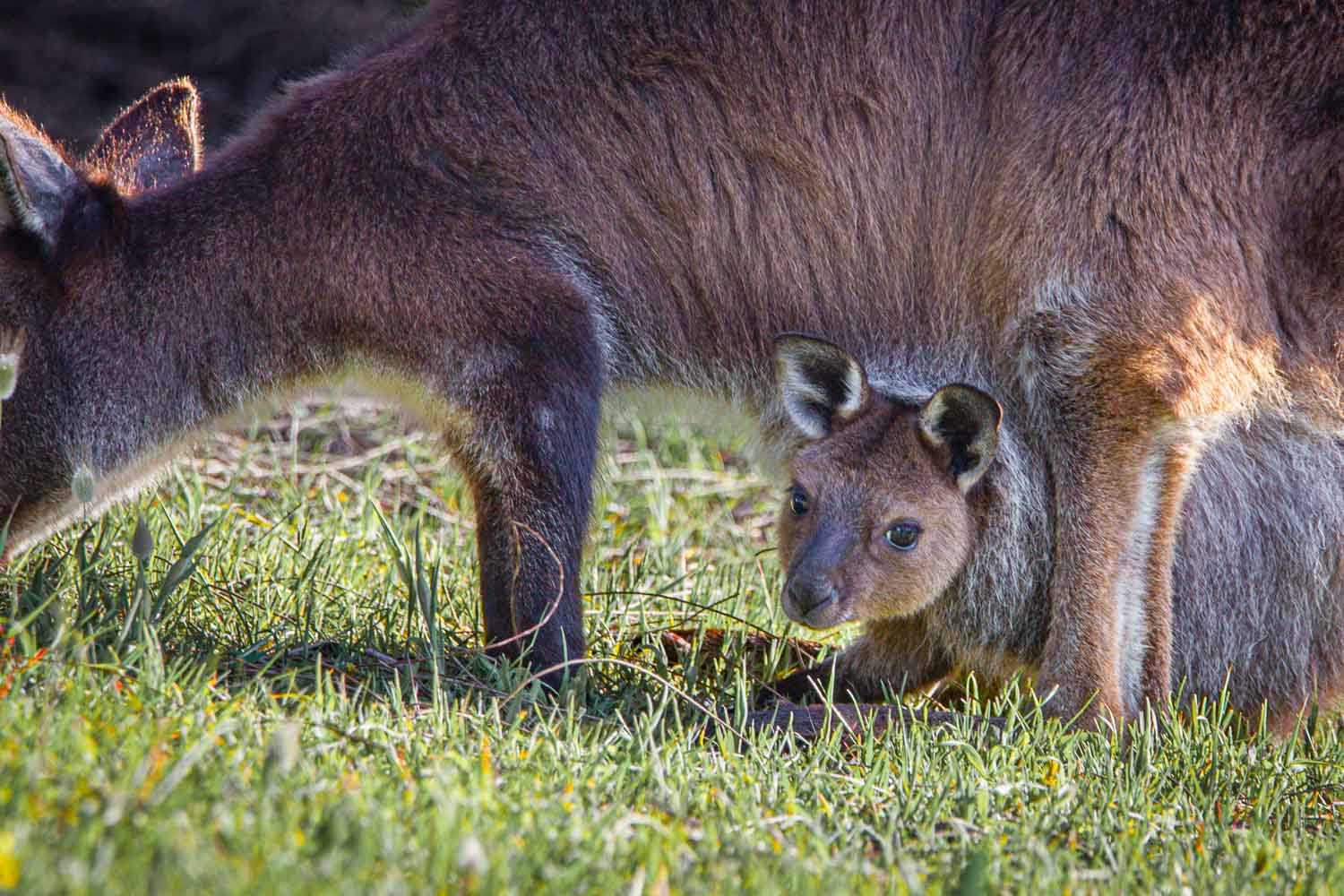
A baby kangaroo pokes its head and front paws out of its mother’s pouch; its exploration of the world begins.
We drive back to the lodge through an evening light that turns everything the colour of honey. Kangaroos stand by the roadside, two black swans lead their cygnets through the reeds.
Evolution playing an absurd game in a very small space
And Duncan from the tourism office in Adelaide already sounds a little different now: a continent pretending to be a country. Here, on this island without fox or hare but with echidnas, primeval rocks and a storm-lashed sea, evolution seems to be playing an absurd game in a very small space. For 500 million years.
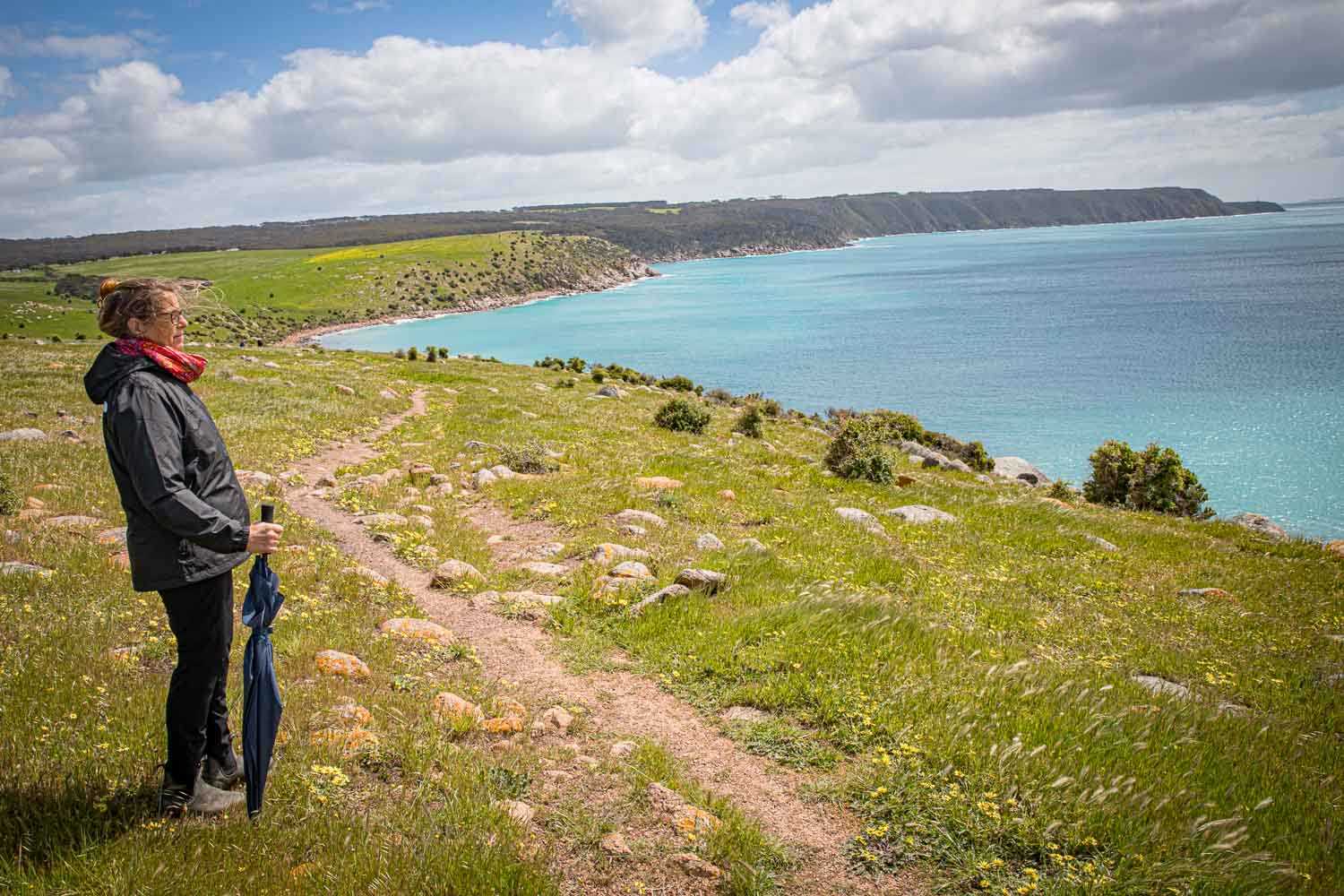
Turquoise water laps at the bay near Cape Willoughby, whilst a salty breeze sweeps across the grasslands.
Keepers of the breath
McLaren Vale: hills like gentle waves, covered in vines turning autumn red and gold, slender goldcrest cypresses swaying between them. The road from the island back inland brings us to the Salopian Inn.
An estate dating from 1851
An estate dating from 1851, pale sandstone, climbing plants across the façade and close to 3,000 square metres of organically farmed garden behind the restaurant.
Oliver Budack welcomes us. Sommelier, thirty years in Australia. “Today you’re drinking a fiano from Paralian,” he says, and presents us with two filled white wine glasses. “A really wonderful producer from the valley. You’ll like it.” We drink, we smile, and we cannot help but agree with him.
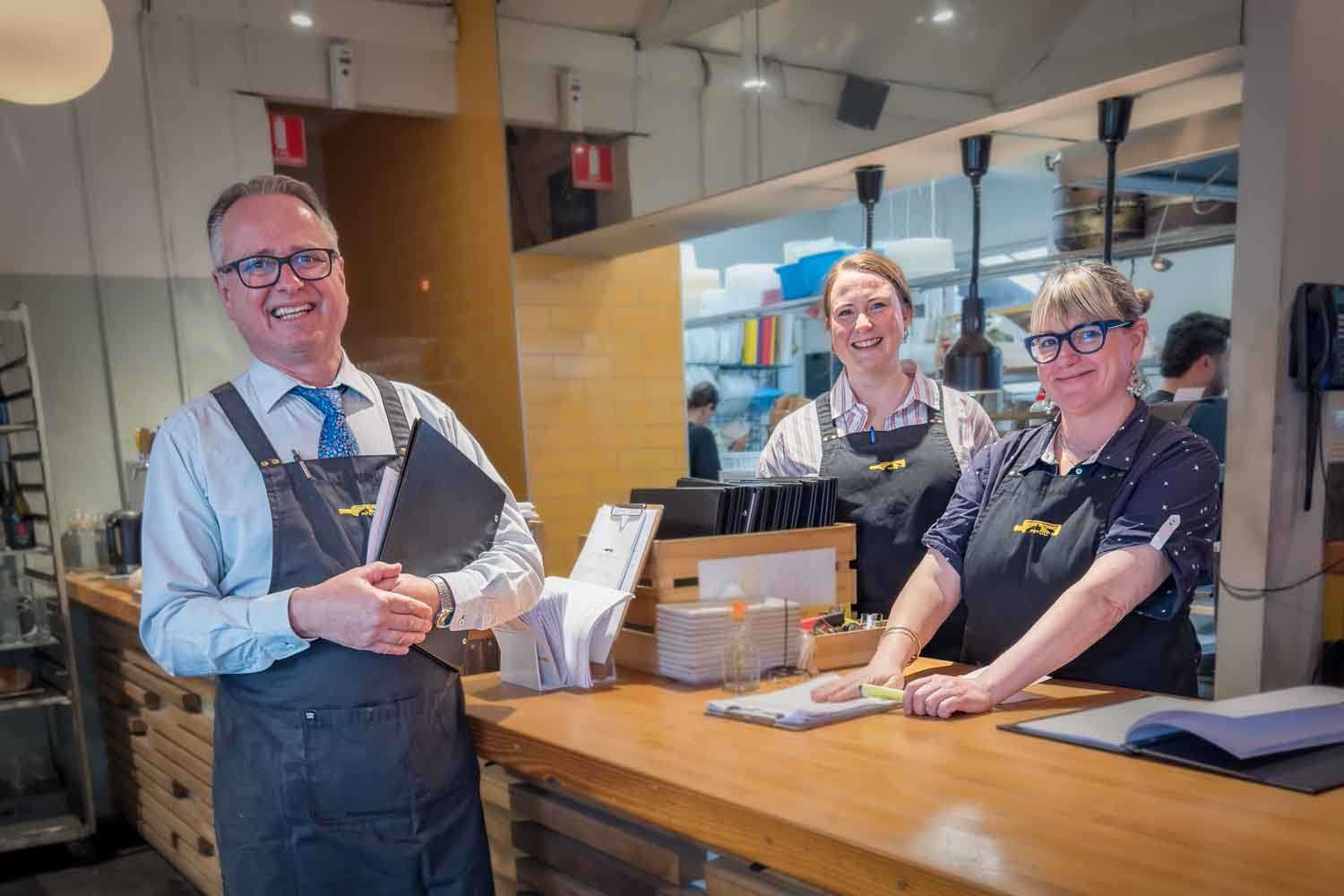
The Salopian Inn, McLaren Vale; from left to right: Oliver Budack, sommelier and front-of-house manager, and restaurant managers Sarah and Bec.
What then arrives at the table mostly grows a few metres away: Salopian dumplings with pork, ginger and pickled cabbage, then grilled asparagus with chermoula and tahini, and finally a Coorong mullet from that stretch of water south of Lake Alexandrina where fresh and salt water run into one another. Nature dictates what is cooked. And it tastes superb.
Two days and 192 kilometres later: the Clare Valley. The road here is another slow dissolve – first fat fields of rapeseed in chrome yellow, then softer hills, riesling vines in neat rows, the air cooler and drier.
Warrick conducts the evening, ten courses with anecdotes
Warrick Duthy of the Watervale Hotel runs his Chef’s Table here: ten guests lined up along a long counter right at the open kitchen. Warrick conducts the evening, playing us ten courses complete with anecdotes.
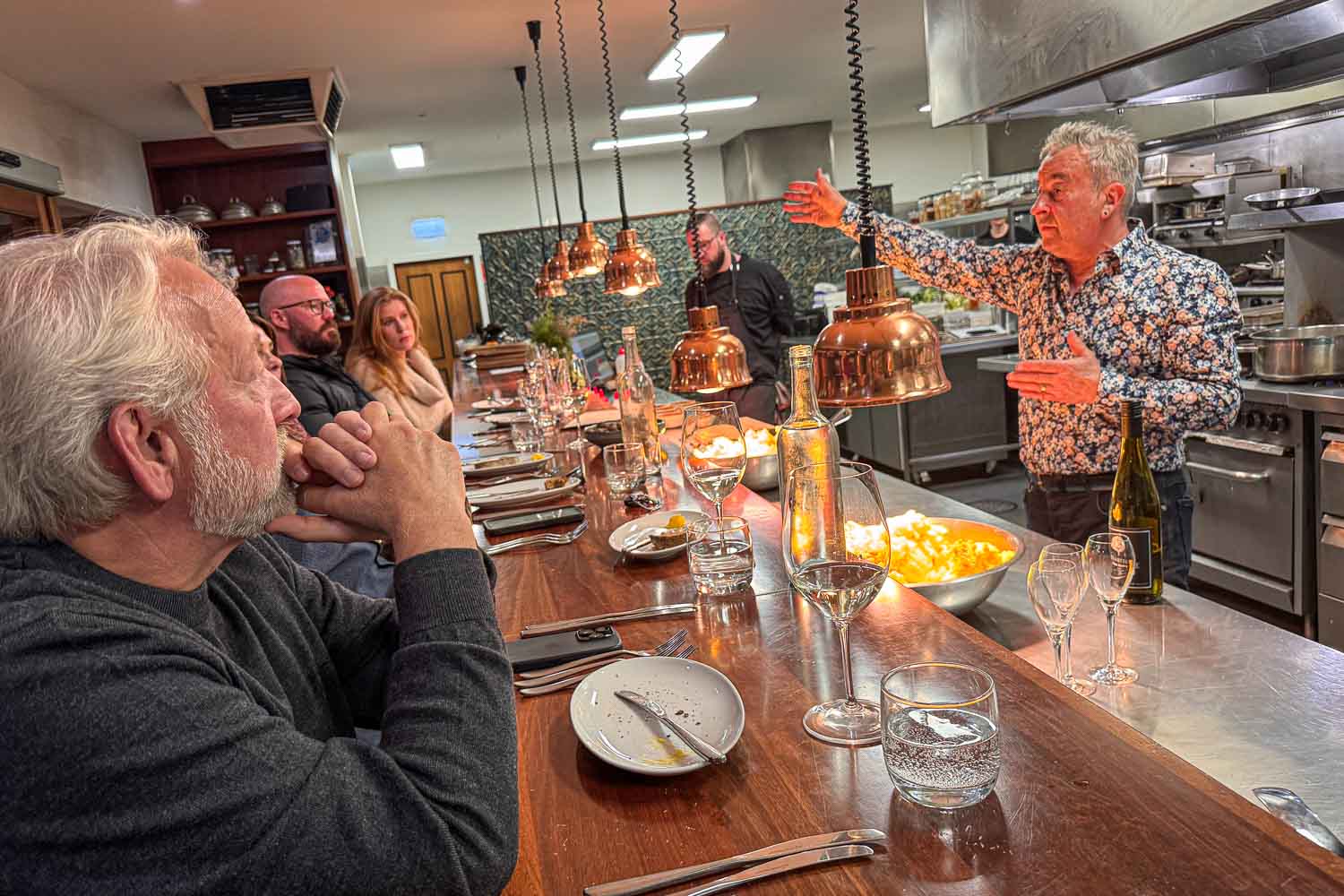
At the Penobscot Restaurant, the drama of the kitchen unfolds behind copper pots and flames. Head chef Warrick Duthy guides his guests through a 10-course menu.
The Clare Valley, he says, is geologically as diverse as almost no other wine region in Australia. That variety beneath the vines explains the worldwide reputation of the riesling grown here: for experts, a tension between minerality and fruit that arises nowhere else in quite this way.
After the fifth course Warrick strikes a more intimate note: “The Ngadjuri people came into this valley every October and November. They called themselves the Keepers of the Breath.” He pauses briefly. “The valley was full of water, the climate good. They came here to give birth. They did not see themselves as owners of the land, they were its keepers.”
Long after the last plate, Warrick’s words still hang over the table
Then comes raw yellowtail kingfish in a lime and oil broth. Halloumi with peach. Duck breast on cauliflower purée, alongside confit of kangaroo tail and pickled quandong. To finish: fermented orange sorbet on chocolate crumble. Long after the last plate, Warrick’s words are still hanging over the table.
The next morning, the Jesuit settlement of Sevenhill. In 1848 a priest from Vienna carried a commission into this valley: pastoral care for German-speaking Catholics who felt ill at ease among the Lutheran Prussians in the settlement of Tanunda. Father Aloysius Kranewitter was taken with the hilly, fertile terrain – and named the settlement after the seven hills of Rome.
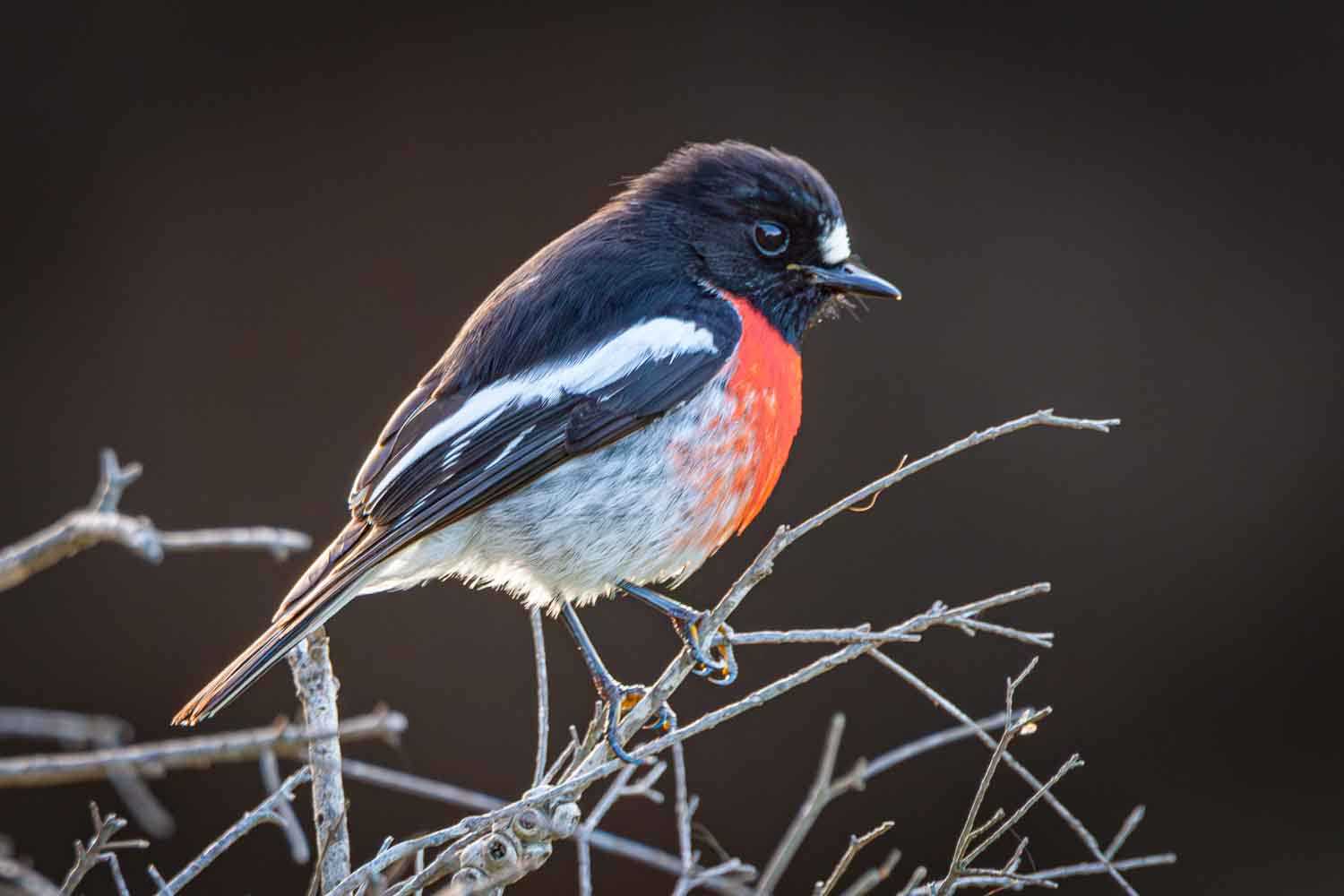
An Australian Scarlet Robin (Petroica boodang) spreads its crimson breast feathers in the morning light. Australia’s smallest flycatcher waits motionless for prey.
Around the church there is quiet activity: a red wattlebird sits motionless on a rotting eucalypt branch. An Australian magpie perches in profile on a fence post – one of those birds that have learned to flip poisonous cane toads over and eat only the non-toxic parts.
In the garden a bird I identify as a musk lorikeet drinks nectar hurriedly from flowering abutilon. And then, among lichen-covered branches: an Adelaide rosella in yellow and blue, so luminous that for a moment I think somebody has hung it there as decoration.
A country you cannot really own
Out in the vineyard, the sun high now, I think of the Ngadjuri, who did not own this valley but kept it. Of Warrick’s line about the keepers of the breath. South Australia is a country you cannot really own, I think. Tomorrow we drive deeper in.
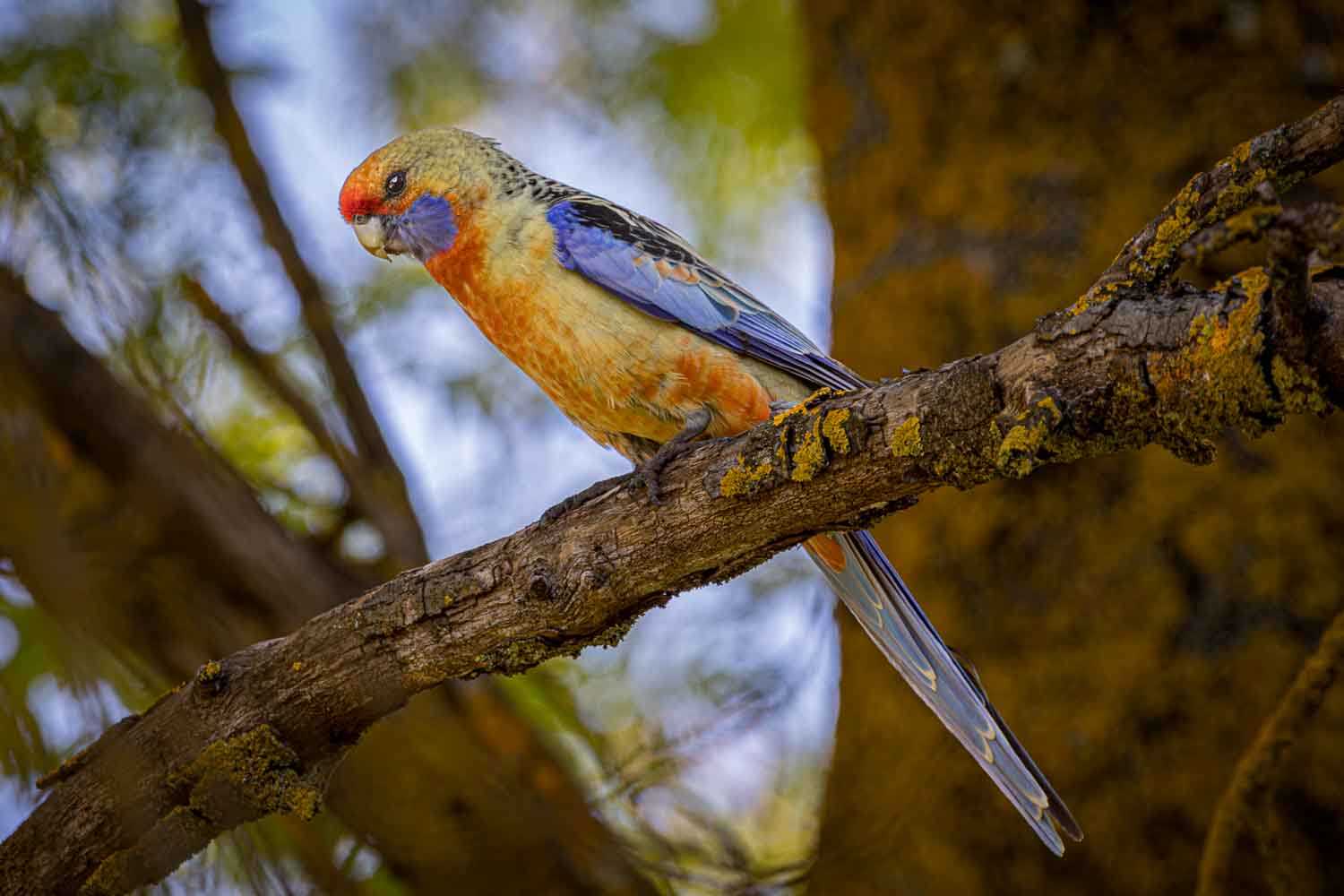
An Adelaide rosella (Platycercus adelaidae) glows yellow and blue among the lichen-covered branches of the Jesuit settlement of Sevenhill.
Stone, salt, silence
The evening begins with emus. Twelve of them roam the ochre-brown grassland east of Hawker. Damon Lawson, our guide, pulls over. “The emu is Australia’s largest bird and, after the African ostrich, the second-largest living bird in the world.”
The tour carries on to a lookout over the Flinders Ranges in the evening light. Layered rock folds towards the horizon in ochre-yellow and sienna-red waves, as if a giant hand had pushed the continent together. Two galahs peck for seeds among dried tussocks of grass, their pink crests glowing in the sunlight.
The deep, inner listening the word Dadirri describes
In the stillness that settles over this evening I think of the word Dadirri – a term from a language of Australia’s north that cannot be translated into English: the deep, inner listening, the quiet perception of nature that goes beyond mere observation. Perhaps that is why I do not much feel like talking just now.
Pilot Aidan Fry starts up the Cessna 210N.
Wilpena Pound first. From below it looks like a mountain range. From above the truth reveals itself: a natural amphitheatre of 80 square kilometres, 17 kilometres long, 8 kilometres wide, its floor 180 metres higher than the surrounding country, its walls of hard Rawnsley quartzite.
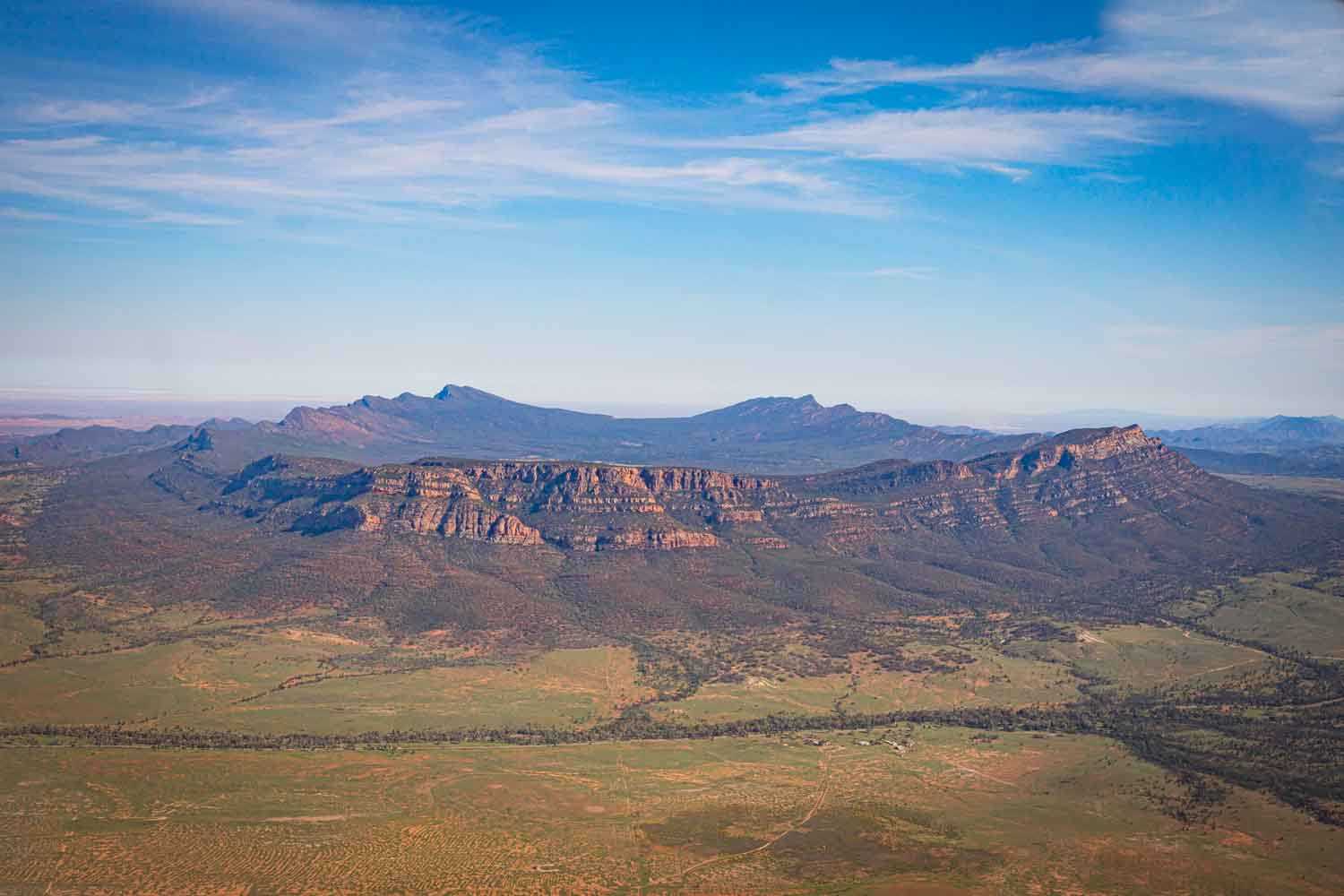
Sediment layers from the Ediacaran stack in ochre, rust-brown, and violet bands to form an amphitheater-like crater – a stone basin in the parched Outback.
The Adnyamathanha, traditional keepers of these mountains, call it Ikara – meeting place. In their Dreaming, two intertwined giant serpents, the Akurra, formed the walls of the Pound on their journey from the north. Geologists may describe it differently.
St Mary’s Peak, the highest point of the Flinders Ranges
St Mary’s Peak, 1,171 metres, the highest point of the Flinders Ranges, rises from the northern rim. Beneath the wing to the right: green steppe country, to the left red desert floor, directly below the ranges themselves – purple-grey folds run through the rock as if tectonic pressure had gathered the earth’s crust like fabric.
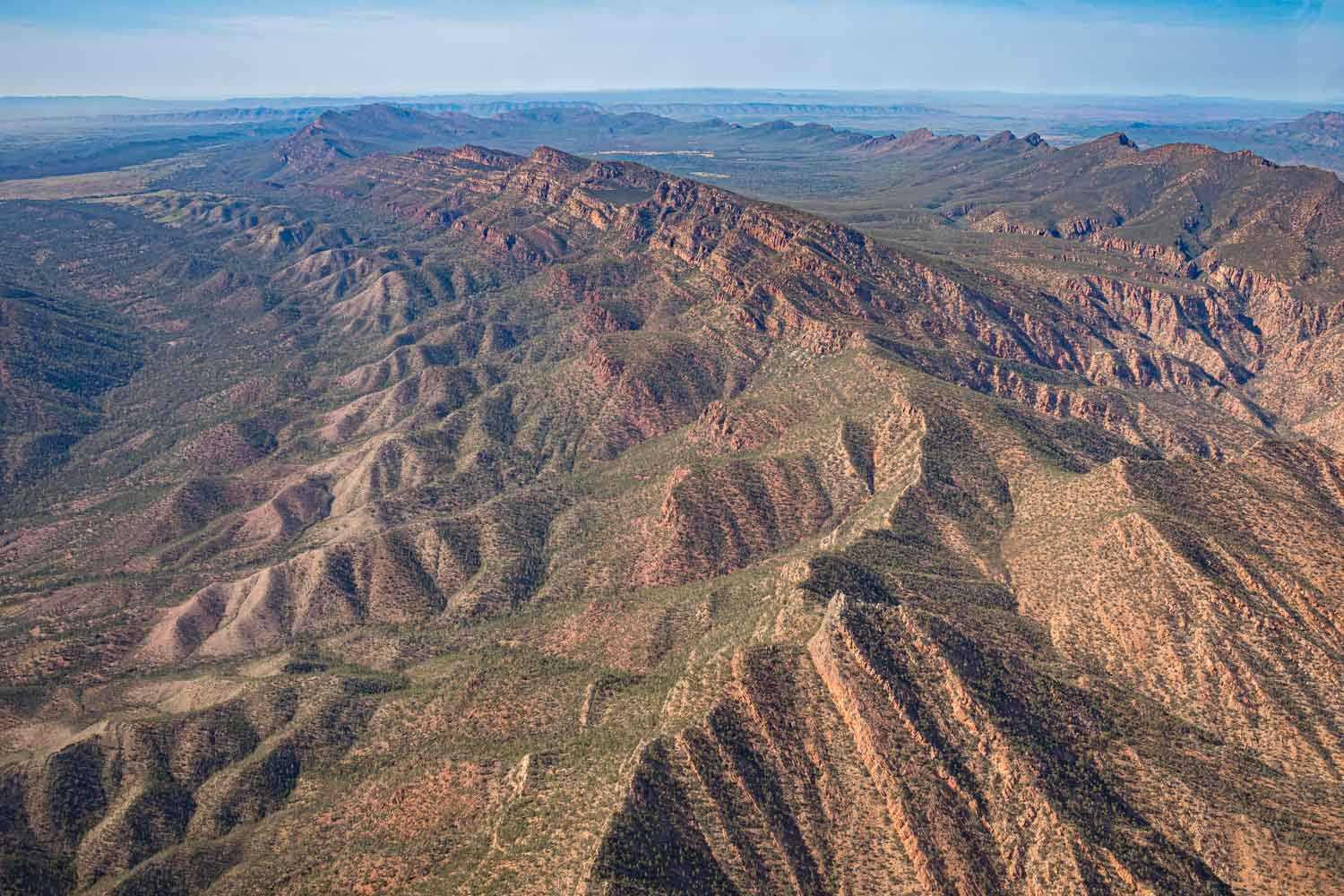
Folded ridges of reddish rock stretch across the parched landscape as if a giant hand had crumpled the continent.
Over millions of years, wind and water have ground ribs into the stone that run towards the horizon like petrified waves.
The Flinders Ranges are the only place on earth where an almost unbroken geological sequence spanning 350 million years is visible. The oldest fossils of multicellular animal life on the planet were discovered here, in the Ediacara Hills to the north. So significant was the find that science declared a new geological period for it – the Ediacaran, named after this very place.
The largest cattle station in the world, larger than Israel
10.08 a.m. We fly over Leigh Creek, a small settlement with a lake in a crater behind it – a former open-cut mine, now a water reservoir. Then the landscape opens out into the boundless. Below us Anna Creek Station, at 23,677 square kilometres the largest cattle station in the world, larger than Israel. Cattle scattered like dots on a sheet of paper; from up here we can barely make them out.
Aidan points at the ground beneath us. “He’s down there somewhere.” I see nothing. Then a pale line, a second one, and suddenly he steps forward – the Marree Man.
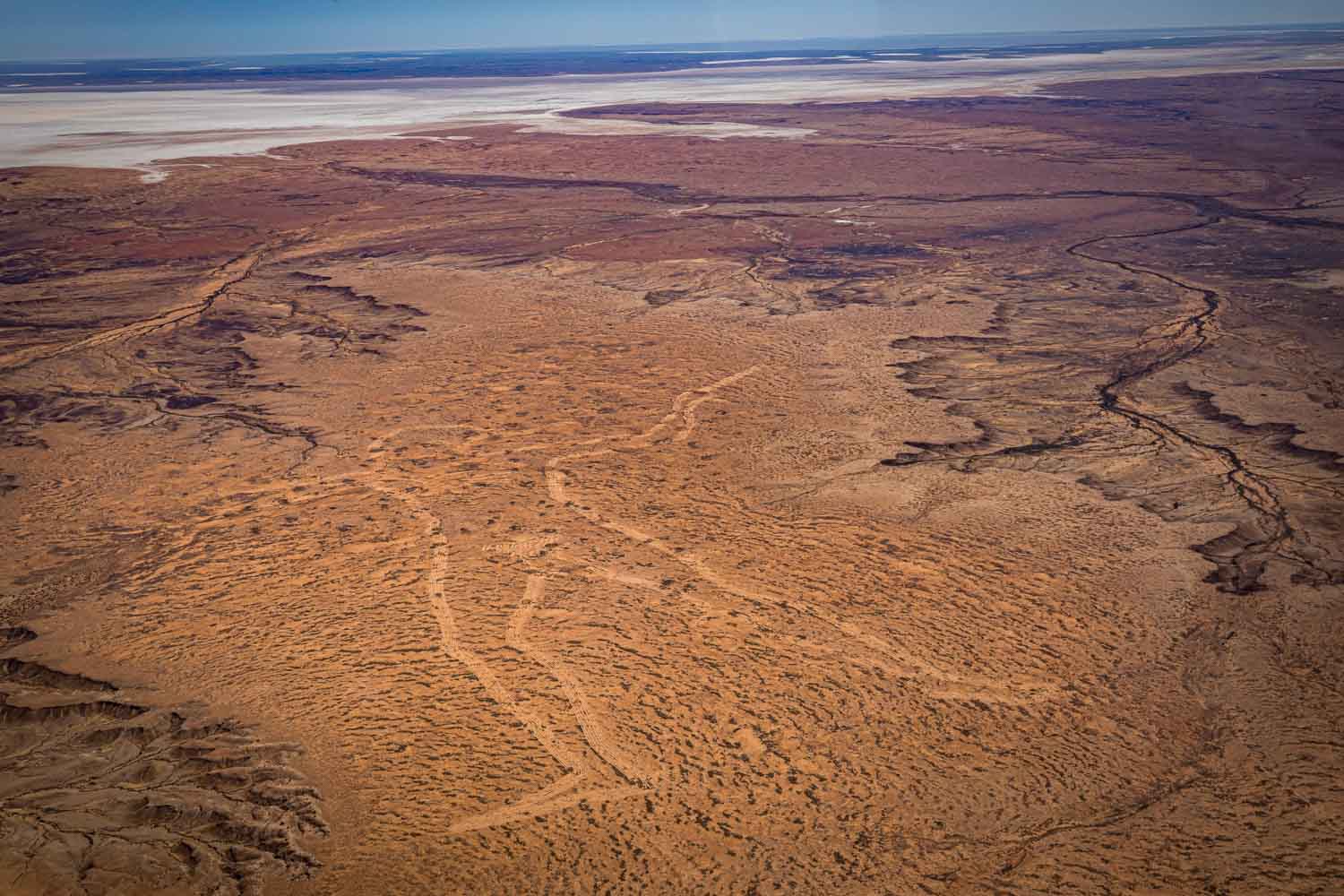
A gigantic human figure, the Marree Man – the largest ground drawing in the Southern Hemisphere – has been a mystery ever since its mysterious appearance in 1998: its creator is unknown and its purpose remains unclear.
A gigantic human figure, most likely scratched into the earth with a bulldozer, 2.7 kilometres from head to foot. The perimeter of its roughly 35-metre-wide lines runs to 28 kilometres. It is one of the largest ground drawings in the world.
In 1998 a bush pilot spotted the figure on a routine flight. Who created it remains unexplained to this day. Even a reward of 5,000 Australian dollars is still unclaimed. Nobody saw it. Nobody talked.
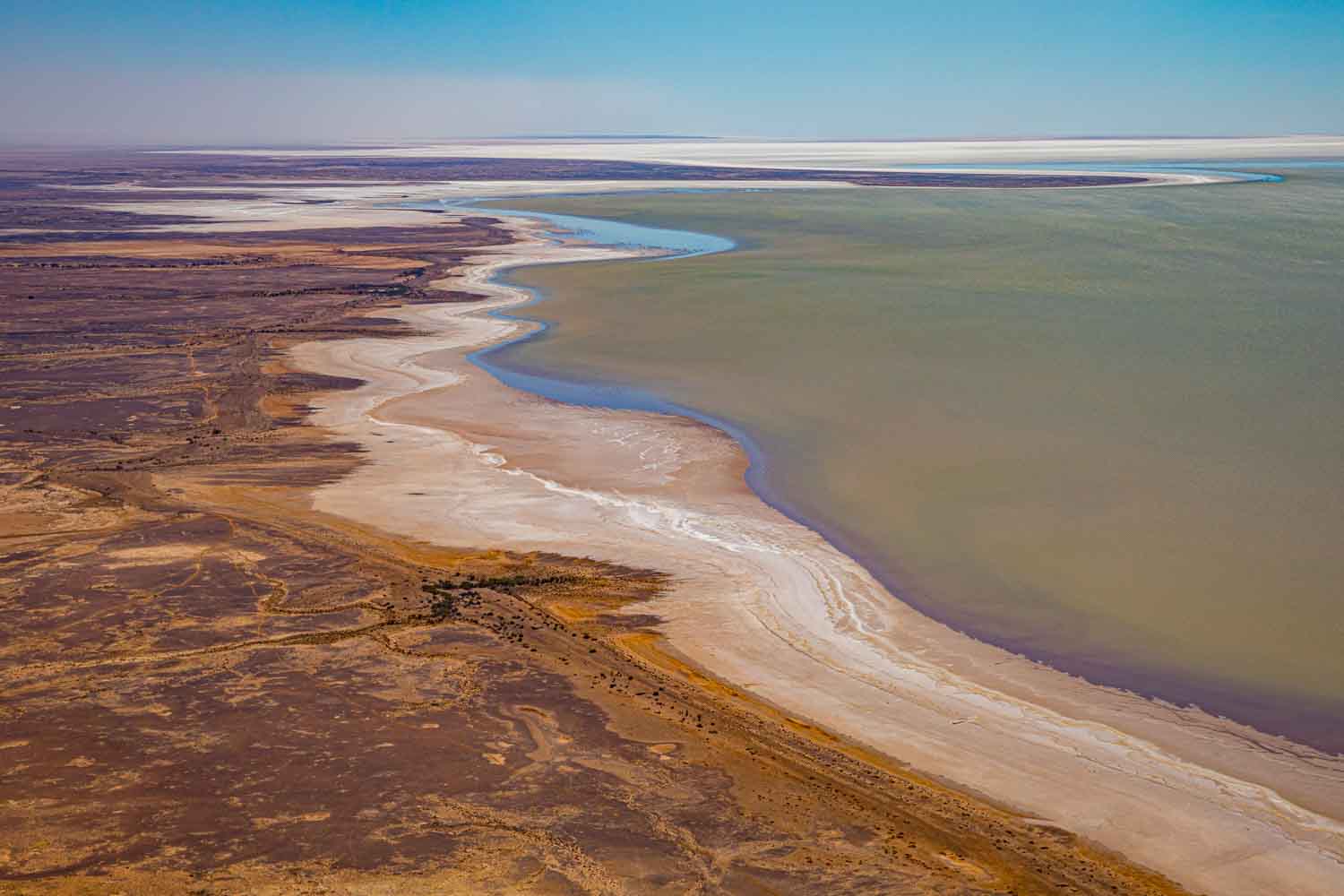
Then – Lake Eyre. The vast lake lies beneath the Cessna like a shattered shard of mirror, catching the light and scattering it. It consists of two basins – the larger measuring 144 kilometres in length and 65 kilometres across, the smaller 65 by 24 kilometres, joined by the 15-kilometre Goyder Channel.
The water glows carmine
At the shore, rust-brown water meets salt-encrusted earth, fringed with brightly glittering crystals. The water glows carmine where minerals and algae form organic patterns.
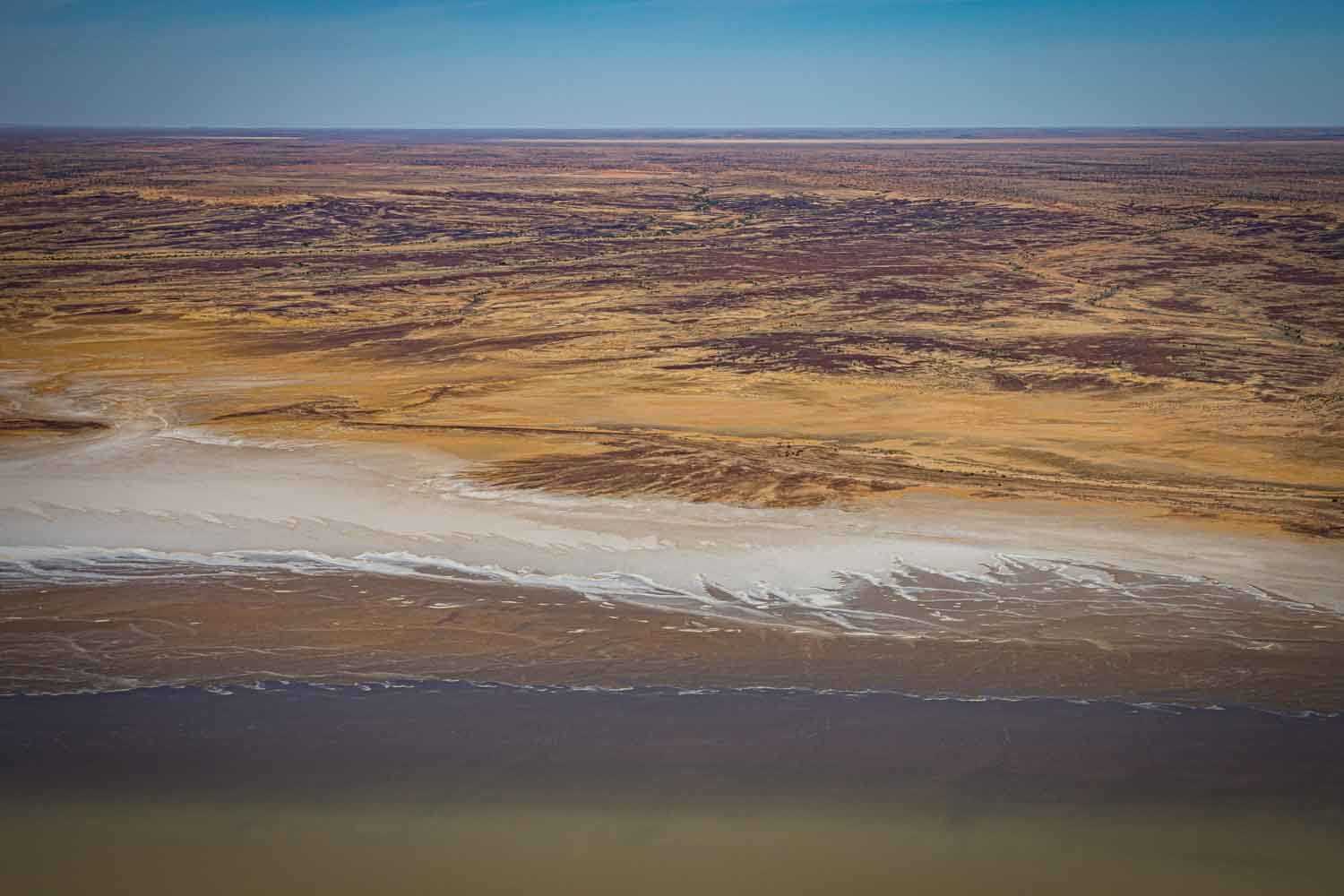
White salt meets rust-brown, a boundary as if drawn with a ruler. Where Lake Eyre recedes, a crystalline crust and a salt rim remain.
Islands of sand drift like weathered bones in the liquid desert. The all but dried-out plains shine in pastel tones – dusty pink, beige, a pale turquoise.
It is one of those places you do not believe until you see them, and then need a while longer before you believe what you are seeing.
When full, Lake Eyre is the largest lake on the continent
When full, Lake Eyre is the largest lake on the continent. It holds 400 million tonnes of salt and, over the past century, was genuinely full only four times. The last time was 1974.
On average it fills completely just twice a century – and then dries out again within two years. In 1964 Donald Campbell used the mirror-smooth salt crust as a racetrack and drove his Bluebird CN7 to 649 kilometres per hour.
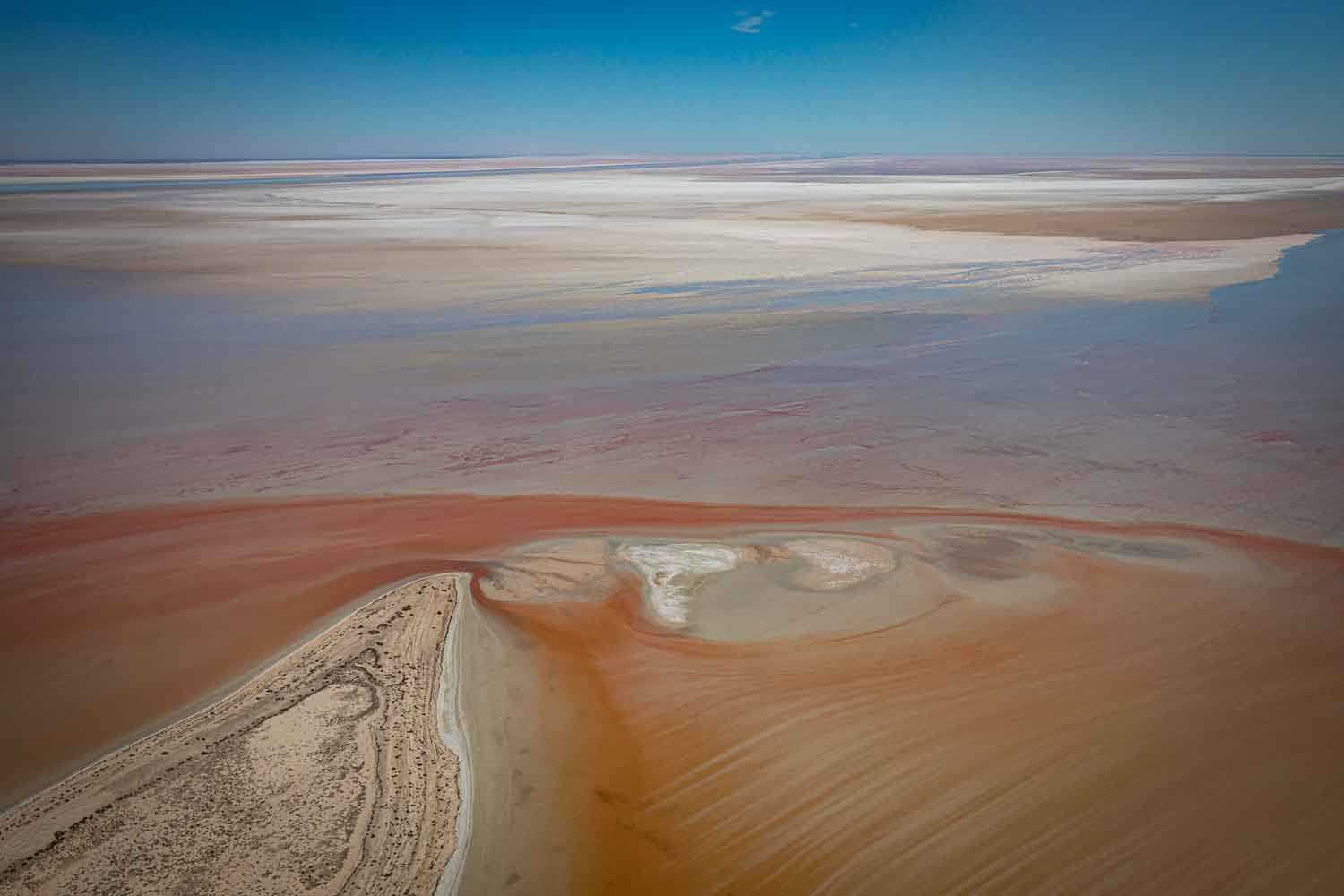
Salt crusts trace spirals across the almost dried-up lake bed. Wind currents have compacted the sediments into geometric patterns. The horizon merges with the sky into a single line that blurs all sense of direction.
Aidan turns round briefly: “Campbell was three times faster than us back then – but on the ground.” He grins. Then he looks ahead again.
Beneath the wing the outback layers itself in ochre and dust all the way to the violet horizon. Then: a red-brown runway, two handfuls of buildings, an airfield. William Creek. Officially a town. Six to ten inhabitants, depending on the season.
The William Creek Hotel, founded in 1887 and run as a pub since 1935, is a heritage-listed building today. We have lunch at tables made from recycled railway timber. Alongside cattle farmers, motorcyclists, miners and air passengers like ourselves. Anyone sitting here has often just come two hundred kilometres along a gravel track.
Another salt lake, almost entirely dried out for decades
The return flight takes us over Lake Torrens. Another salt lake, 5,745 square kilometres, almost entirely dried out for decades.
Salt crusts push across the desiccated lake bed like frozen waves, rust-red islands of oxidised sediment between them.
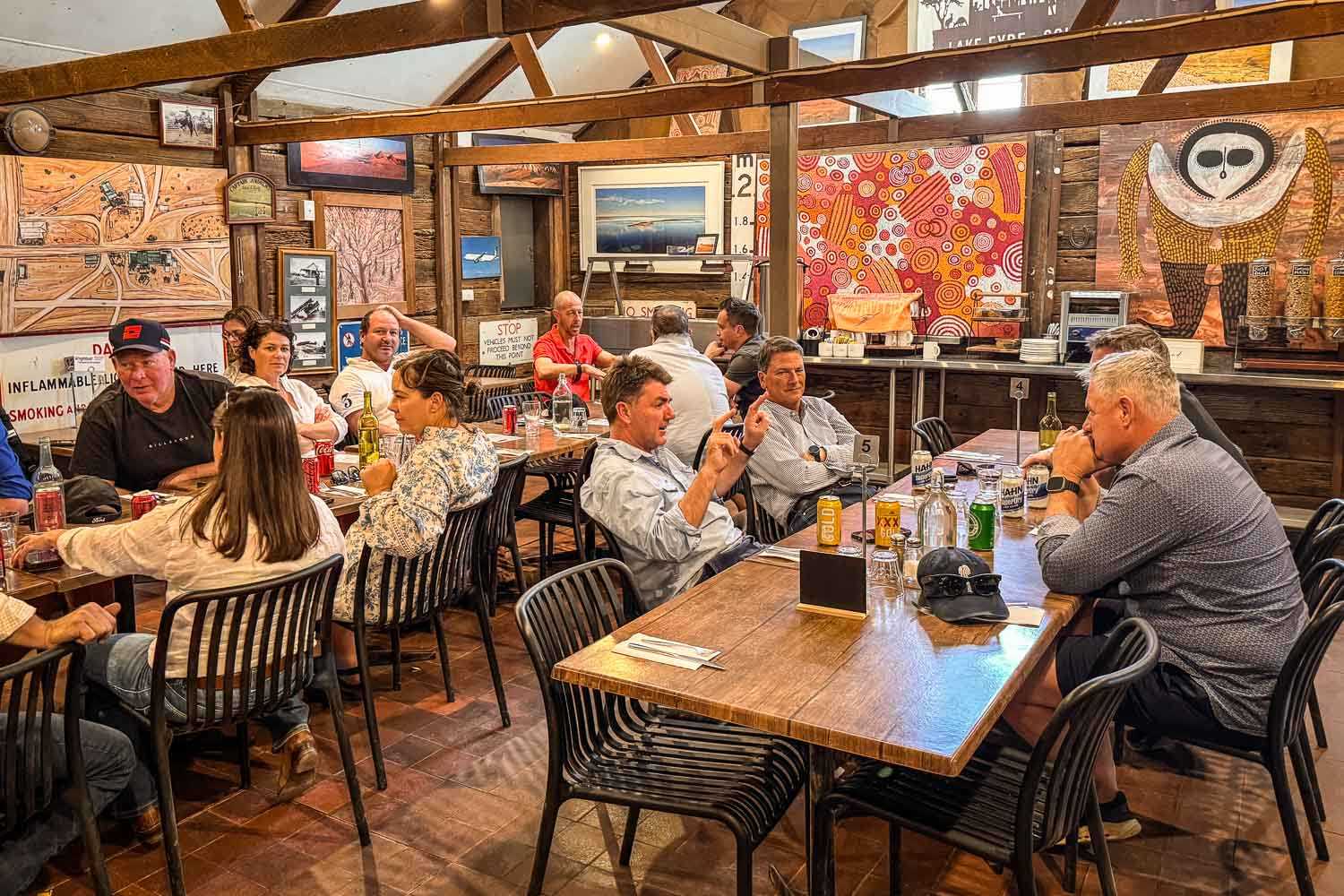
Tables made from recycled railway timber separate cattle farmers, motorcyclists, miners, aircraft mechanics and passengers like us. Anyone sitting in William Creek’s only pub has often travelled two hundred kilometres along a gravel track to get there.
Mineral deposits trace the borders between water and desert, evaporation remodelling the contours over and over. From above, a surprisingly many-coloured geological X-ray of the continent.
I press my forehead against the window of the Cessna and think of Duncan’s line, the one he let fall almost in passing over lunch in Adelaide. A continent pretending to be a country.
Now, after Rodin and Ophelia, after sea lions and echidnas, after Gondwana rocks in a whistling wind, a speck called William Creek in the desert nowhere and two salt lakes whose dimensions are as unfathomable to me as their beauty – now that line simply flies away. What remains is my childlike wonder, deep humility and gratitude.
Want more of this?
My DISCOVERY LETTER brings you adventurous stories, stunning pictures and challenges to take part in.
Read now:
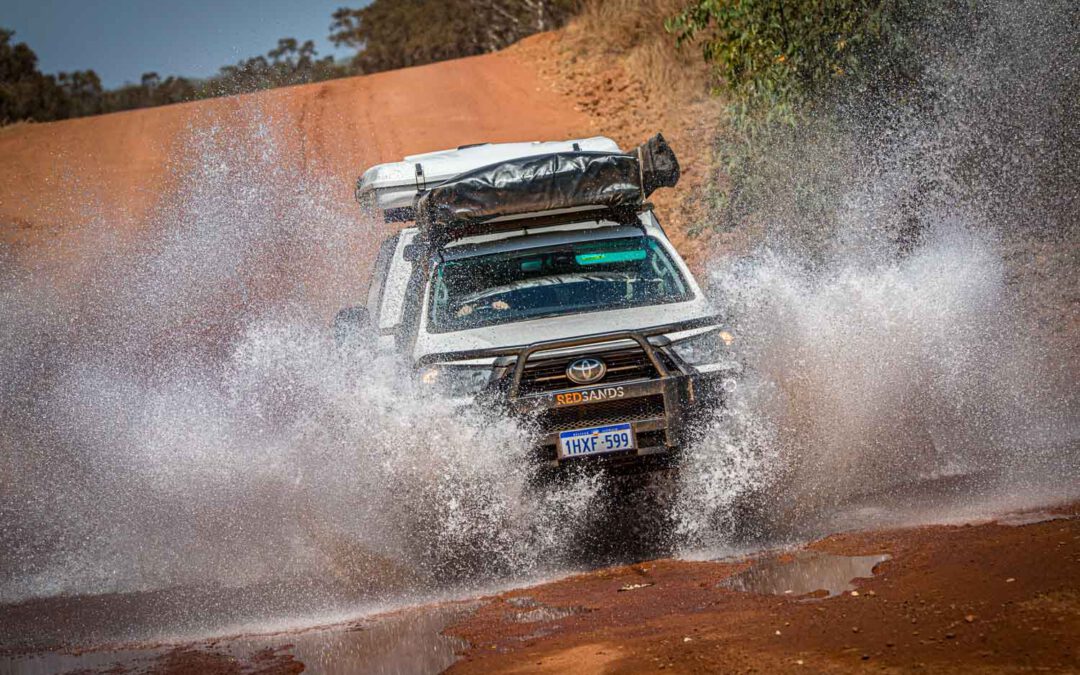
The top 30 pictures
Photo gallery Western Australia
Western Australia – a complex symbiosis of extreme nature, isolated farms and human adaptability – from dusty gorges and remote caves to the turquoise blue ocean in Broome.

Food for thought
Adventure is the salt in your life-soup
Adventure is like salt in the soup of life. It adds flavour.

Marvel at primeval forces
Iceland extreme – ice bath and volcanic eruption
Volcanic eruption! One of the most fascinating spectacles in nature. For the first time we were to witness spewing lava live. The largest volcanic island in the world offered us even more: cold weather training, a glacier hike and an ice cave visit.