

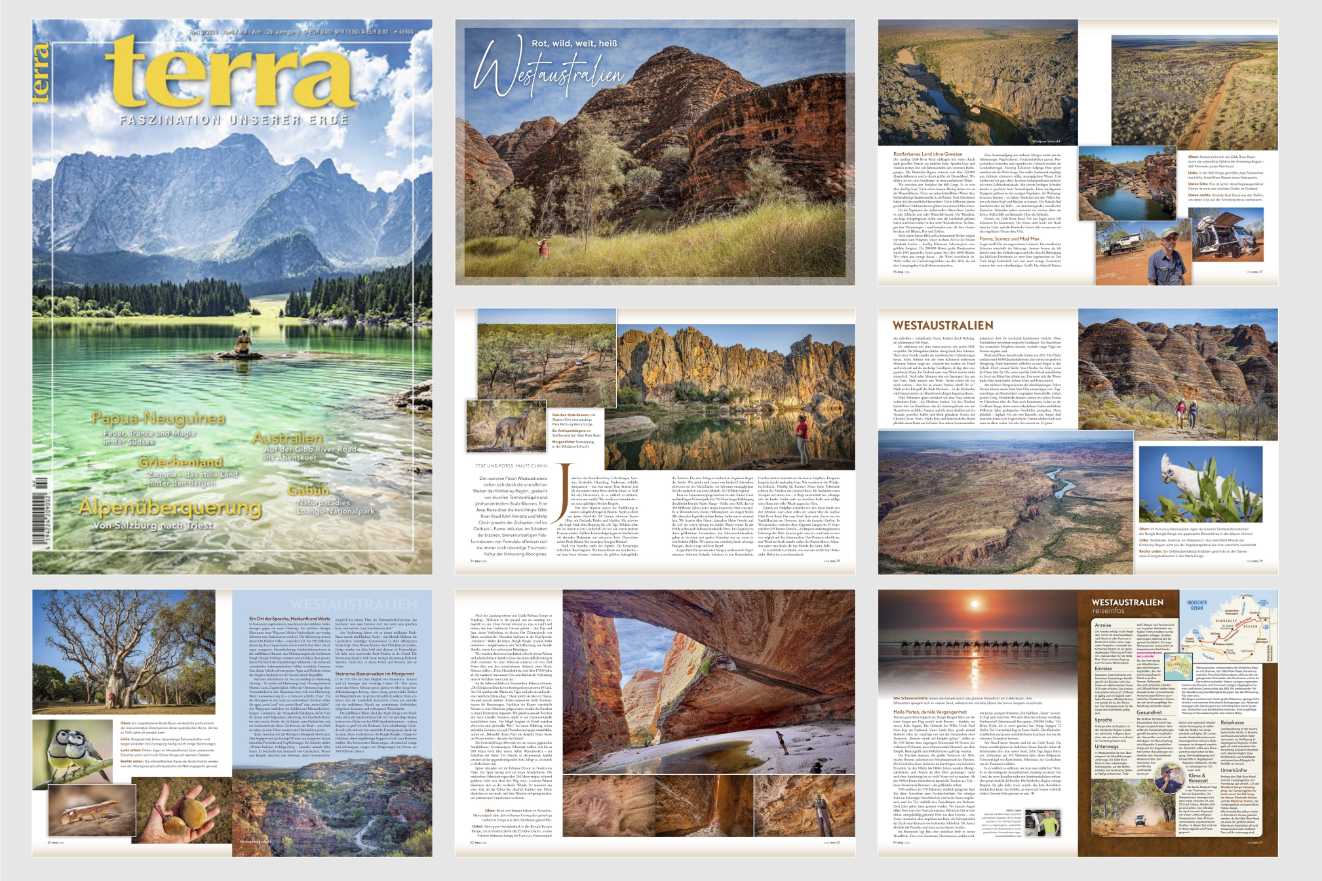
Published in:

Germany’s largest nature travel magazine
14 pages | Text & photos Malte Clavin
Everyone has a story about Australia. Venomous snakes, spiders, crocodiles, heatstroke, dehydration, deadly car breakdowns – what my wife Annette and I hear before our first trip there sounds like the stuff of a horror story. Is it really as bad as people say? We’re going to find out – with a healthy dose of respect.
The introduction lasts nearly two hours
The orientation session for our rental SUV in Broome lasts nearly two hours. Stephan explains every control on the 2.8-metric-ton Toyota Hilux, which is equipped with a rooftop tent, kitchen, and awning.
My head is spinning.
After stocking up on supplies for eight days in the wilderness, we set off into a landscape that seems like something from another planet. Countless termite mounds rise from the ochre-red earth along the roadside like abstract sculptures. In between them, boab trees stretch their gnarled branches toward the sky.
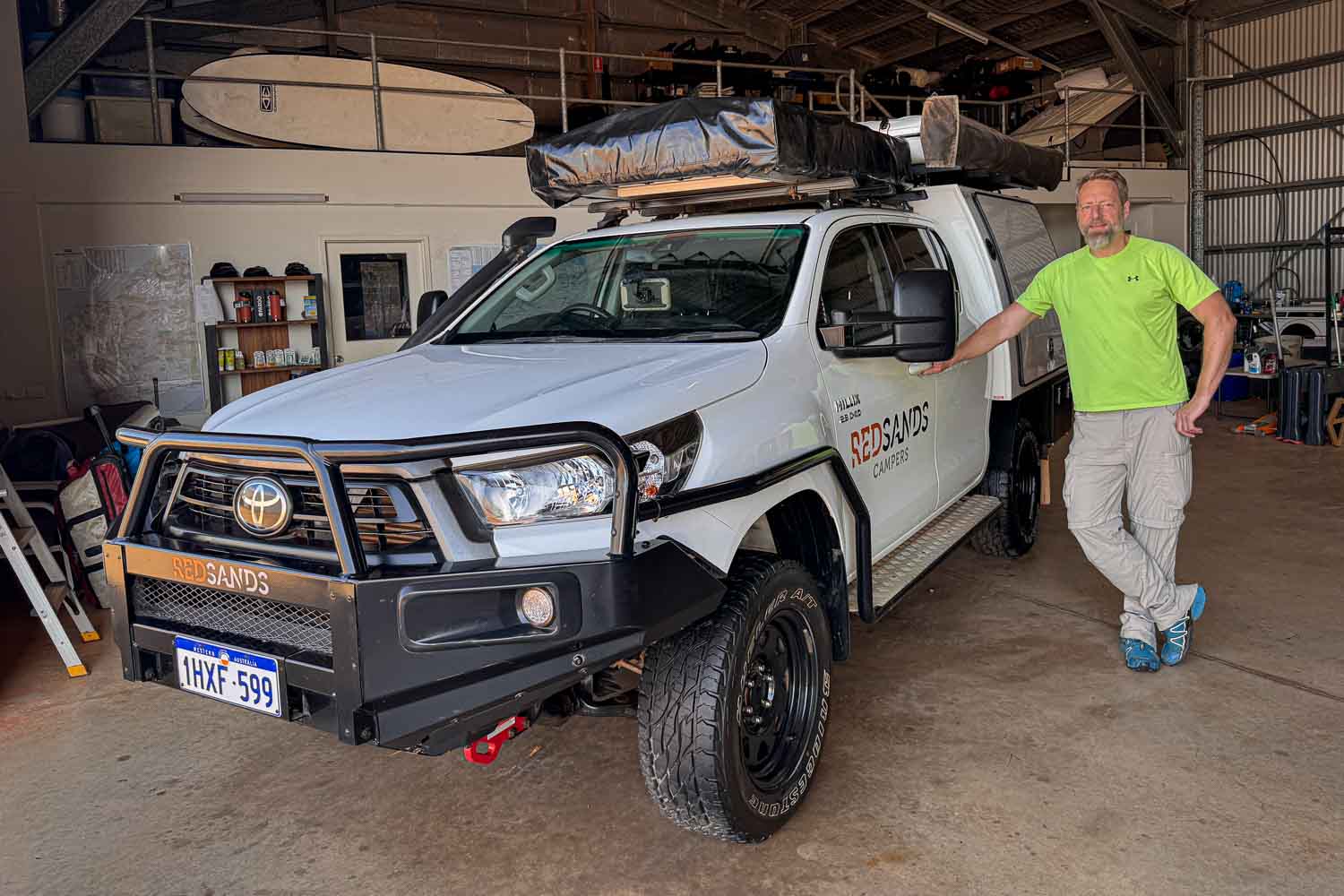
The orientation on our off-road vehicle – including setting up the tent, the vehicle’s electronics, changing a tire, etc. – takes a full two hours.
After four hours, the asphalt ends. The infamous Gibb River Road begins. We let some air out of the tires – on the loose gravel, the larger contact patch improves traction. The first kangaroo crosses the road in an elegant arc.
We cheer and rejoice like kids! Swallows flit in front of the hood, and a flock of emerald-green parakeets bursts out of the bushes. The wilderness begins!
A 750-meter-long cave passage cuts through the Napier Range here
Shortly before sunset, we reach Tunnel Creek in Bandilngan National Park. A 750-meter-long cave passage cuts through the Napier Range here – a remnant of a reef that formed 350 million years ago beneath a tropical sea. It is Western Australia’s oldest cave system.
In some places, faint daylight filters down to the floor. There’s no one here but us. We scramble over rocks, startling small frogs that leap into the dark water to escape.
Freshwater crocodiles are also said to live in the cave. Unlike their dangerous relatives, the saltwater crocodiles, they are considered shy and only attack humans when they feel threatened. We feel our way cautiously through shadowy passages, but no reptiles are in sight.
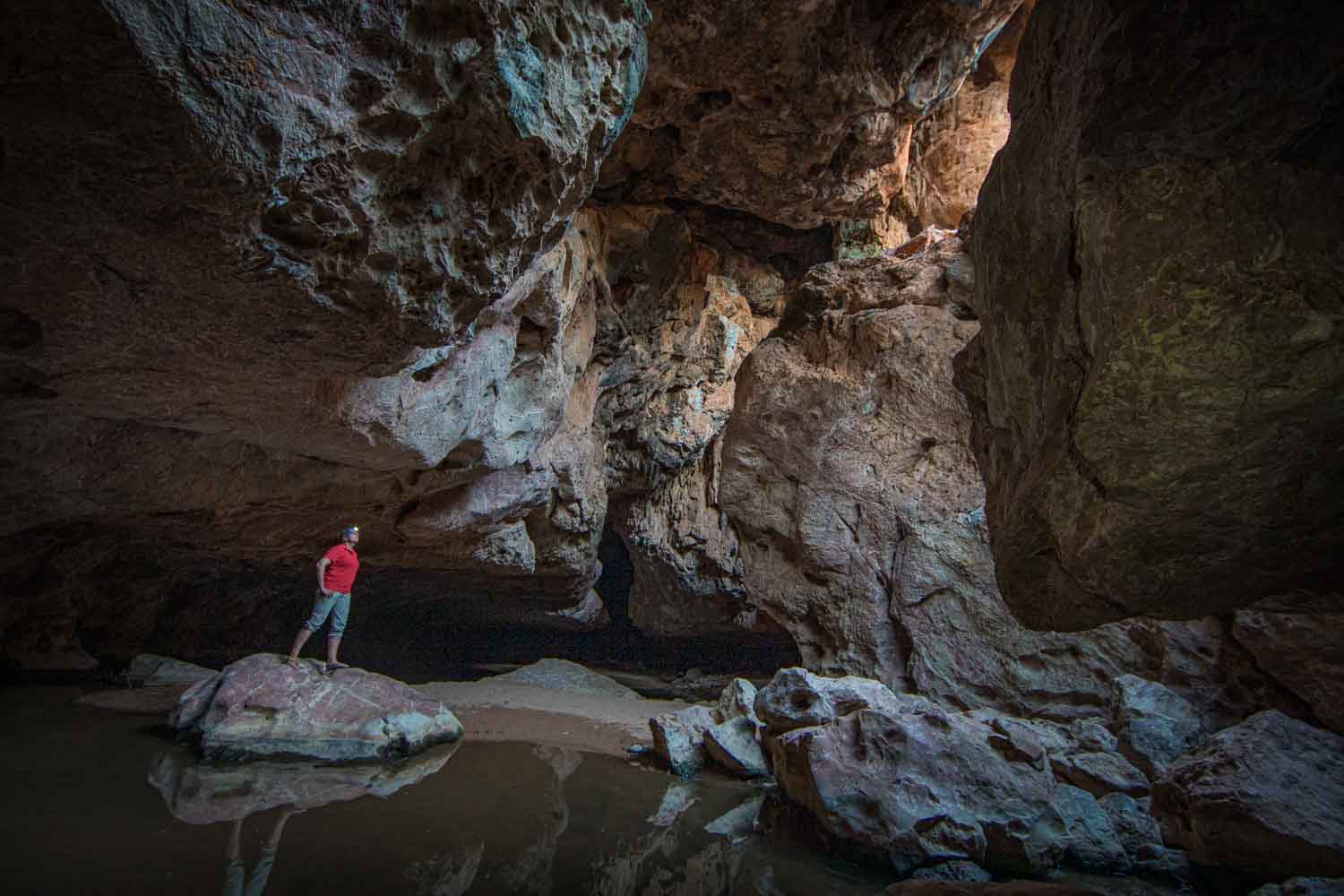
Annette in Dimalurru Cave, also known as “Tunnel Creek.”
Around five o’clock the next morning, I’m awakened by birdsong. Black cockatoos squawk in the treetops, and corellas squabble loudly over the best perches. Kangaroos hop through the dew-soaked grass.
Rock faces ranging from thirty to one hundred meters high frame the riverbed
We hike into Windjana Gorge. Rock walls ranging from thirty to one hundred meters high frame the riverbed of the Lennard River. I watch an ornate sparrow perched on a branch – it suddenly takes flight, snatches an insect, lands in exactly the same spot, and slams its prey against the wood with full force.
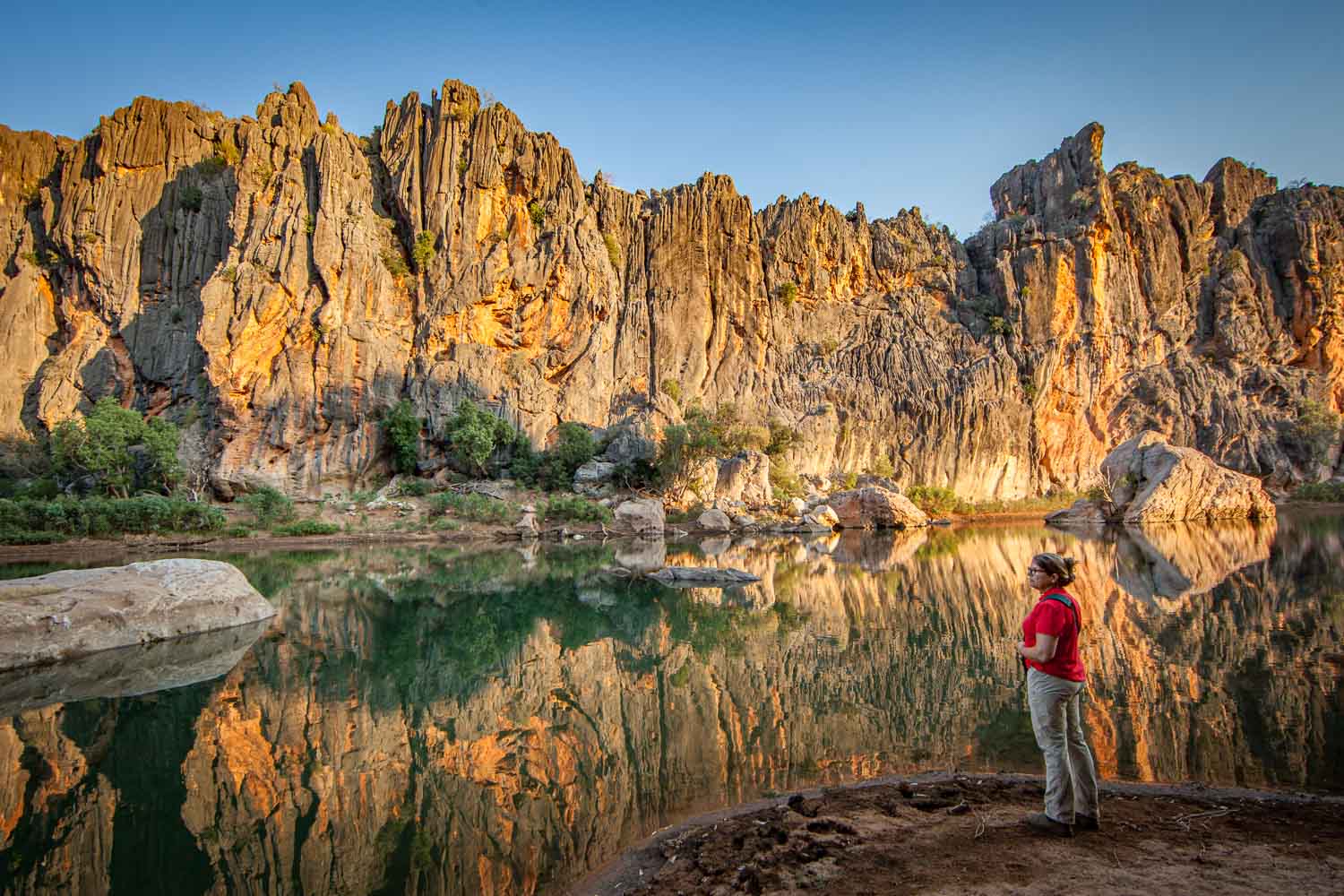
Morning walk in Windjana Gorge, also known as Bandilang.
Back at the parking lot, we shake the red dust off our shoes, and before we know it, we’re rolling down the endless Gibb River Road again. The first road train is approaching. At first, just a wisp of dust on the horizon, then a dull rumble.
The rumbling grows louder; a wall of dust rushes past
In Western Australia, these giants can reach lengths of up to 53 meters and weigh over 175 metric tons – they are the longest road-legal vehicles in the world. Annette eases off the gas and steers as far as possible onto the shoulder.
The roar swells, a wall of dust rushes past, the ground vibrates. Seconds later, the red wasteland swallows the noise. Silence. Is it really as bad as we’ve been told? Not so far. So far, it’s breathtaking.
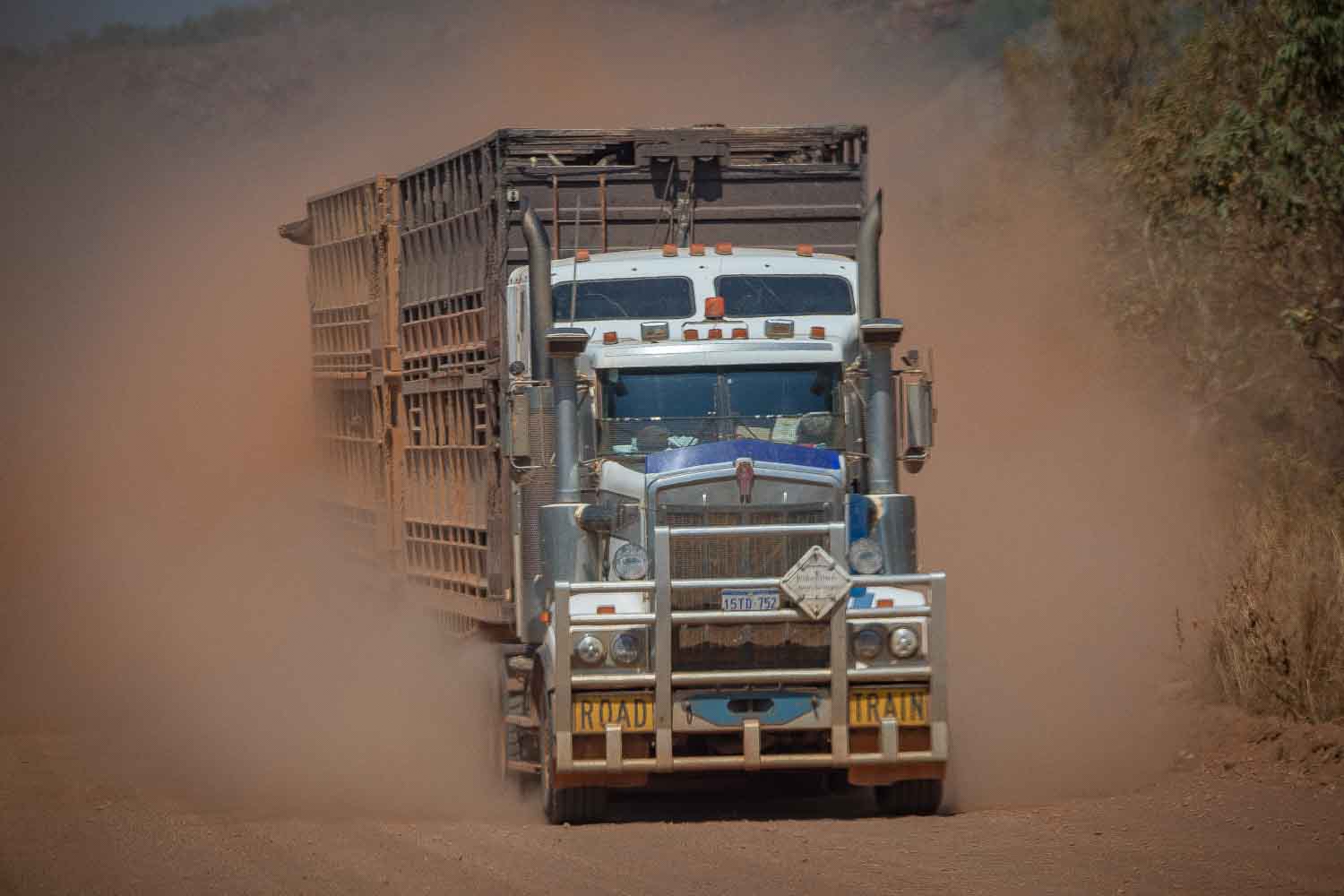
A massive road train thunders through the dust clouds on the Gibb River Road.
The dusty Gibb River Road continues to wind its way through gently undulating terrain of reddish earth. Spinifex grass and acacia trees have been withstanding the extreme conditions here for millennia. The Kimberley region spans 423,000 square kilometers, making it larger than Germany. We feel like two grains of sand in a rust-colored desert.
Crystal-clear water cascades over horseshoe-shaped sandstone steps right beneath us
We arrive at the Bell Gorge parking lot. The temperature is well over thirty degrees. After a short descent, we stand at the edge of the waterfall. Below us, crystal-clear water plunges over horseshoe-shaped sandstone steps into a pool. Two swimmers have claimed this natural oasis for themselves.
The rock formations, polished over millions of years, glow in warm ochre tones. For the Ngarinyin, the traditional custodians of this land, every gorge and every waterfall is imbued with spirit.
The Wandjina, mighty creator spirits, are said to have once shaped the landscape and have lived in the deep waterholes ever since. They bring the monsoon rains – and punish those who break their laws with lightning, floods, and cyclones.
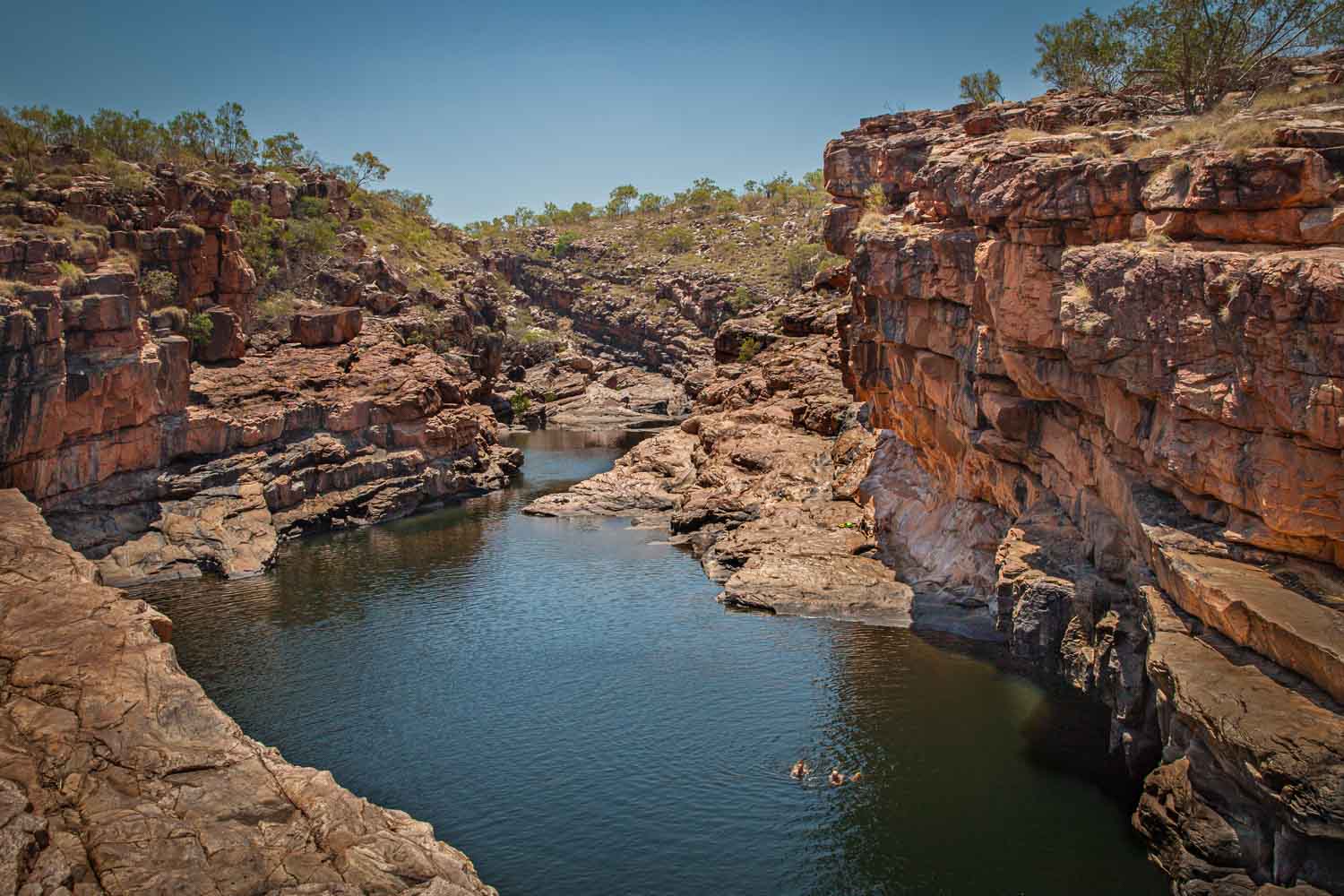
Two swimmers have discovered a natural oasis in Bell Gorge – the crystal-clear water pools to form a perfect natural swimming hole.
After one last look at the shimmering pond, we head back to the parking lot. Our next destination is Mount Elizabeth Station – thirty kilometers of gravel road that feels like an eternity.
The 200,000-hectare cattle station was founded in 1945; today, over 6,000 head of cattle graze here. We see only a few of them – the vast expanse swallows them up.
Instead, we meet off-road drivers from all over the world who are swapping stories at the campground.
A white sandy beach welcomes us
At sunrise the next morning, we’re awakened by a chorus of birds. Peace doves coo, red-necked lorikeets squawk, and somewhere in the bushes, a gray-leaved bird rustles.
Twenty kilometers down a bumpy dirt road later, we reach Warla Gorge. A white sandy beach welcomes us, with still, emerald-green water shimmering beyond it. And once again, we are all alone. In a eucalyptus tree, I spot a yellow-crested cockatoo. With its powerful beak, it skillfully cracks open hard seed pods.
These intelligent parrots are among the few bird species capable of using tools – they hold sticks between their feet to scratch their heads and backs.
The cockatoo’s call cuts through the silence – a piercing, metallic screech. Seconds later, a second one answers, then a third. Soon, a raucous chorus fills the gorge.
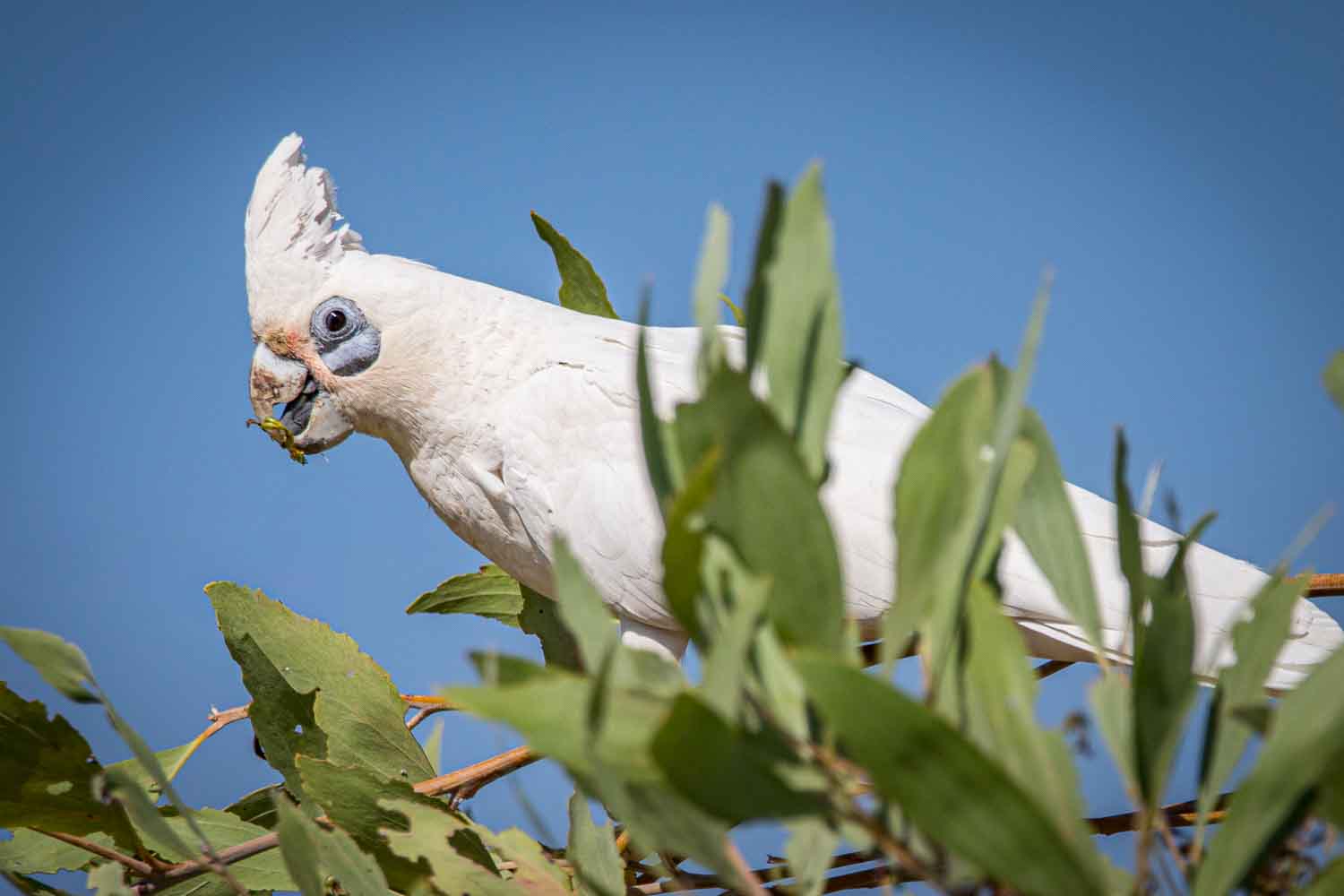
A yellow-crested cockatoo skillfully nibbles on the seeds of an eucalyptus tree in Warla Gorge.
Back on the Gibb River Road. We still have 320 kilometers to go to Kununurra. The sun is high in the sky, the dust dances in the light, and the Kimberley stretches out before us like a reddish-gold ocean without shores.
Around noon, an unfamiliar sound. A metallic scraping beneath the vehicle. Annette slows down; I crawl under the SUV and see that the mounting for the 140-liter diesel tank has snapped off on one side.
The tank is hanging dangerously low; only a few centimeters separate it from the sharp-edged gravel. An impact could tear it open – leaking diesel, sparks from friction, and, in the worst case, a fire.
The midday heat is oppressive – forty degrees, no shade
I call the car rental company, which promises prompt assistance. The midday heat is oppressive – forty degrees, not a speck of shade. An hour later, a dust-covered SUV comes racing up the road.
Mark Sulman from Ellenbrae Station, ten kilometers away, gets out, shakes my hand without a word, and throws himself onto the jagged gravel road as if it were a cushioned mat. In the Outback, people are sparing with words and don’t stand on ceremony.
Ten minutes later, a tension strap is securely fastened around the tank. Mark inspects his work: “I wouldn’t call that safe – but you’ll make it to our station.”
Mark is the epitome of a bush mechanic – in the Kimberley, improvisation becomes a vital engineering skill.
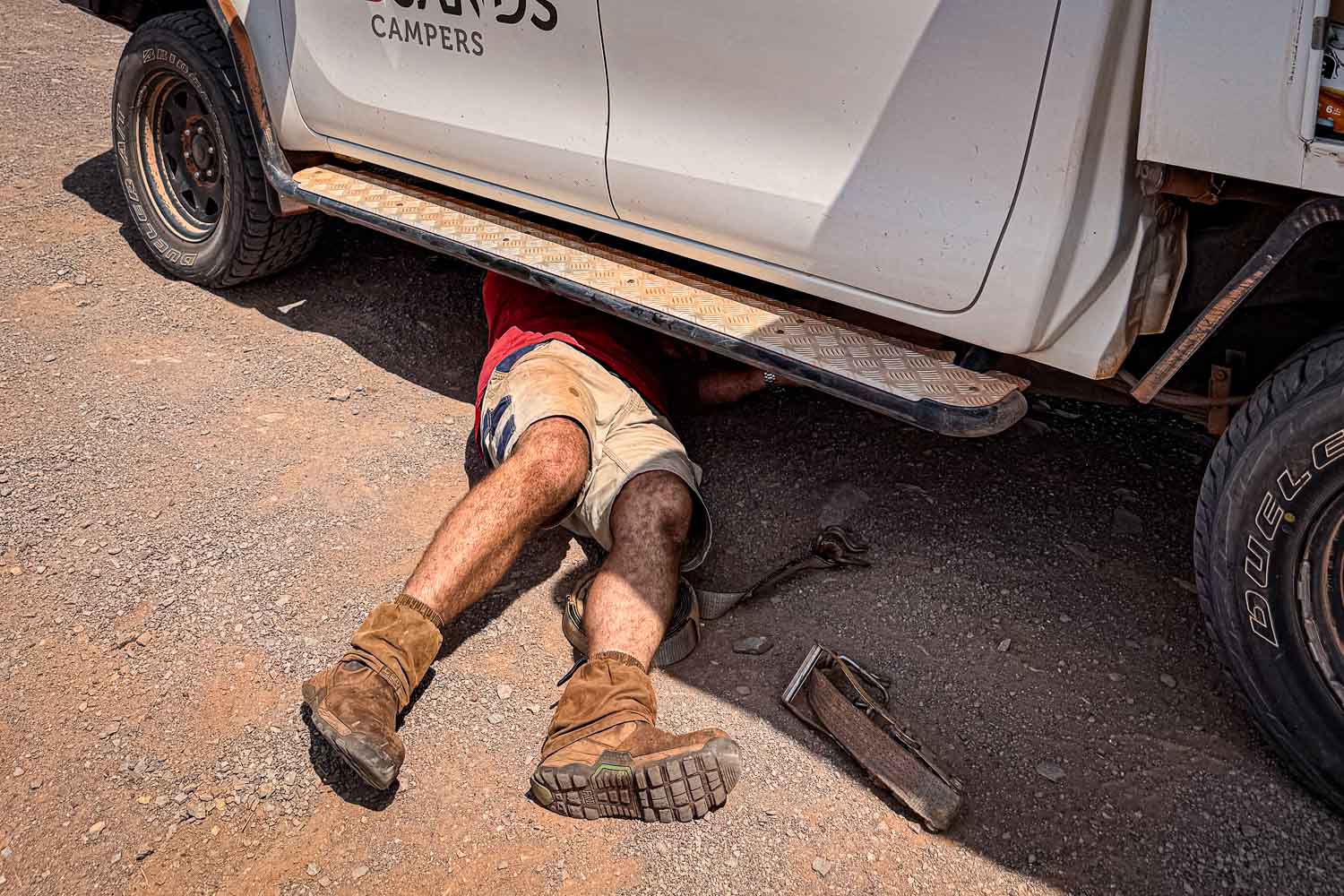
A silver lining: Mark Sulman makes a makeshift repair to the SUV so we can reach the station ten kilometers away.
Ten kilometers later, we reach an oasis in the midst of scorched earth – Ellenbrae Station. Three weeks ago, a bushfire raged here, missing the buildings by a hair’s breadth. Annette and I sit gratefully on the veranda, enjoying coffee and freshly baked scones with clotted cream.
Fiona, Mark’s wife and station manager, suddenly fixes her gaze on a spot on the railing. A rare sun finch is showing off its bright carmine-red face there. These magnificent finches inhabit tropical grasslands. The bushfire likely destroyed their nesting sites, which is why some of the birds have migrated to the station.
The area covers approximately 4,000 square kilometers
Mark and Fiona have been running the station since 2021. The area covers about 4,000 square kilometers – almost four times the size of Hong Kong. At the end of September, they’ll close up shop and fly off on vacation.
But someone stays behind: From October through March, when the rivers overflow their banks and Gibb Road becomes impassable, a caretaker holds out here alone. Only when the water recedes at the end of March do Mark and Fiona return.
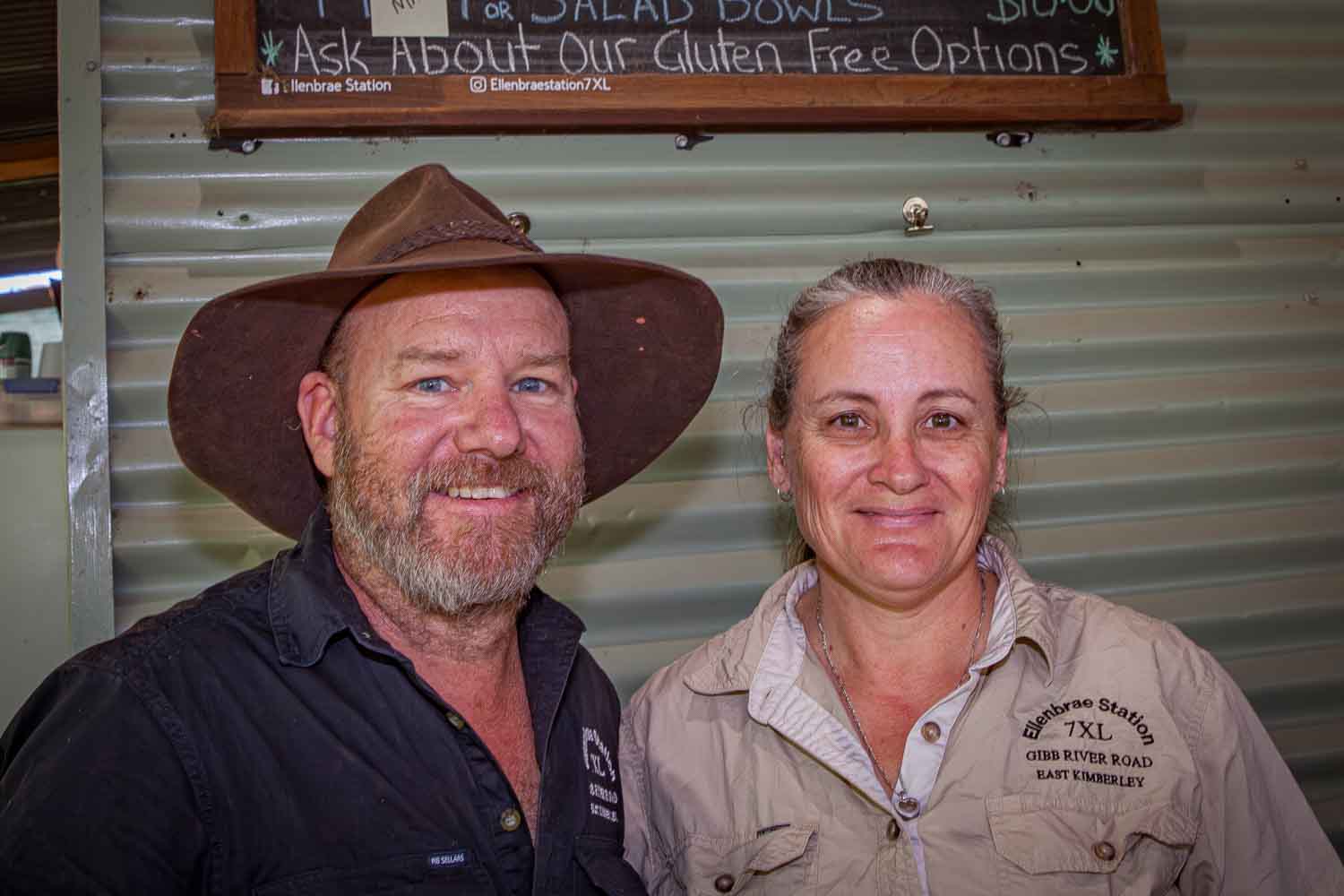
Mark and Fiona Sulman, the warm and welcoming owners of Ellenbrae Station.
The next morning, the tow truck arrives. The driver, Darren, looks like he stepped right out of a *Mad Max* movie: a cigarette butt hanging from the corner of his mouth, mirrored sunglasses, and a shuffling gait.
For three and a half hours, we rattle along the dirt road to Kununurra alongside Darren in the cab, passing the Cockburn Range, whose rust-red and ochre-colored sedimentary layers reveal millions of years of geological history.
Darren shifts into high gear and zooms past everything
Then suddenly – asphalt. A construction zone ahead of us, a red light, five cars waiting, no oncoming traffic. Darren shifts into high gear and zooms past everything. I look at him in horror. He grins.
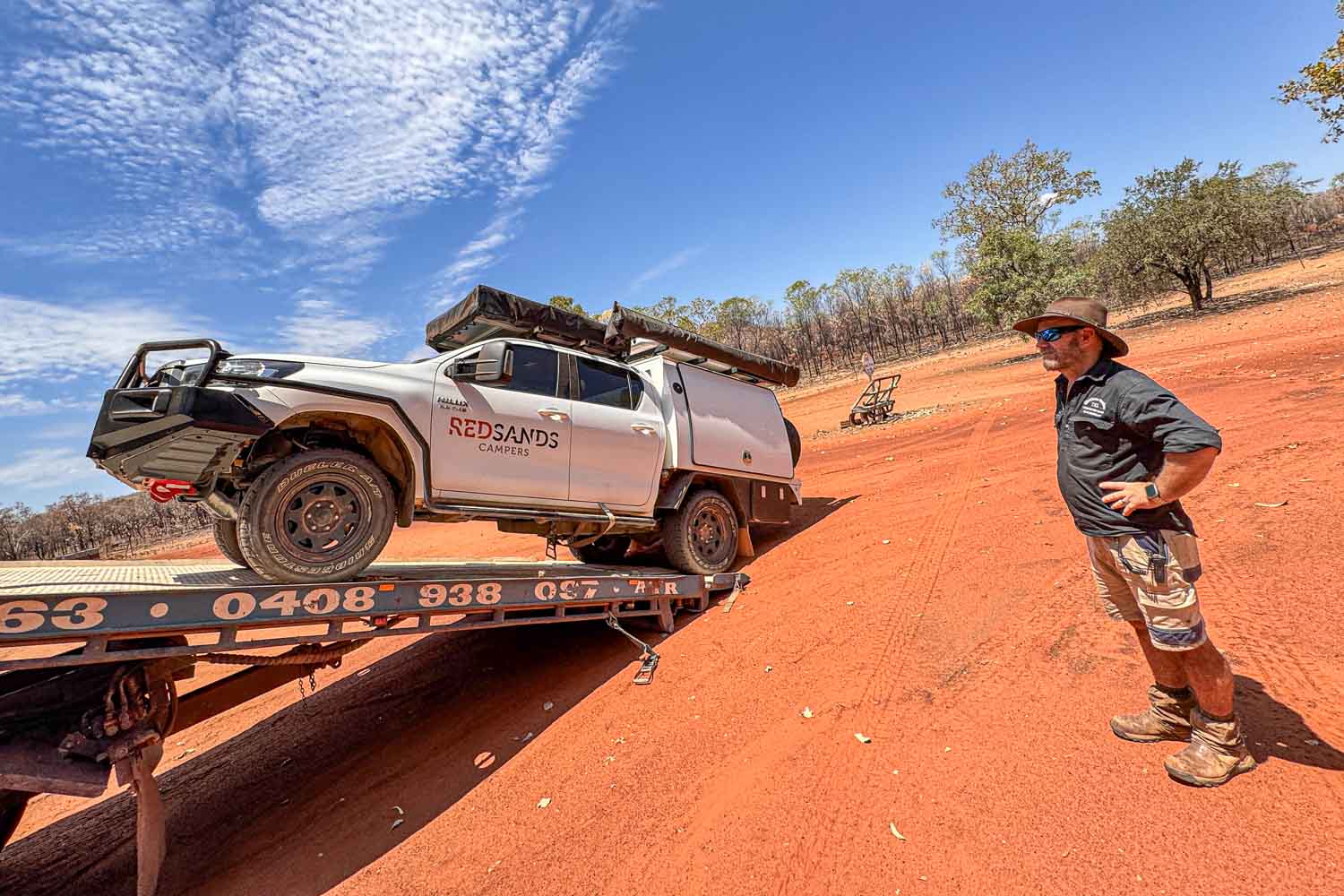
After the fuel tank mount broke, our rental car was towed over 230 km to Kununurra.
Upon arriving in Kununurra, we trade in the broken-down SUV for a new vehicle. The next morning, our first stop is Mirima National Park, just a few minutes from downtown. The Miriwoong call this place “Hidden Valley.” 350 million years ago, this area lay beneath a primeval sea.
Today, orange-red, beehive-like sandstone formations rise into the steel-blue sky – a miniature version of the famous Bungle Bungle Range. Annette and I follow the winding path through the labyrinthine gorges.
The horizontally layered sedimentary strata form natural terraces. A thin layer of black-green algae and lichens protects the fragile sandstone from erosion caused by rainfall.
For the Aboriginal people, the land is an inseparable part of who they are
On an information sign, I read: “You are standing on Miriwoong Dawang” – you are standing on Miriwoong land. Dawang means home, land, belonging.
Even the name of the town embodies this connection: Kununurra is derived from the Miriwoong word Goonoonoorrang – it simply means “river.”
For the Aboriginal people, the land is an inseparable part of themselves. They say “my land” just as they would say “my hand” or “my feeling.”
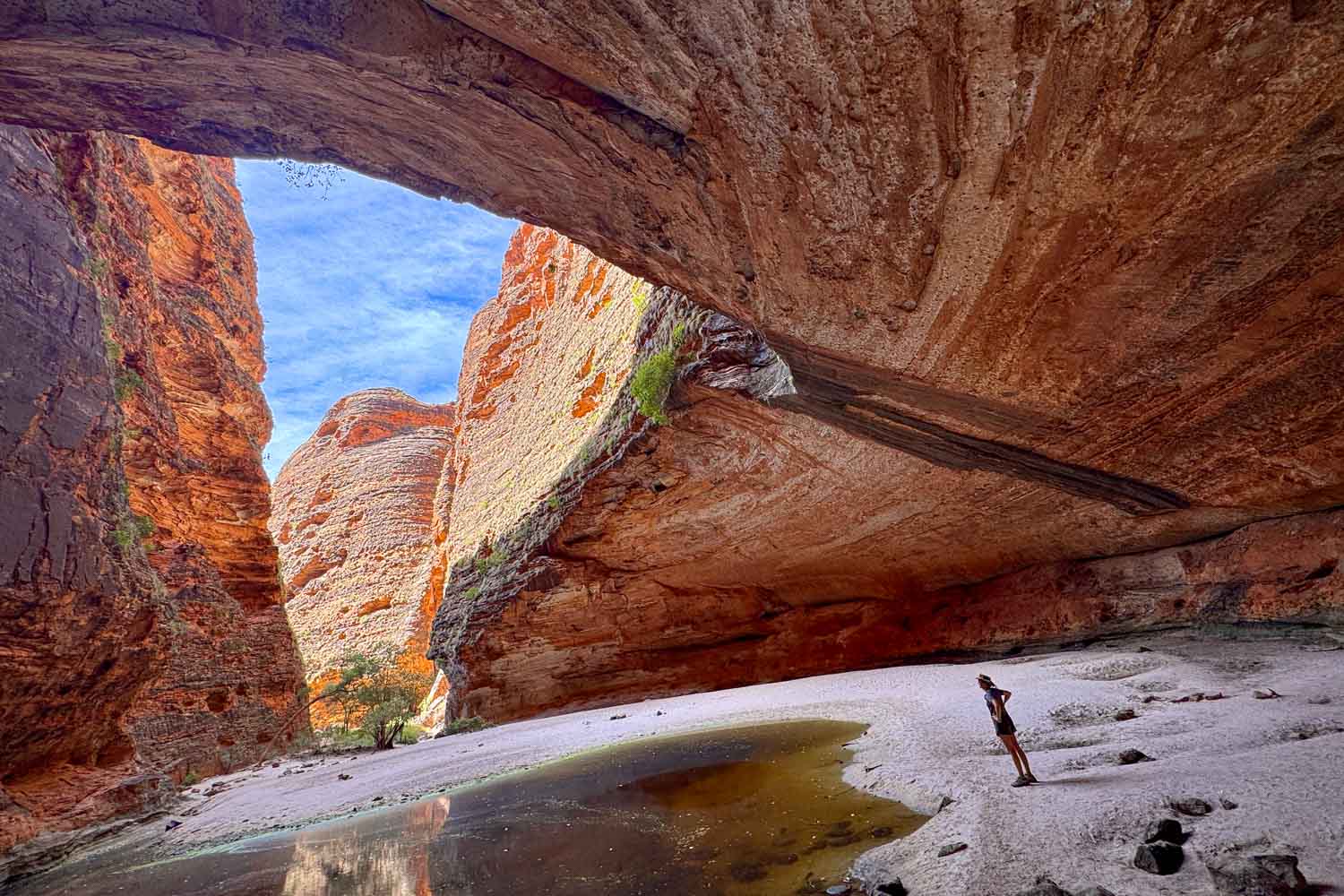
Rock formations that resemble a cathedral of Earth’s history – a testament to the forces that shaped Western Australia’s Northwest.
Along the way, we come across signs describing plants. Gardanyen, the stringybark eucalyptus, provides wood for spears and didgeridoos. Merndang, the paperbark tree, has soft bark that is used for pillows, roofing, and repelling insects. Gerdewoon, the boab – its pith is edible, and messages were once carved into its nuts.
Later, we visit the Waringarri Aboriginal Arts Center. Here we encounter the concept of Wirnan, a complex system of cultural protocols and obligations.
An artist explains: “Wirnan means berlebga-yileng – never letting each other down. It describes the exchange of gifts, knowledge, and respect between tribes. Every community member has their place in the kinship system, which determines whom you may marry, with whom you may speak, and which lands you may enter.”
These trees can live to be over 1,500 years old
In the afternoon, we drive to a massive boab tree not far from Elephant Rocks – a living sculpture whose silver-gray bark bears the stories of countless generations.
These trees can live to be over 1,500 years old. Some have become hollow with age and served as shelters. I hold two velvety-soft boab fruits in my hand.
Today, there are fewer than twenty fluent speakers of the Miriwoong language. Yet here, in these rocks and trees, it lives on.
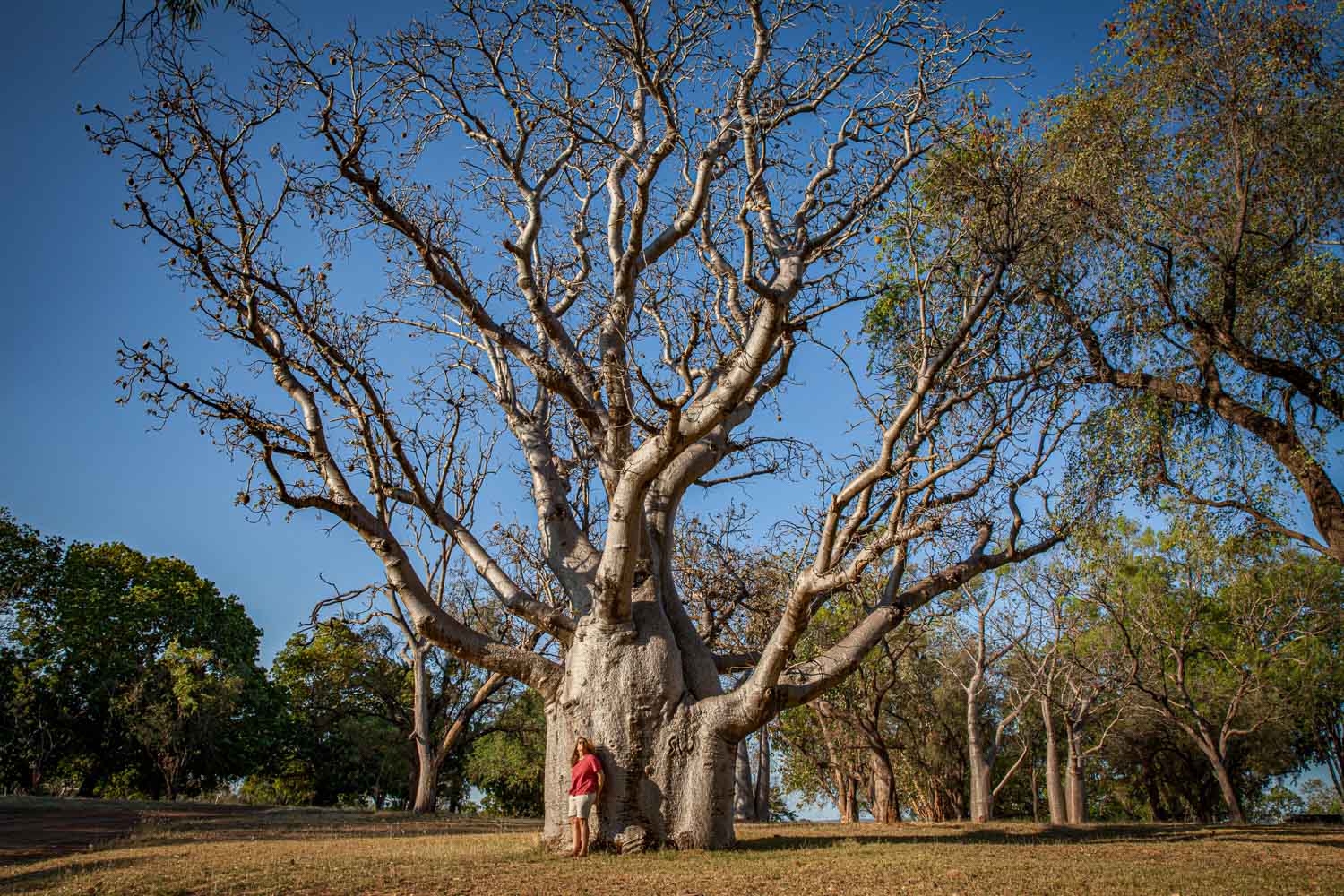
A majestic baobab tree – a living sculpture that can live up to 1,500 years.
It’s 5:52 a.m. at the Kununurra airfield. Annette and I board a four-seat Cessna 210. Pilot James starts the engine. Minutes later, we glide over vast sandalwood plantations, whose strictly geometric rows look like a green checkerboard in the morning light.
Then the landscape changes dramatically: below us stretches a rugged mosaic of rust-colored cliffs, olive-green savannas, and hidden waterways.
Then they come into view: the Bungle Bungles
The steel-blue waters of Lake Argyle cut deep into the sandstone landscape like fjord arms. The massive reservoir covers an area of nearly 1,000 square kilometers – almost twice the size of Lake Constance.
A jagged escarpment stretches across the savanna like a natural fortress wall.
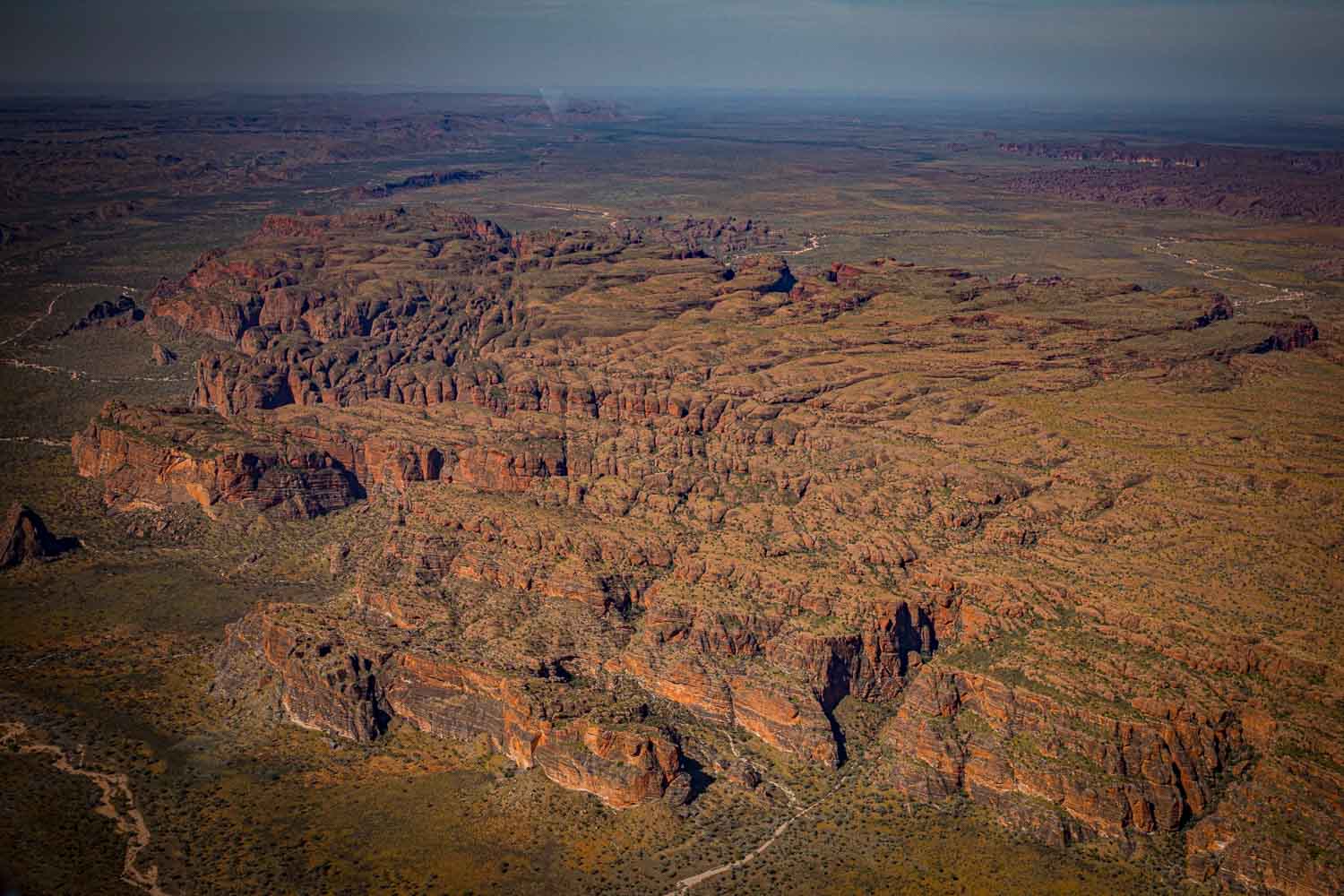
Then they appear: the Bungle Bungles. Orange-red rock towers whose conical summits cascade all the way to the horizon. Their horizontal banding, alternating between orange and black-gray, bears witness to sedimentary deposits from the Devonian period 360 million years ago.
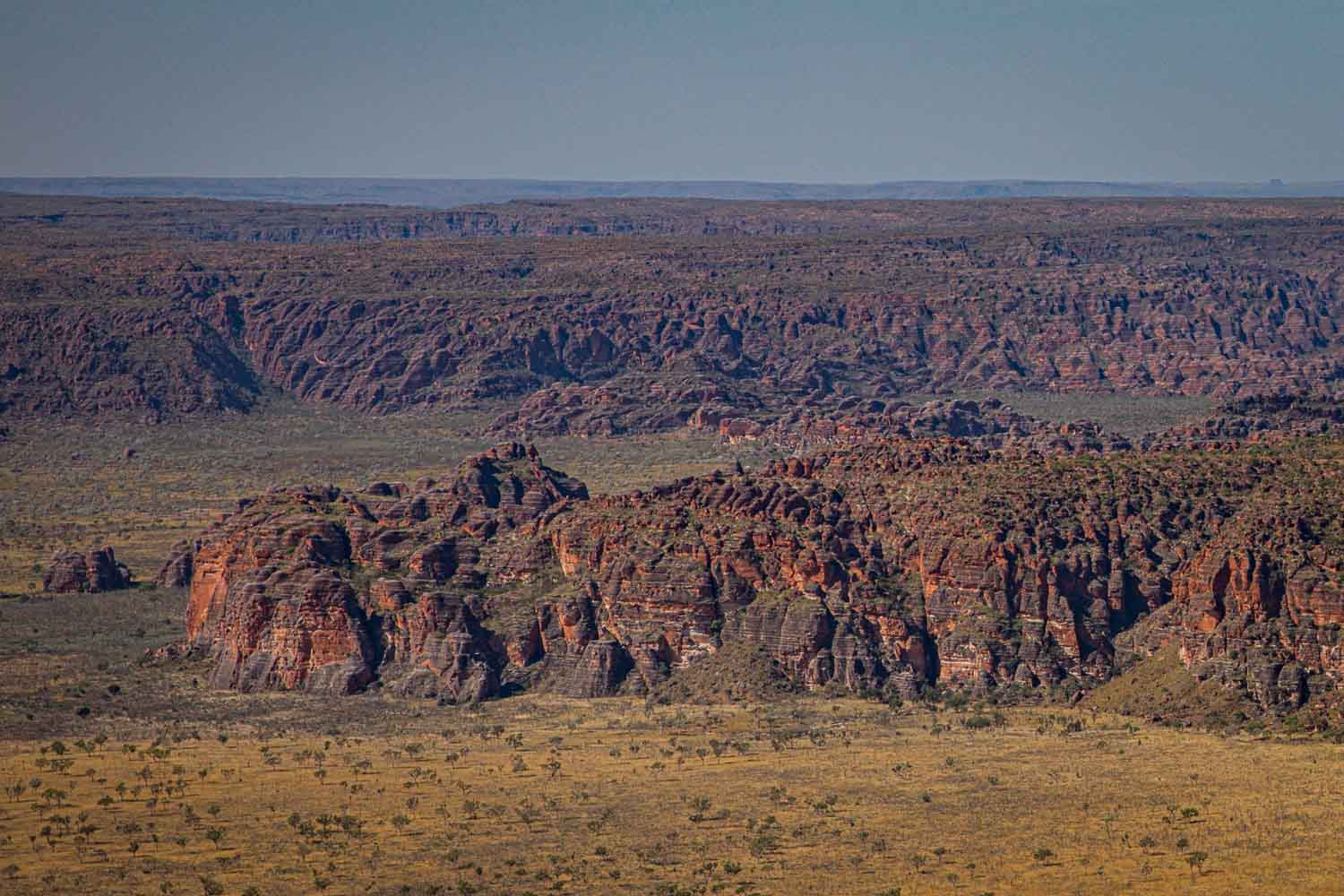
The distinctive orange-red rock towers of the Bungle Bungles rise from the green plain.
After landing, our guide Rebecca Sampy welcomes us. “Welcome to the ground you are standing on,” she greets us. This phrase acknowledges that we are standing on land that belongs to the Traditional Owners – the Kija and Jaru, whose connection to this place dates back tens of thousands of years. In the Kija language, Purnululu means “sandstone.”
We hike through a landscape filled with Livistona palms and shoulder-high spinifex grass, which gives off a sweet, spicy scent.
On a rock face, about five meters above us, I spot an ochre-colored handprint. Rebecca explains, “These handprints are over 17,000 years old. They mark significant places and express our ancestors’ connection to the land.”
The rock stores the heat of the day and releases it at night
A termite mound clings to the rock face. Rebecca explains: “The queen and her larvae need a constant temperature of about 30 degrees. The rock stores the heat of the day and releases it at night – a natural air conditioner.”
Then she talks about a topic that touches me deeply: “We used to use hollow termite mounds for burials. After a body had lain in a rock niche for four and a half months, the bones were buried in a termite mound. We believed that the termites would release the spirit more quickly so that it could return to the Dreamtime Spring. The mound acts as a portal between the physical and spiritual worlds.”
At a billabong, she warns: “Treat this place with respect! Don’t throw stones into the water – it disturbs the spirits!”
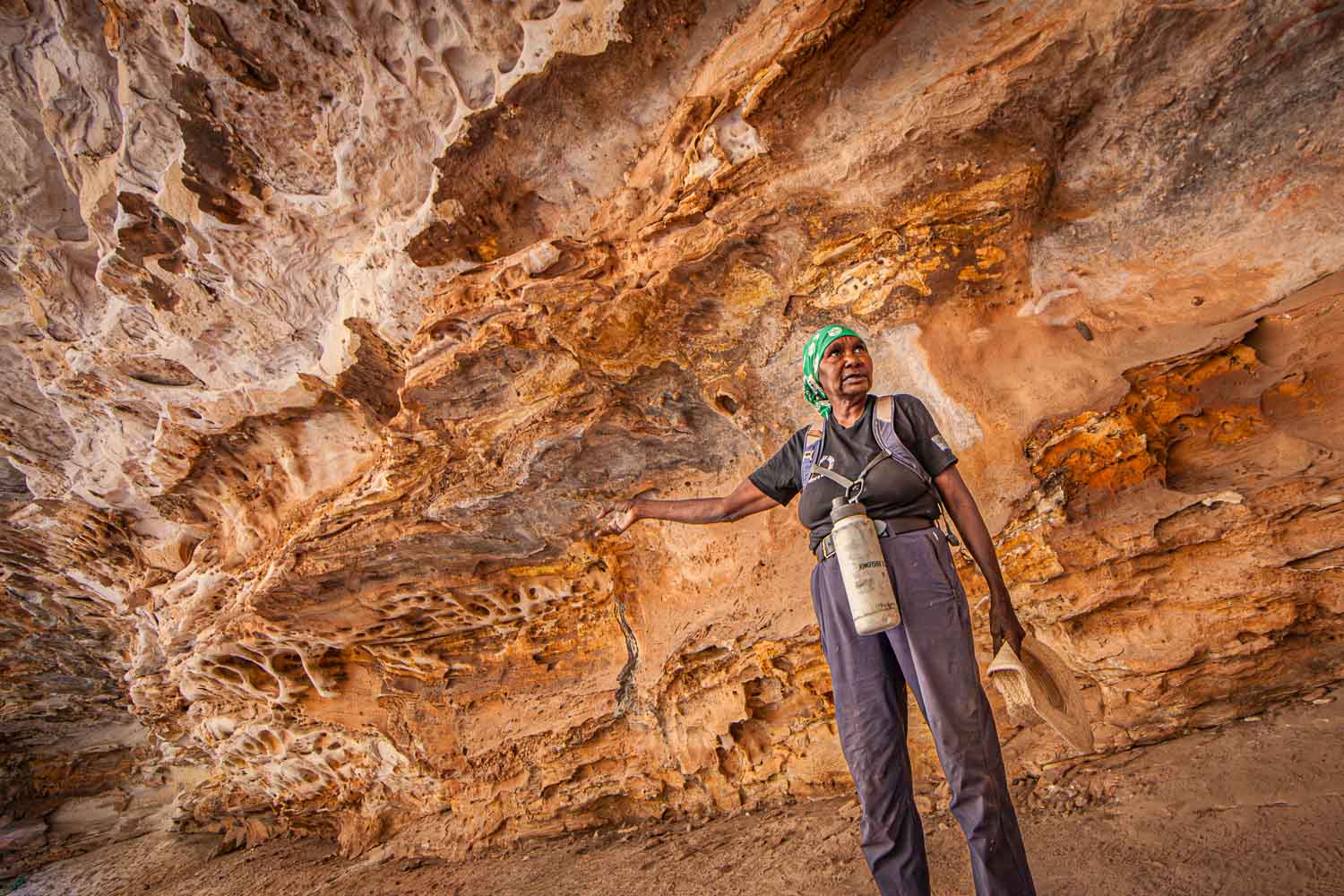
Guide Rebecca Sampy takes us on a tour of the rocky landscape of Purnululu National Park.
Cathedral Gorge opens up before us like a gigantic amphitheater. Curving rock walls soar up to 200 meters high above a still pool of water – a sacred structure created by nature. The acoustics are phenomenal: if someone speaks from the opposite side, it sounds as if they were standing right behind me.
The gap narrows to barely shoulder-width
Later, we explore Echidna Chasm in the northern part of the park. The crevice narrows to barely shoulder-width. The vertical rock walls soar over 200 meters high, while golden light from above illuminates the path.
Livistona palms cling to the vertical walls. They date back to a time when the climate here was significantly more humid. Today, they survive only because their roots reach deep enough to find a permanent water table.
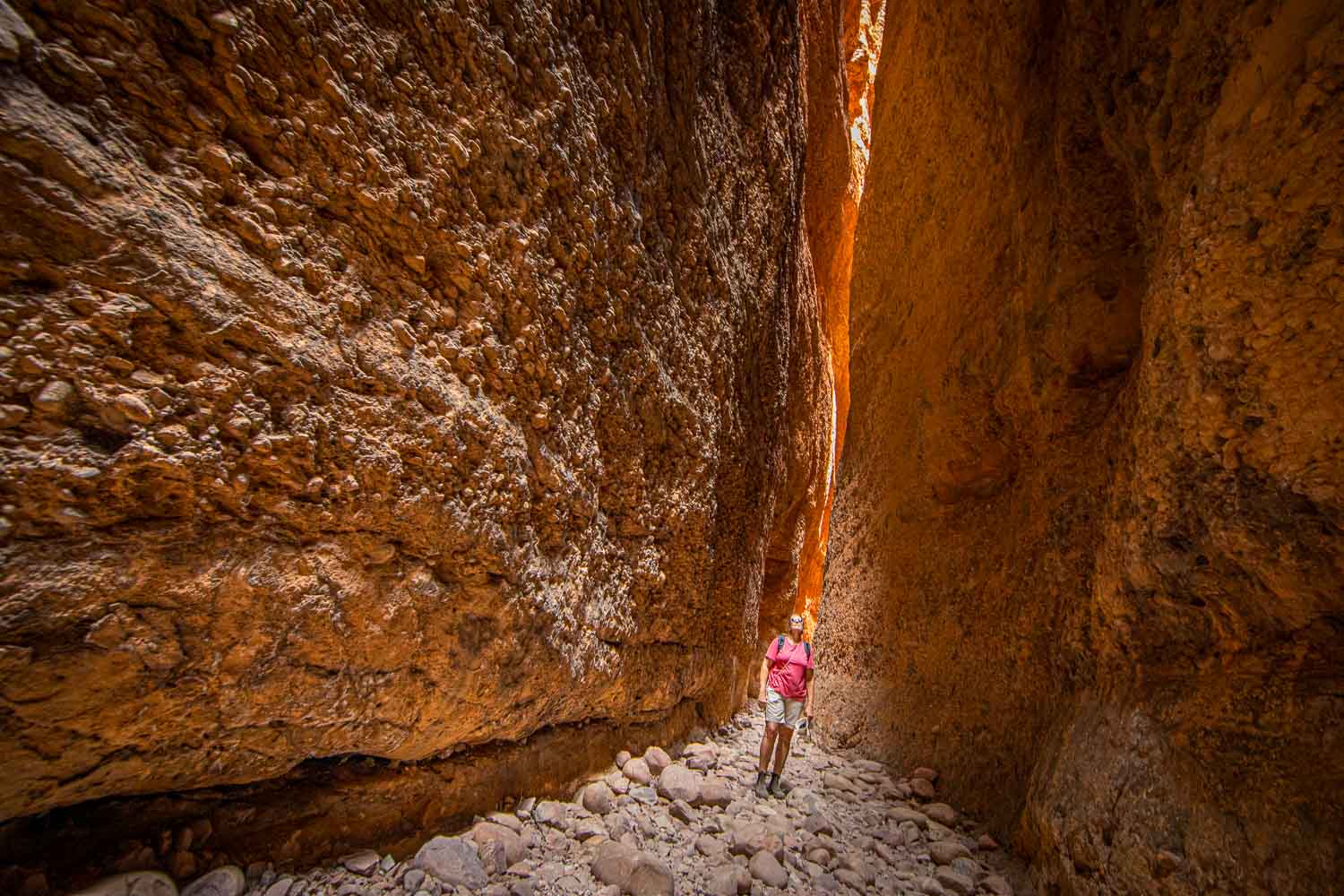
Echidna Chasm narrows to a narrow crevice, barely shoulder-width, with rock walls rising over 100 meters.
From the striped domes of the Bungle Bungles, the final leg of our journey takes us back to Broome by plane. Our guide, Bess – just fifteen years old – welcomes us with the composure of a veteran. “Broome was built on buttons,” he explains. Until 1914, this remote coastal town supplied 80 percent of the world’s mother-of-pearl.
The Pinctada maxima, the world’s largest pearl oyster, made Broome the pearl capital of the planet. The history of this industry is riddled with colonial brutality.
From the 1860s to the 1880s, Aboriginal men and women were forced to work as skin divers, diving up to twelve meters deep naked and without equipment. Beginning in the 1890s, Japanese divers from Taiji – now Broome’s sister city – took over the dangerous work.
Right before our eyes, Bess is now opening a Pinctada maxima
In 1956, Australia’s first cultured pearl farm opened in Kuri Bay, 370 kilometers to the north. A tiny nucleus made from Mississippi mussel shell is implanted into the oyster, and the animal coats the foreign body with mother-of-pearl. Two years later, the pearls are ready to be harvested.
Right before our eyes, Bess now opens a Pinctada maxima. Gently, he extracts a small, irregularly shaped pearl from the tissue – a keshi, formed without an implanted nucleus, a byproduct of culturing and yet one of captivating beauty.
In the showroom, Bess places a flawless pearl in the palm of my hand. About two centimeters in diameter, perfectly round, with that velvety sheen that experts call “luster.” Bess grins: “100,000 dollars.” The small keshi, by contrast, fetches 72 dollars.
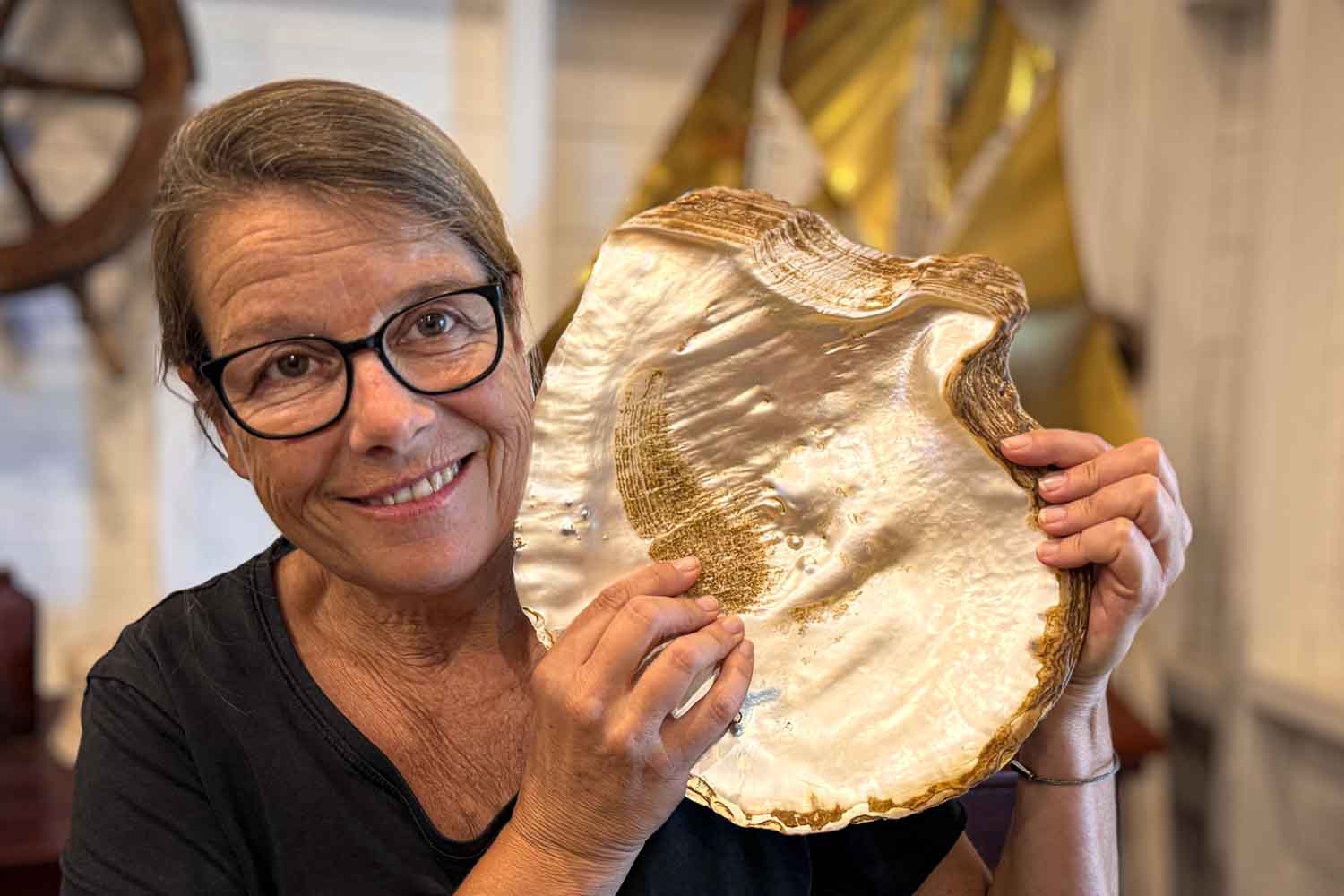
At the Willie Creek Pearl Farm, a Pinctada maxima – the world’s largest pearl-producing oyster – shimmers.
In the evening, Annette and I are sitting on Cable Beach. The sun sinks, glowing red, into the Indian Ocean; camels move across the wet sand as silhouettes.
Ten days have passed.
Gorges of 350-million-year-old reef rock. Termite mounds like cathedrals. Rock faces that tell stories from the Dreamtime.
A country that doesn’t treat its visitors with kid gloves
Is it really as bad as we’ve been told?
No. It’s overwhelming, challenging, and humbling.
A land that doesn’t treat its visitors with kid gloves, but touches them deeply precisely because of that.
The Kimberley region demands respect. In return, it offers something no travel guide can describe: the feeling of having been to one of the last truly wild places on Earth.
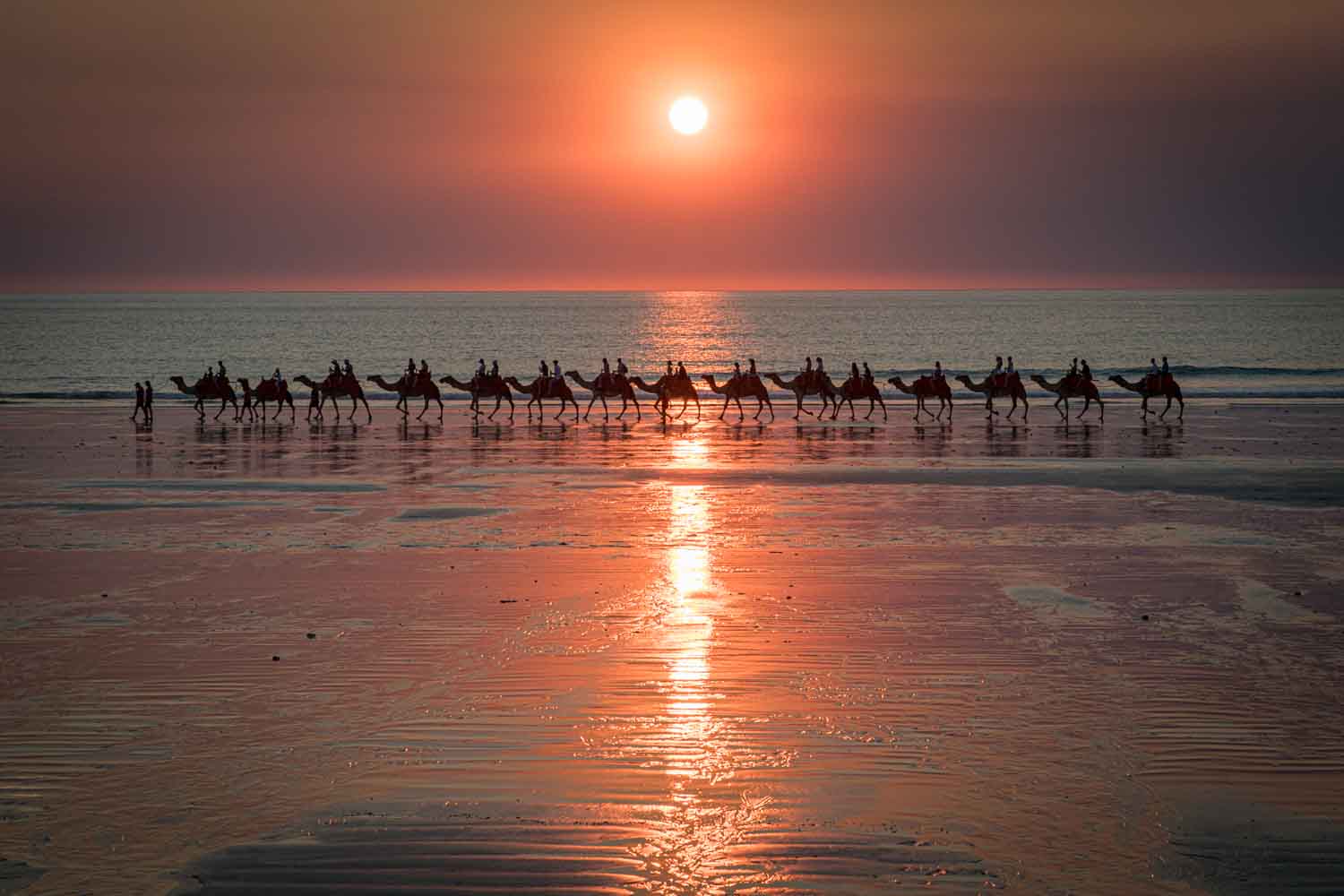
Like silhouettes, the camels move through the fiery red evening light at Cable Beach.
Want more of this?
My DISCOVERY LETTER brings you adventurous stories, stunning pictures and challenges to take part in.
Read now:

Caves, deserts & frankincense
Oman – in the sultanate of adventure
Breathtaking desert landscapes, impressive mountain ranges, exuberant hospitality and delicious food. Oman offers all of that. I venture deep into the interior – the 7th Hole Cave on the Selmah Plateau is quite something.

Life hack
Valuable concept against doubts
When I tackle a new project and doubt or hesitate, which is often, I repeat this phrase: “Not easy, but humanly possible, so doable.” Like here with a desensitization with a tarantula.

A journey with the Royal Canadian Geographic Society
Arctic – Ship expedition from Canada to Greenland
Aboard the research vessel ‘Resolute’, I lent a hand as a temporary scientist and helped collect data. The expedition took us through the Canadian Arctic to the breathtaking fjords of Greenland.