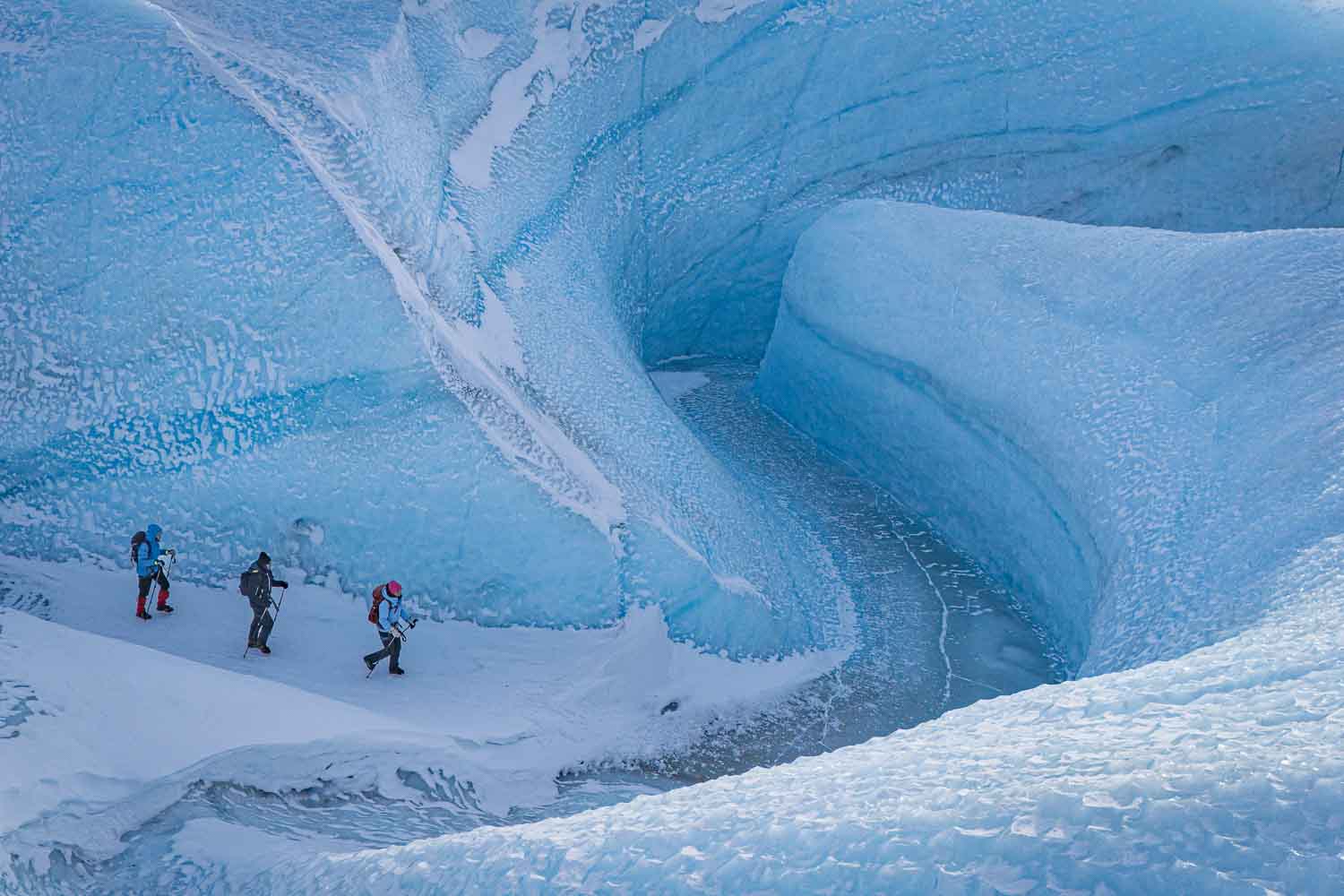
Three figures on a snow ridge between the walls of an ice canyon – only from the air does it show how deep the meltwater has cut into the ice cap.
A single tower of ice divides the canyon, with paths passing it left and right – the ground is bare ice, walkable only with crampons under the soles.
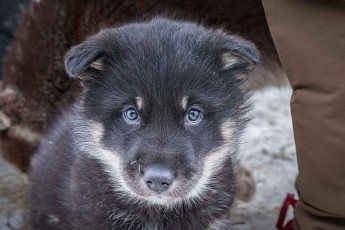
A puppy from Nivé Heilmann’s pack, its eyes still puppy blue – Greenland dogs have been kept without crossbreeding for over 850 years, since they arrived with the Thule Inuit.
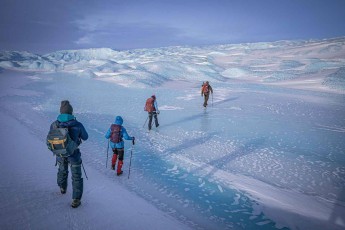
The group crosses a frozen meltwater lake – in summer the water bores shafts down through the ice here, called moulins, which vanish under snow in winter.
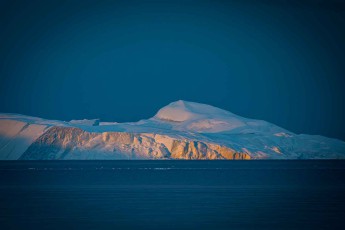
Ilulissat: warm light grazes the edge of the ice, as if the rising sun were reaching for the rock face.
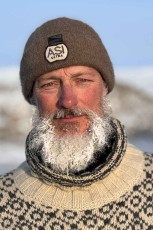
Back from Point 660 after six kilometres on the ice – what hangs in Klaus Larsen’s beard is frozen breath.
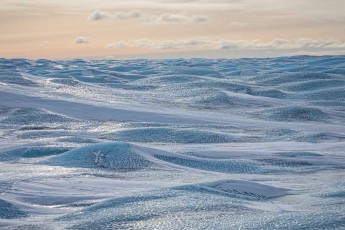
The ice cap, rippled like a frozen swell all the way to the horizon – further inland the Greenland ice sheet grows more than three kilometres thick.
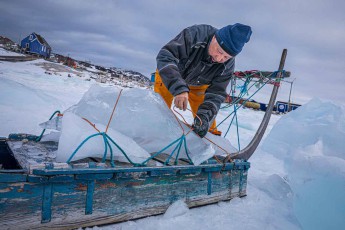
A man is securing blocks of ice to his wooden sledge, which he has previously chopped from an iceberg. In Oqaatsut, where there is no mains water supply, this has been the local people’s method of obtaining drinking water for centuries.
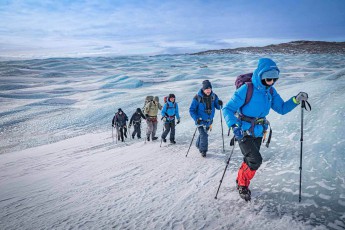
Crampons under our soles, our group makes its way across the ice cap – beyond Point 660 the ice runs on for more than 550 kilometres to Greenland’s east coast.
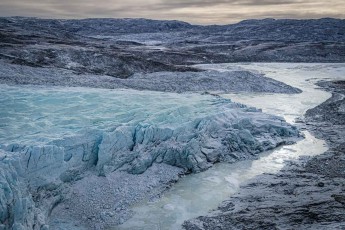
The tongue of the Russell Glacier from the air, its frozen outflow below – in 2007 an ice-dammed lake emptied here: 39 million cubic metres of water in seventeen hours.
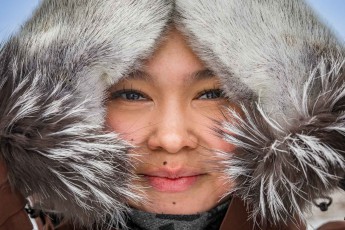
Henni Ostermann in Disko Bay, the fur trim of her hood pulled close around her face.
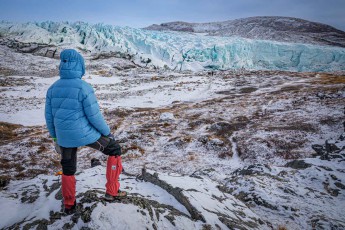
The view from the terminal moraine towards the front of the Russell Glacier – the ice reached this far twenty to twenty-five years ago, and has been retreating ever since.
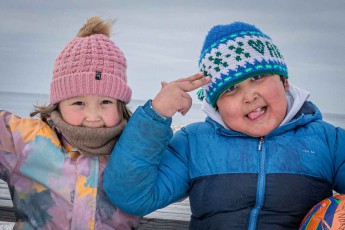
Oqaatsut: Two children are saluting on a bench in the village square.
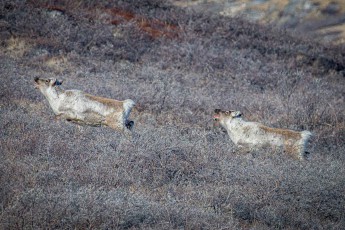
Two reindeer bolt through the dwarf scrub near Kangerlussuaq – each of their hairs is hollow inside, trapping air that insulates better than cashmere.
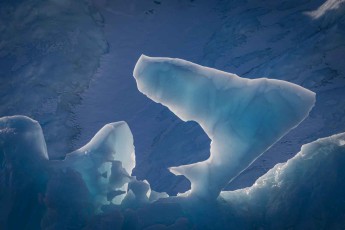
Wind and weather carve strange sculptures into the icebergs in the fjord at Ilulissat, Greenland.
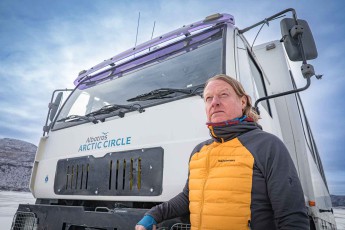
Niels in front of the truck that carries the group along the Ice Road. Later, on a climb, the vehicle loses its grip; Niels reverses two hundred metres and takes a run at it.
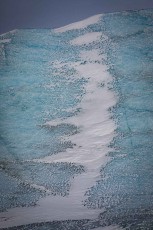
What looks like water is a flank of the ice cap at Point 660 – snow has settled in a channel, and the blue beneath it is ice under pressure.
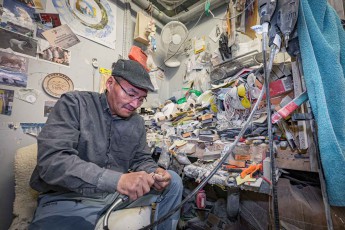
Kristian Fly carves a reindeer antler into a figurine in the workshops of his artists’ commune in Ilulissat, Greenland.
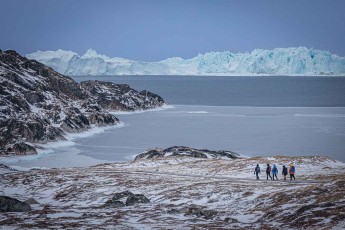
Five figures on the boardwalk below the Ilulissat Icefjord Centre, the edge of the icefjord behind them – the path leads down to the frozen Disko Bay.
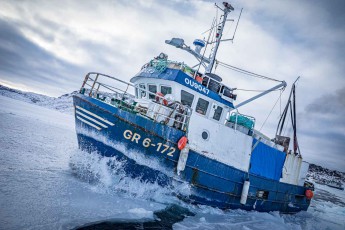
A traditional Greenlandic longline fishing boat, the backbone of the local Greenlandic coastal fishing industry, is making its way through the ice in Red Bay.
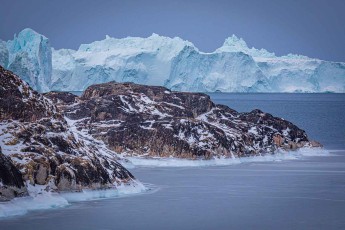
Behind the black rock coast the ice of the Ilulissat Icefjord piles up – at the fjord mouth the icebergs run aground on a terminal moraine, some for years, until they finally slip across it.
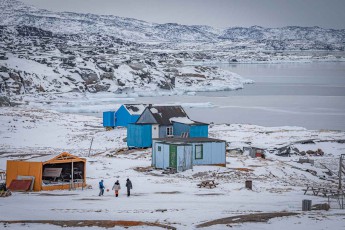
Three children playing football in the snow at Oqaatsut. Behind them, floes drift in grey water.
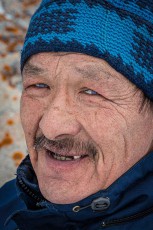
Oqaatsut: for decades Steen Gabrielsen, 54, has fished the waters of west Greenland, bred sledge dogs and mended nets.
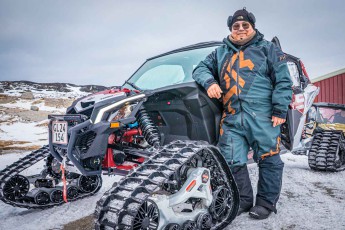
Oqaatsut: Where tarmac roads end, on frozen fjords and windswept plateaus – that is where the terrain of tracked vehicles begins.
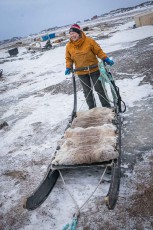
Nivé Heilmann pulls a sledge across her dog yard on the edge of Ilulissat, where she keeps 73 Greenland dogs – from a two-week-old puppy to a thirteen-year-old veteran.
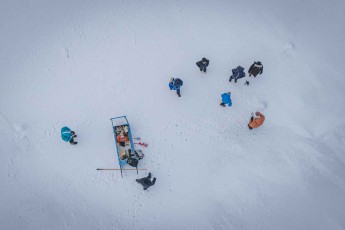
In Oqaatsut Bay, in the icy wind, we lean eagerly over the ice holes, fishing lines in hand.
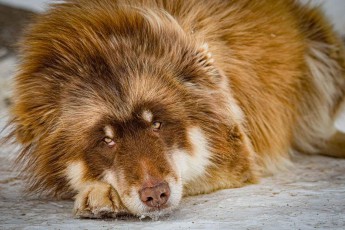
A full-grown Greenland dog dozes in the snow, its head on its paws – at minus thirty degrees the dogs sleep outside; their coat is all they need.
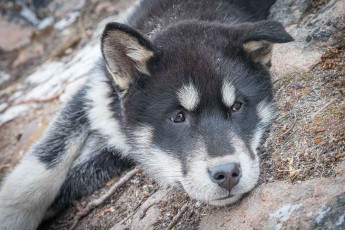
Tulu, three months old, lies tired on the rock – Nivé Heilmann names her dogs only once they can walk and their character begins to show.
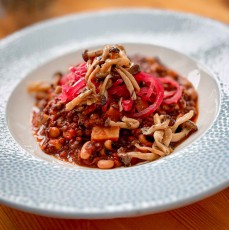
Roast reindeer served with caramelised mushrooms and pickled onions – at Restaurant H8, the only Oqaatsuuts, Arctic hunting traditions meet Nordic culinary art.
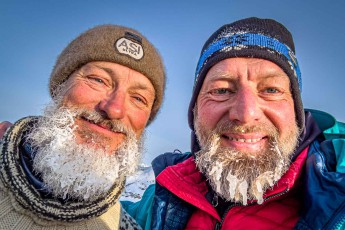
At the end of the day on the ice cap, Klaus’s beard and mine full of ice.