

To appear in:

Germany’s largest nature travel magazine
Issue 3/2027 | Text & photos Malte Clavin
Shortly after nine, the mist still hangs on the ridge. Below it, on the steep slope above the cobbled path, stand dragon trees. A dragon tree looks like an umbrella someone has opened and left standing. Its thick trunk forks again and again as it rises, and every branch ends in a tuft of stiff, sword-shaped leaves. Between them, agaves stretch their leaf rosettes into the haze.
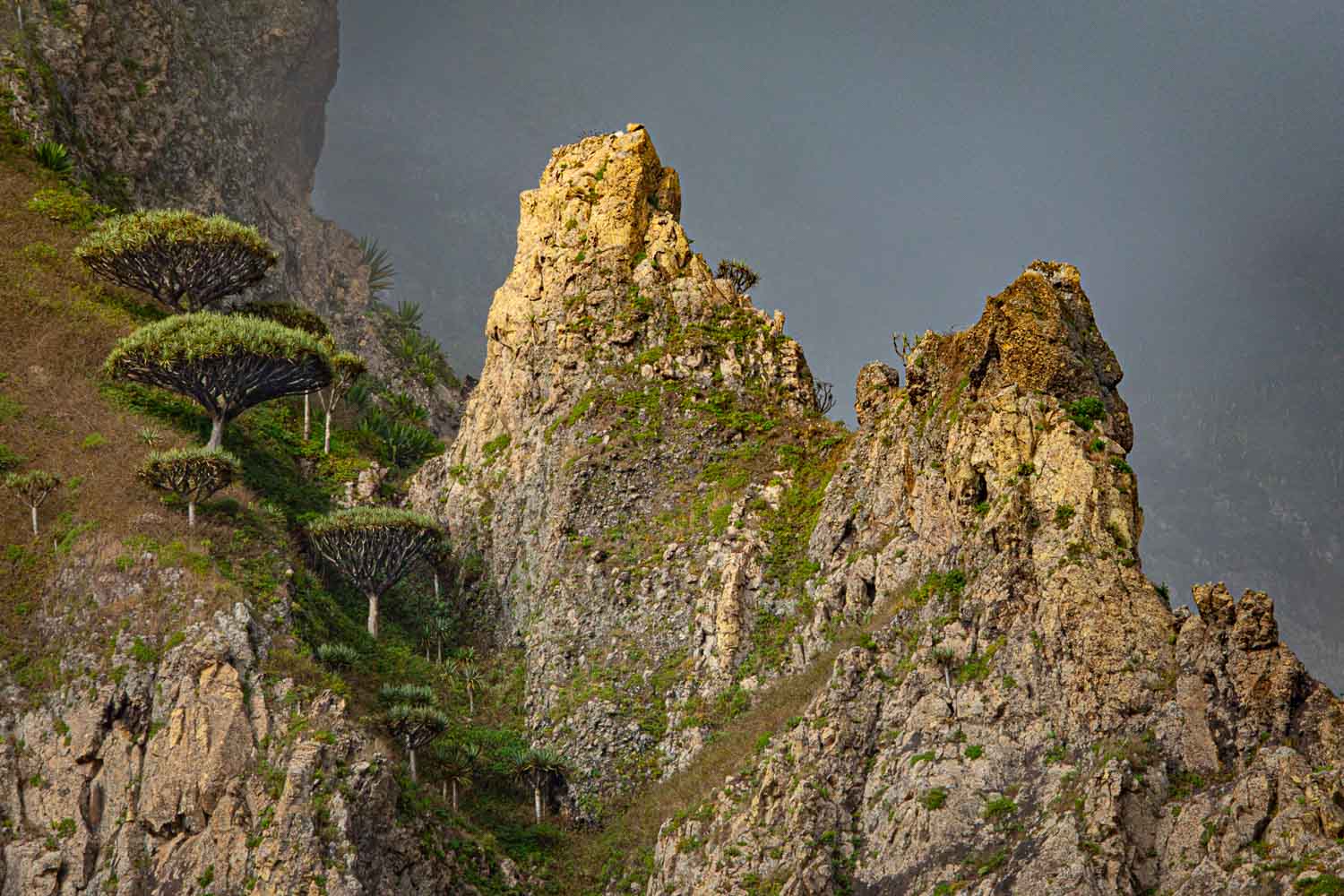
Dragon trees on a rocky ridge above Fajã. The largest stands of dragon trees in Cape Verde grow here.
Our group of tour operators and journalists set out from the valley of Fajã, on São Nicolau. Nowhere in Cape Verde do as many dragon trees grow as here and on the slopes above. That comes as a surprise.
A long-term average of 228 millimetres of rain a year falls on these islands, not even half as much as Berlin gets
For hardly any rain falls on these islands off West Africa: a long-term average of 228 millimetres a year, almost all of it between August and October. That is not even half as much as Berlin gets. What do islands live on when so little water falls on them? The answer is drifting over the ridge right now, as mist. Its story begins two days earlier, on São Vicente.
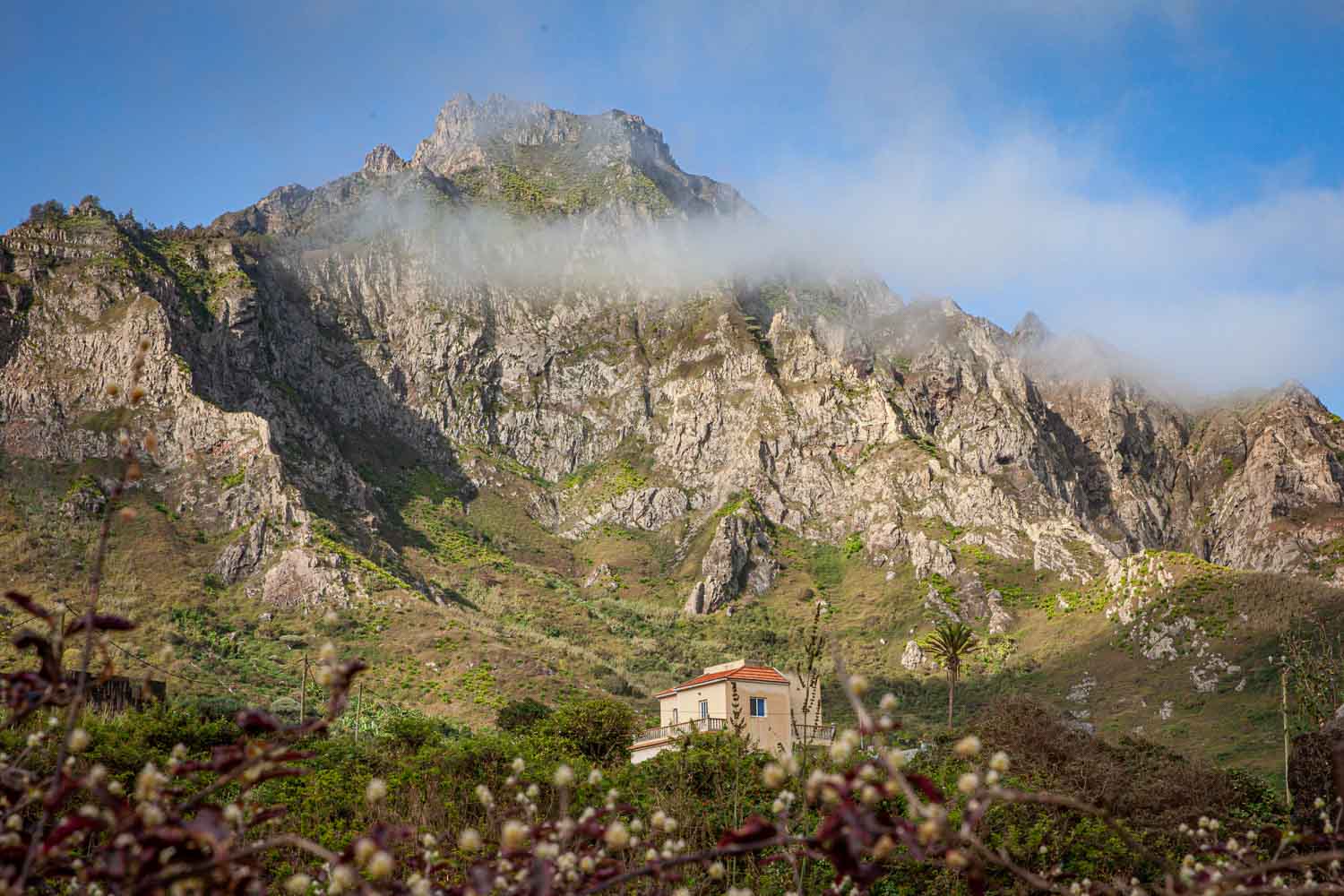
A lone house below the massif above Fajã.
Mindelo: where Cesária walked barefoot
Brown, bare ridges enclose Mindelo, the port city of São Vicente. We land in February, in the middle of the dry season.
In a workshop in town, a sheet of paper lies on the workbench: “Construindo Musicalidade”, building musicality. Listed beneath are the instruments made here, among them the cavaquinho, the small four-stringed guitar of Cape Verdean music. Smiling, Luis Baptista tightens a piece of wood in G-clamps. Guitars and empty bodies hang from wall and ceiling; egg cartons deaden the sound.
Bau learned in this workshop too, and later led the band of Cesária Évora
The workshop goes back to his father, Mestre Baptista, who built instruments here until his death in 1997 and taught his children the craft. Rufino Almeida, whom everyone simply calls Bau, learned in this workshop too. He plays cavaquinho and guitar, and in the late 1990s he led the band of Cesária Évora, Cape Verde’s most famous singer.
The next morning, Cesária Évora herself gazes out over the seafront promenade, ten metres high, as tall as a three-storey building. The Portuguese artist Vhils, who chisels portraits out of walls, carved her face into the white wall of a house in 2019. She smiles; palm fronds frame her portrait.
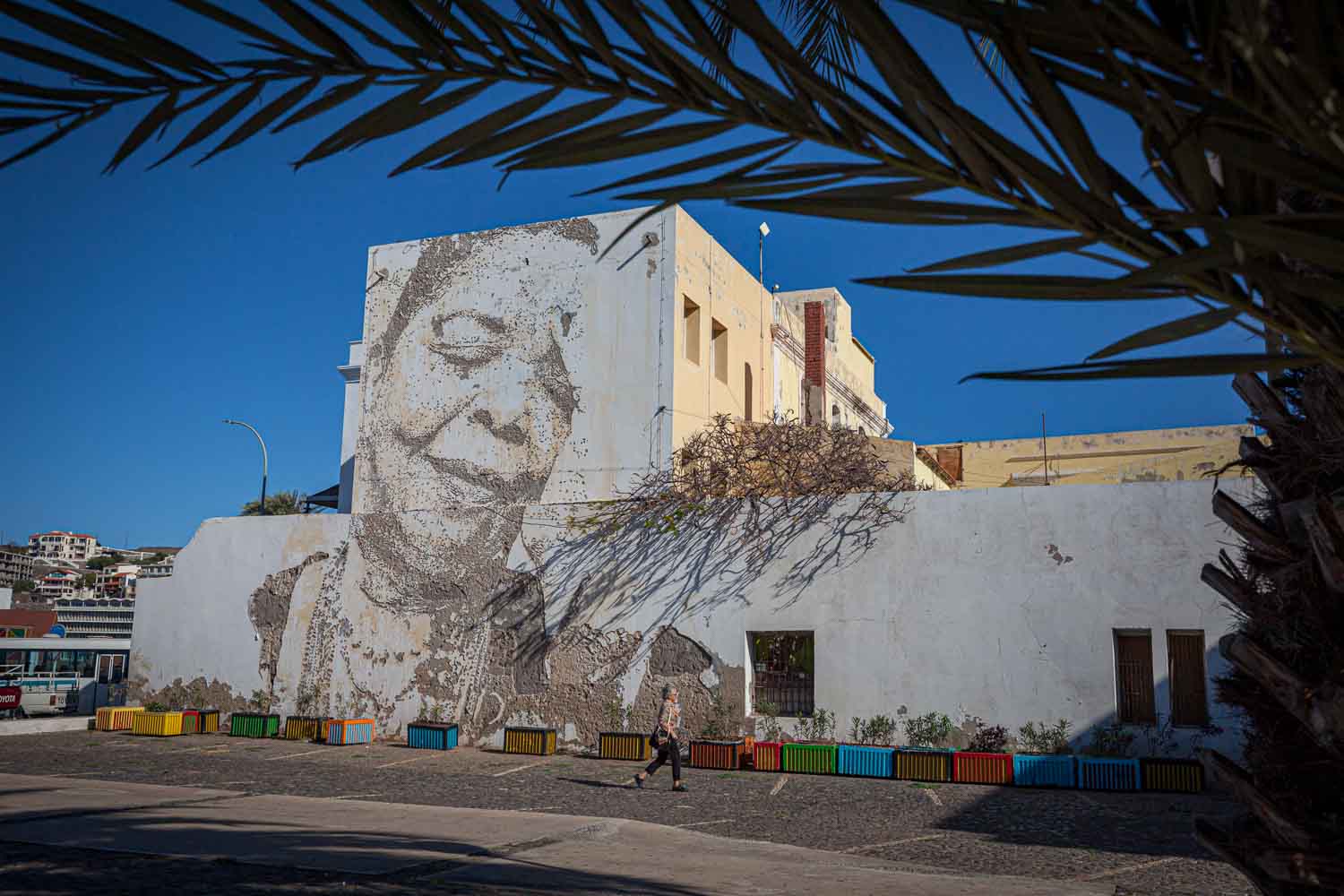
Ten metres tall: Cesária Évora, carved into a house wall in Mindelo by the Portuguese street artist Vhils in 2019. The singer was born in the city in 1941.
She was born here in Mindelo in 1941; in 2004 she won a Grammy for her album “Voz d’Amor”. The world knew her as the barefoot diva. She performed barefoot, it was said, in solidarity with the poor women of her country. She herself saw it more soberly: “In Cape Verde, where I lived, I always went barefoot.”
At the fish market, red mullet and small tuna lie on the tables. The houses beside it and in the old town, built under Portuguese and British influence, have tiled roofs and dormer windows.
Mindelo calls itself the city of music. In the evenings, bands play in many of the restaurants, with guitar, cavaquinho and often a violin. Their repertoire is the morna: slow, wistful songs that Cesária sang too.
Sodade is the Cape Verdean word for the longing for something you have lost
Throughout these days, one of her songs accompanies me on my headphones: “Sodade”. Sodade is the Cape Verdean word for the longing for something you have lost. The song tells of people who, in the twentieth century, had to leave their island because the rain failed and hunger came. That island is called São Nicolau.
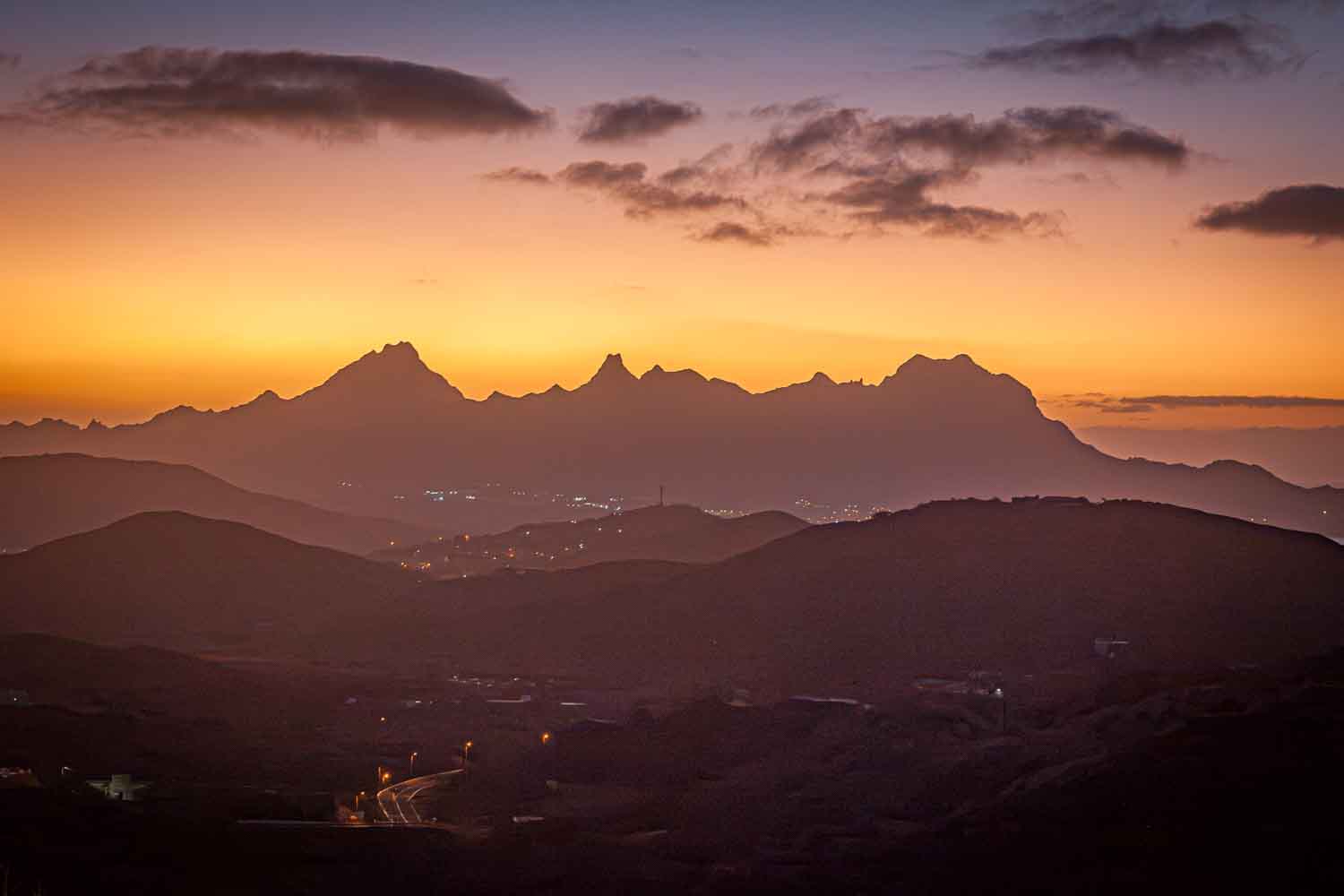
The last colours of the day over the mountains on the horizon, with the lights of a settlement on São Vicente below.
São Nicolau: into the land of longing
The evening before, we flew over from Mindelo to São Nicolau. Now we are walking downhill from Fajã. The stones of the path were laid by hand; walls run along either side, some so thickly overgrown that you can barely see them. Along the way grows whatever the island yields: papaya, guava, figs, mango and tamarind, peas, broad beans and cherry tomatoes, plus coffee, ginger, cotton, aloe and tobacco.
All the land reptiles native to Cape Verde exist nowhere else in the world
The wind rustles in the bushes; cockerels crow across the valley. In a crevice of a reddish wall, a dark, finely speckled lizard basks in the sun. All the land reptiles native to Cape Verde exist nowhere else in the world. They are either geckos or skinks; the skinks have smooth, glossy scales. There are no snakes.
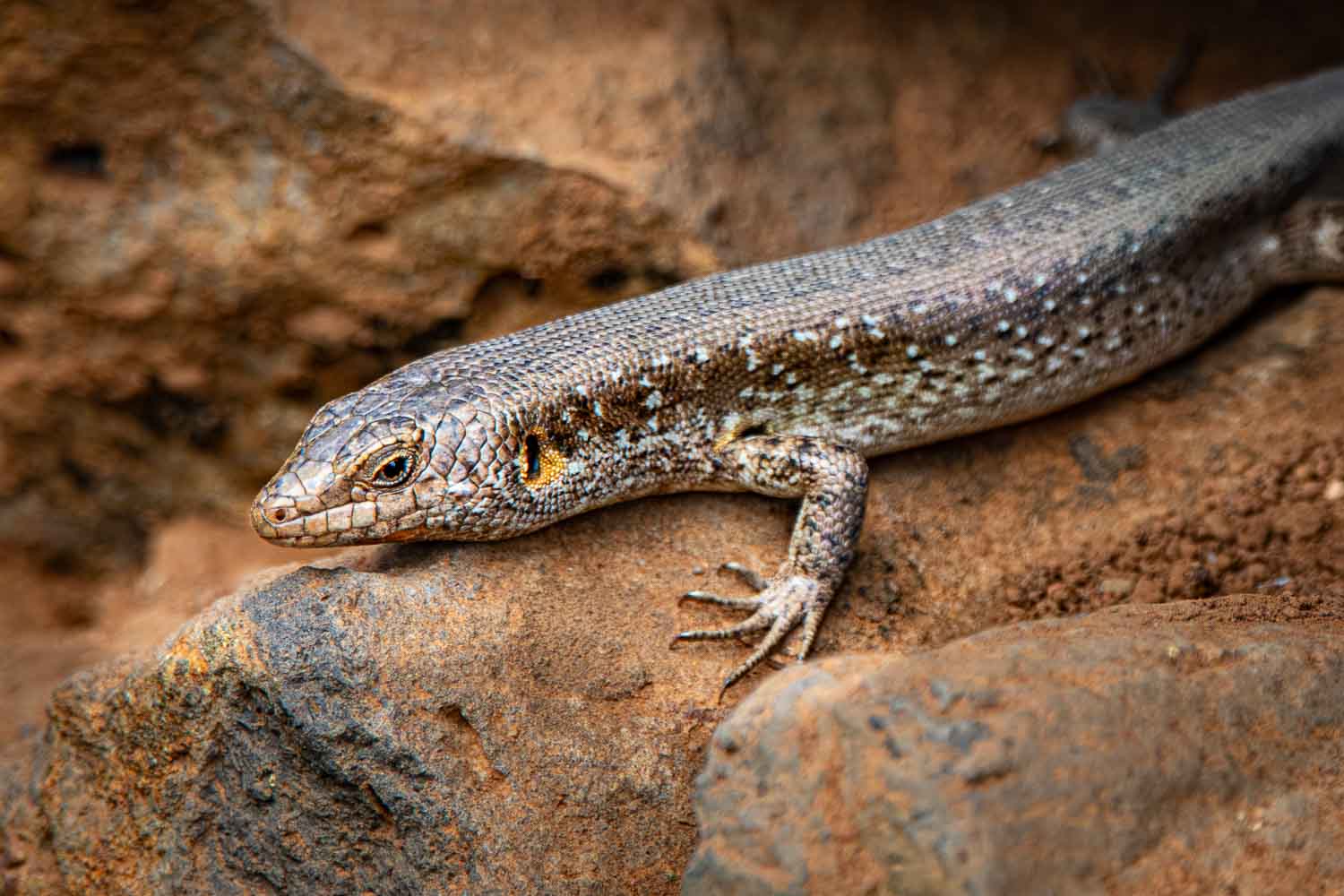
A skink on a rock beside the path from Fajã. There are no snakes on the islands, but there are endemic geckos and skinks.
We stop at a densely branched shrub. At the tips of its twigs, narrow leaves sit in rosettes, like little green stars. It is tortolho, a spurge that grows only in Cape Verde. Its milky sap is poisonous.
Where the path steepens, dry-stone walls shore up the terraces. We pass ruined, overgrown stone houses and go through the village of Fragatona. In the early afternoon we reach Ribeira da Prata. We have descended 800 metres today.
Armando Zeferino Soares was not recognised as the author of “Sodade” until December 2006, shortly before his death
In the neighbouring village of Praia Branca lived the trader Armando Zeferino Soares. It was there, in the 1950s, that he wrote “Sodade”. He was not recognised as its author until December 2006, shortly before his death. Praia Branca calls itself Terra d’Sodade, land of longing.
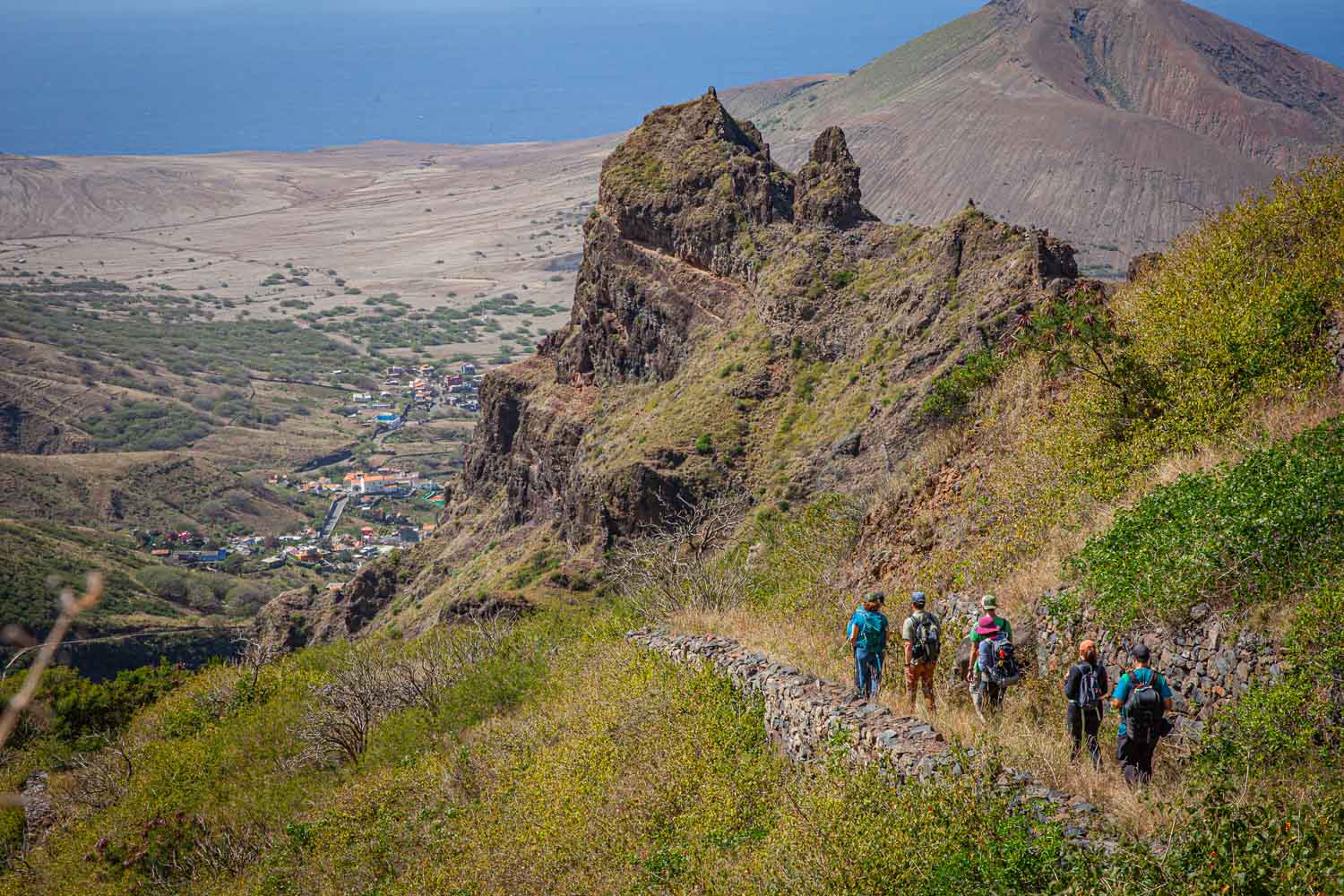
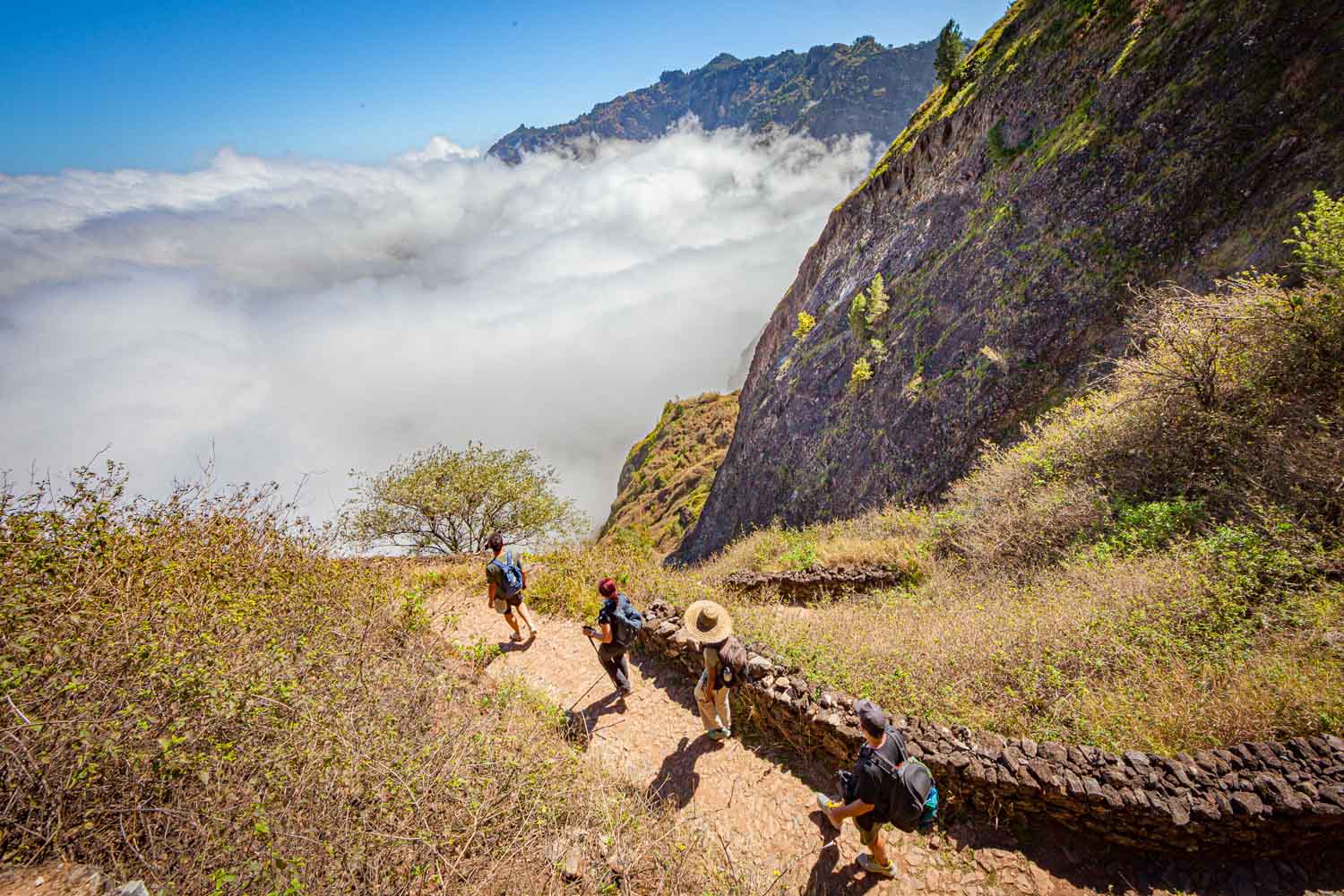
Hikers on the stone-built path down to Ribeira da Prata.
The song has a dark history, and it is about water. In the 1940s the rains failed several times. By the calculations of the historian António Carreira, around 45,000 people starved to death. At the time, some 180,000 people lived on the islands: roughly one in four died.
Between 1903 and 1970, the Portuguese colonial administration sent around 80,000 Cape Verdeans to São Tomé and Príncipe, an island group in the Gulf of Guinea. There they had to work on coffee and cocoa plantations. The labourers travelled in the ships’ holds and did not know whether they would return. This is what “Sodade” tells of. One line names the “caminho pa São Tomé”, the road to São Tomé.
The surf forces water through a cleft in the rock, and it shoots metres into the air
Later the car takes us to the coast. At Carbeirinho we stand before a rock face. Its layers lie in waves one above the other, shot through with white streaks of mineral; below it, black sand and wide, shallow pools of seawater.
The surf forces water through a cleft in the rock, and it shoots metres into the air. At last, I run into the sea on the beach at Tarrafal. Why coffee grows up on the slope while down here there is nothing but rock and sand will become clear tomorrow on Monte Gordo, the island’s highest mountain.
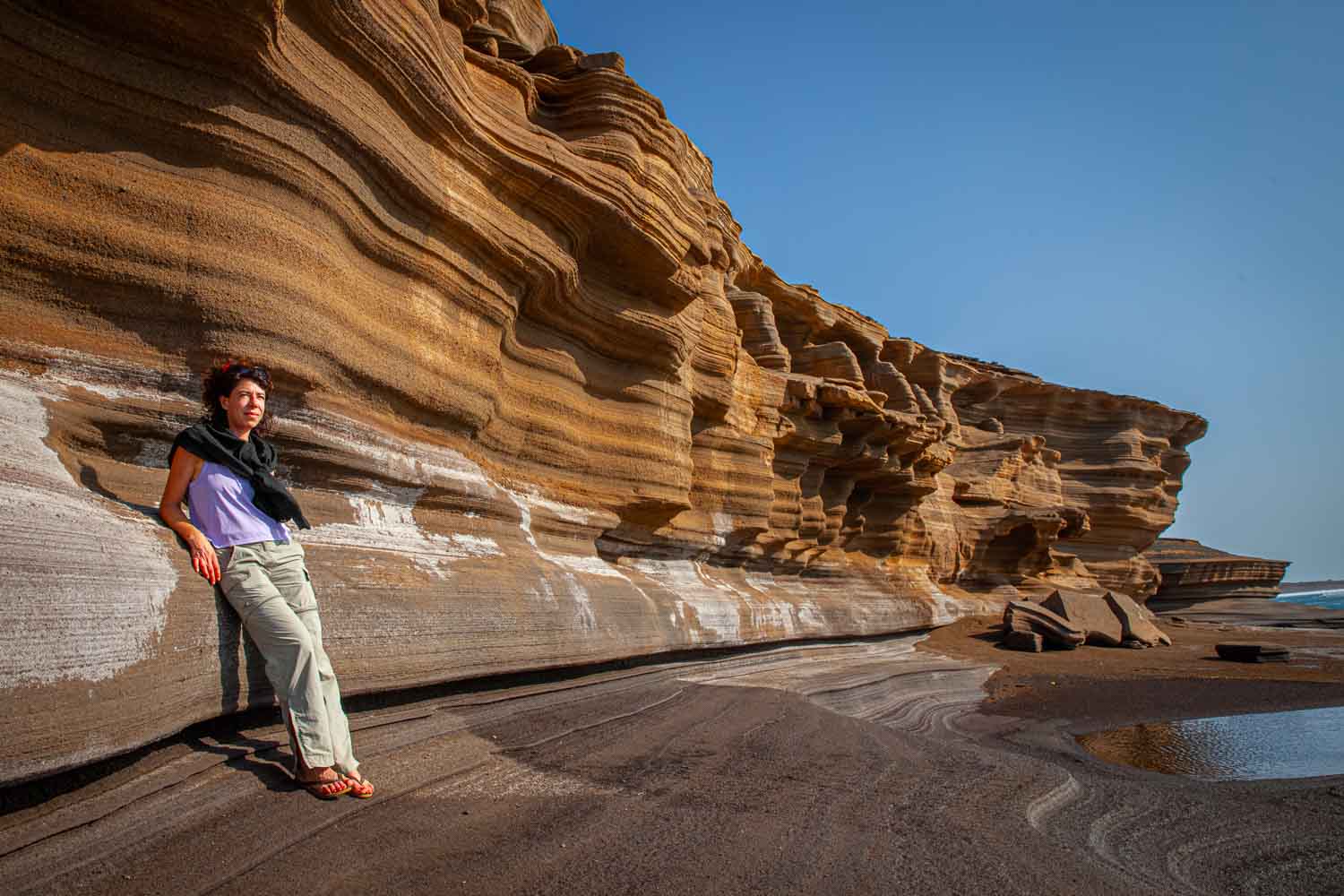
Emmanuelle Radzynski leans against the wavy, layered rock face at Carbeirinho on São Nicolau, black sand at her feet.
Monte Gordo: the cloud forest
The next day we climb into the Monte Gordo Natural Park. It protects 952 hectares, a good 1,300 football pitches, around the mountain of the same name. The summit stands at 1,312 metres. One in three plant species in the park, 28 in all, grows only in Cape Verde.
The clouds come from two sides, touch, and then drift across the crest as a flat lawn
In a small valley below the ridge, the clouds meet. They come from two sides, touch, and then drift across the crest as a flat lawn. It is the same mist that hung above the dragon trees at Fajã. The scent of eucalyptus is in the air; wild carrot grows beside the path, with white umbels.
In the forest stand mossy, twisted trunks, with rosette plants between them; a clearing blurs into the haze. By the path blooms the língua-de-vaca, the cow’s tongue, a viper’s bugloss with rough leaves and pink and violet funnel-shaped flowers on red tubes. It grows only in Cape Verde and is endangered, because people use it as a medicinal plant and as firewood.
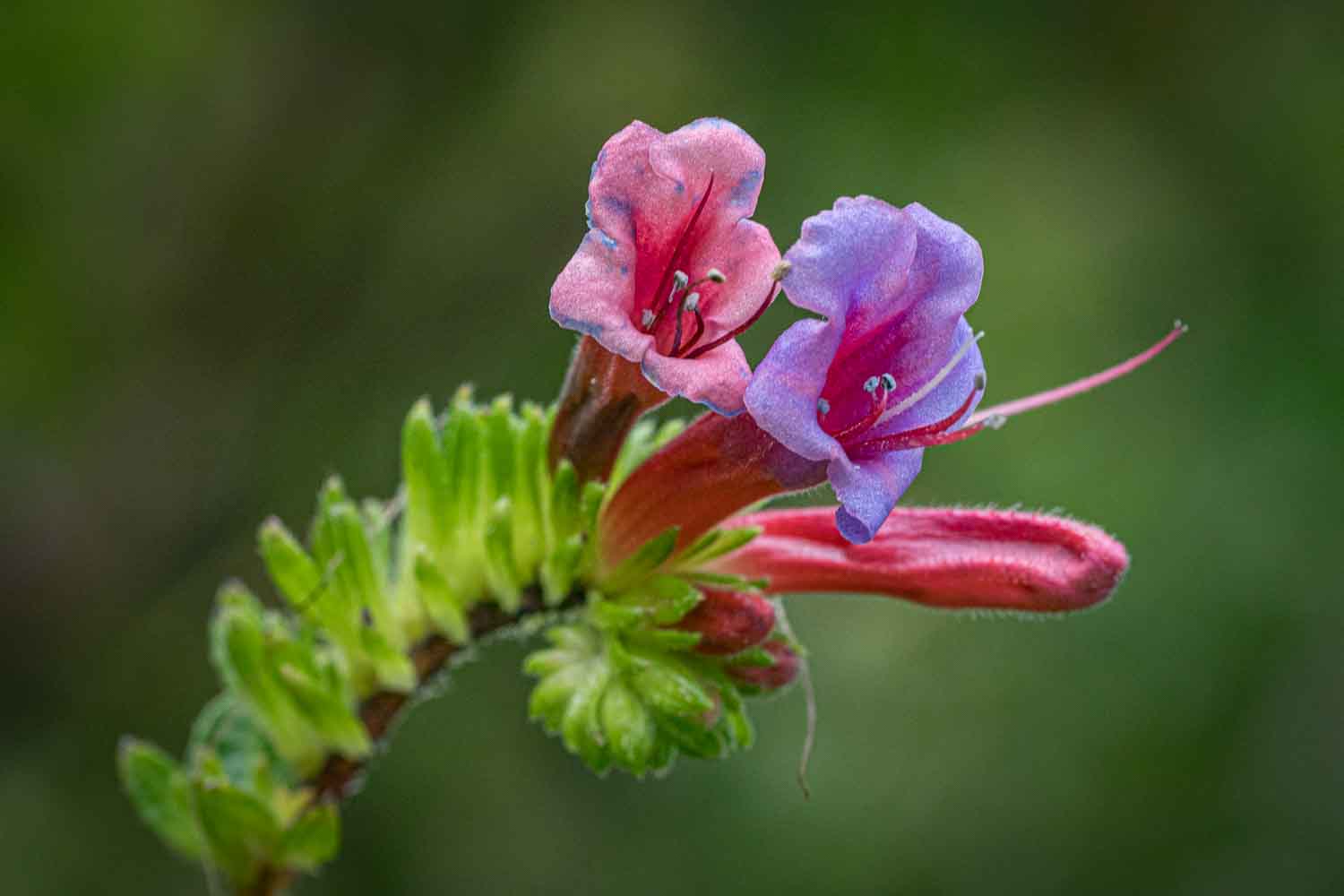
Língua-de-vaca, cow’s tongue, is the name of this viper’s bugloss on Monte Gordo. The plant is found only in Cape Verde and is considered endangered.
What we see obeys simple physics. The trade wind, the steady north-easterly, pushes moist air against the mountains. The air rises, cools and gives up its water, as mist or as rain. That is why the weather station at Cachaço, at 724 metres, records the most rain on the island, and the one down in the main town, at 125 metres, the least.
On the island of Brava, nets made of metal catch up to 1,500 litres of mist water a day
On other islands, people have learned to harvest this mist, with nets strung vertically, on which the droplets catch and drip into channels. On the island of Brava, nets made of metal catch up to 1,500 litres a day, ten bathtubs’ worth.
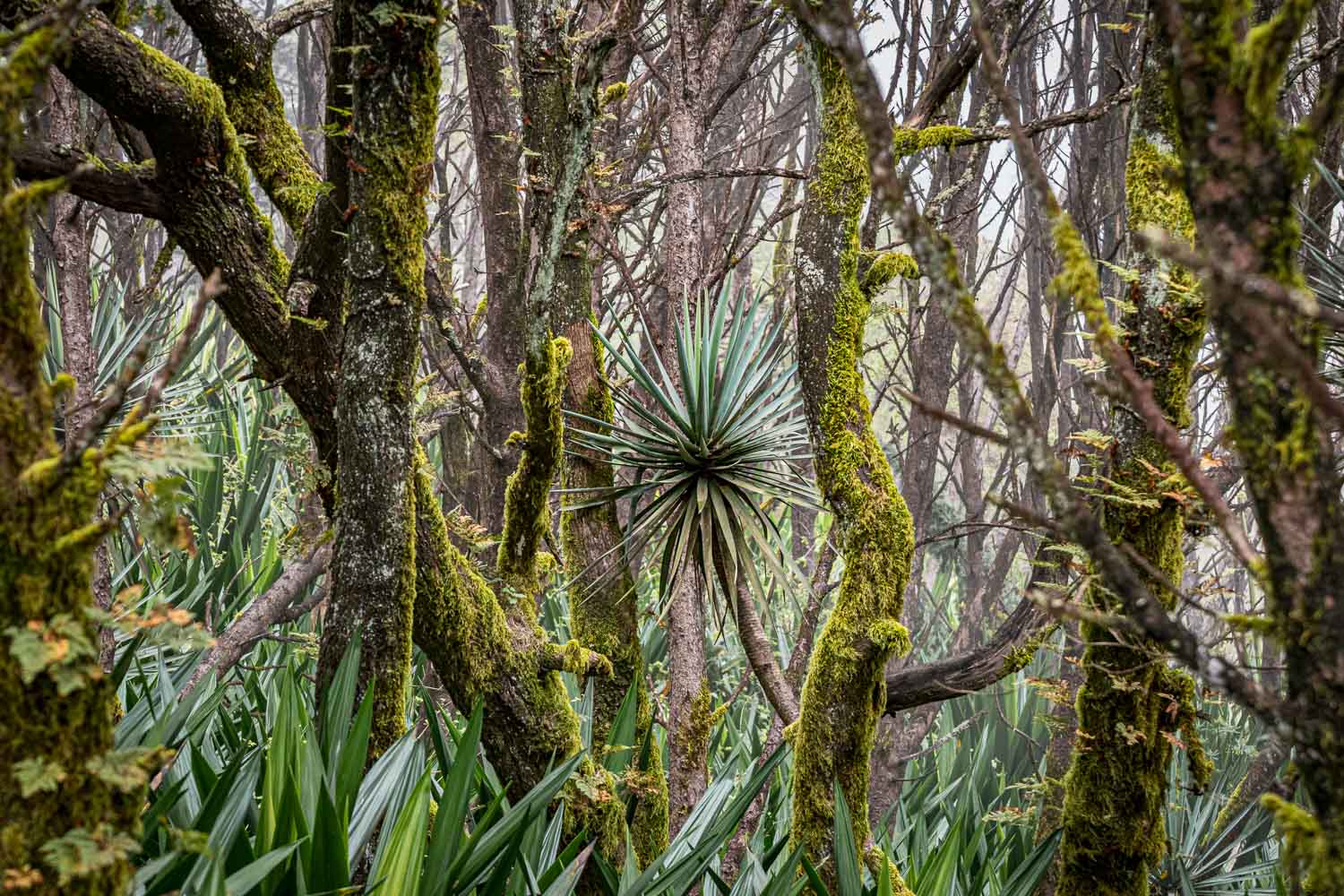
Mossy trunks in the mist on Monte Gordo. The summit rises to 1,312 metres.
Sal: a crater full of salt
On the flight back to Mindelo we make a stopover on the island of Sal. Its name is Portuguese and means salt. In the 2024 rainy season, a mere 30 millimetres fell here, barely two fingers’ breadth. Even so, more than four in five of Cape Verde’s hotel guests stay on Sal and the neighbouring island of Boa Vista. They come for the beaches.
Near the village of Pedra de Lume we stop on a plain of dust and rubble. In ten minutes we climb a bare slope to the rim of an old volcanic crater. From there we look down on rectangular basins, whitish and grey, separated by earthen banks. They are salt pans: the sun evaporates the brine until only salt is left.
Around 90 per cent of Cape Verde’s drinking water comes from desalination plants
More than 50 million tonnes of salt lie in the crater. Until 1887, up to 30,000 tonnes a year were shipped out, mostly to Brazil. After that the trade declined, and in 1963 it came to a virtual standstill. Today only a little salt is extracted here, mainly for cosmetics. Visitors come to bathe in the brine. Like the Dead Sea, the brine keeps the body afloat without any need to swim.
Sal has salt and beaches. The trade wind blows here too, but Sal’s highest mountain, Monte Grande, stands at only 406 metres. It is too low to wring the moisture from the wind. So the island draws its drinking water from the sea. Around 90 per cent of Cape Verde’s drinking water comes from desalination plants.
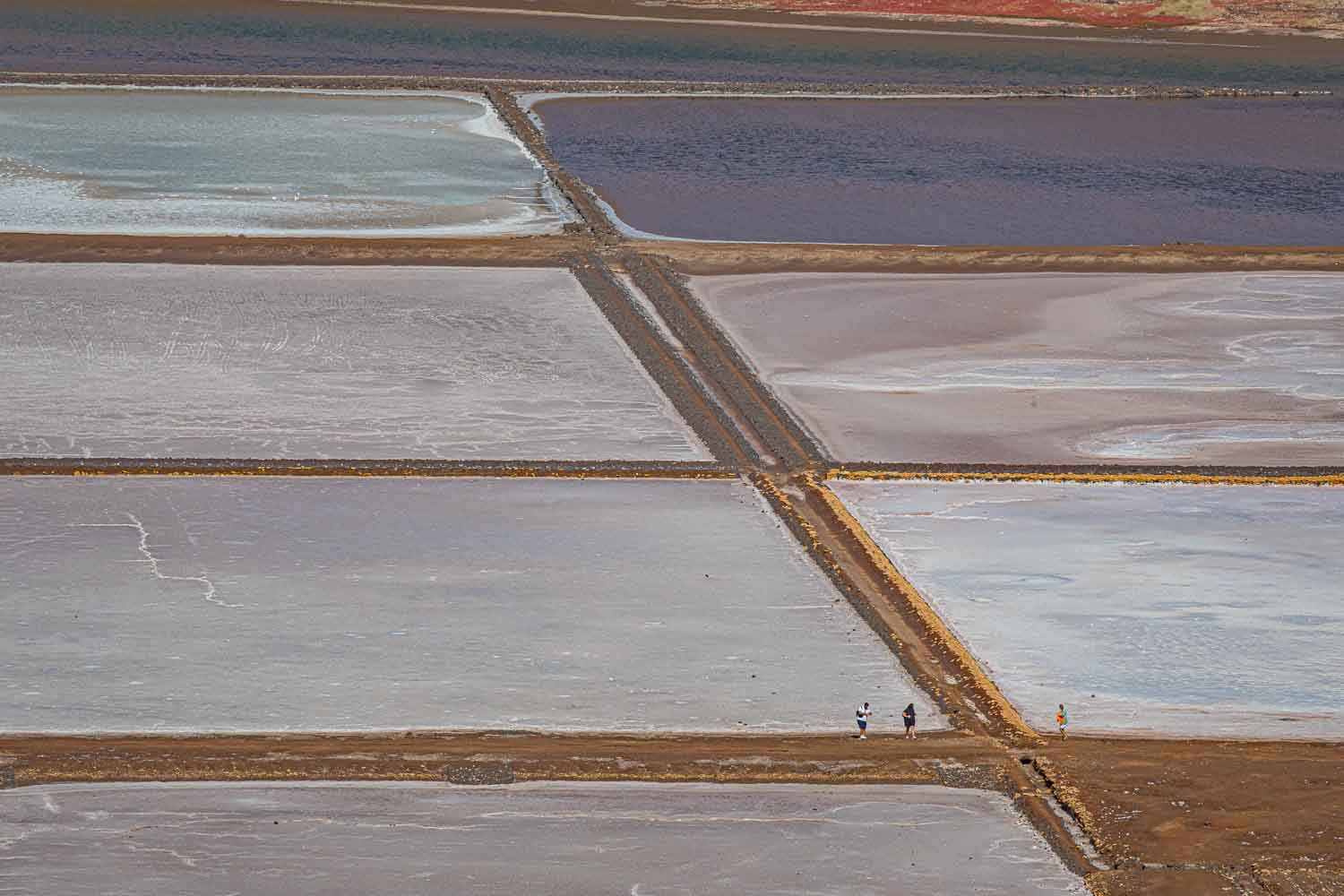
Salt pans in the crater at Pedra de Lume. Until 1887 salt went from here mainly to Brazil.
Santo Antão: fields beneath clouds
After a night in Mindelo, the early-morning ferry carries us across to Porto Novo on Santo Antão, the fourth island of this journey. For half an hour the car climbs, through pine forests, to Água das Caldeiras at 1,300 metres. Then the Cova crater opens up. Its floor is not a field of lava but a patchwork of plots framed by stone walls. A cloud spills over the crater rim and sinks onto the fields.
The path leads over the rim and then downhill, cobbled and lined with dry-stone walls. To the left, the valley of Paul lies beneath an unbroken sea of cloud. Up the rock face the clouds climb. Beside the path grows losna, a wormwood that smells sharply of vapour rub. It is found only on Santo Antão, Santiago and Fogo, mostly above 800 metres. A falcon rides the updraught and spirals upwards.
Through stone-built water channels, some more than 200 years old, the water reaches the terraced fields
The mountains of Santo Antão catch rain and mist from the trade wind, above all on the northern and north-eastern slopes. The southern and south-western slopes, by contrast, stay very dry. Through levadas, stone-built water channels, some more than 200 years old, the water reaches the terraced fields of the valleys. In the 2024 rainy season, an average of 495 millimetres fell on Santo Antão, sixteen times as much as on Sal.
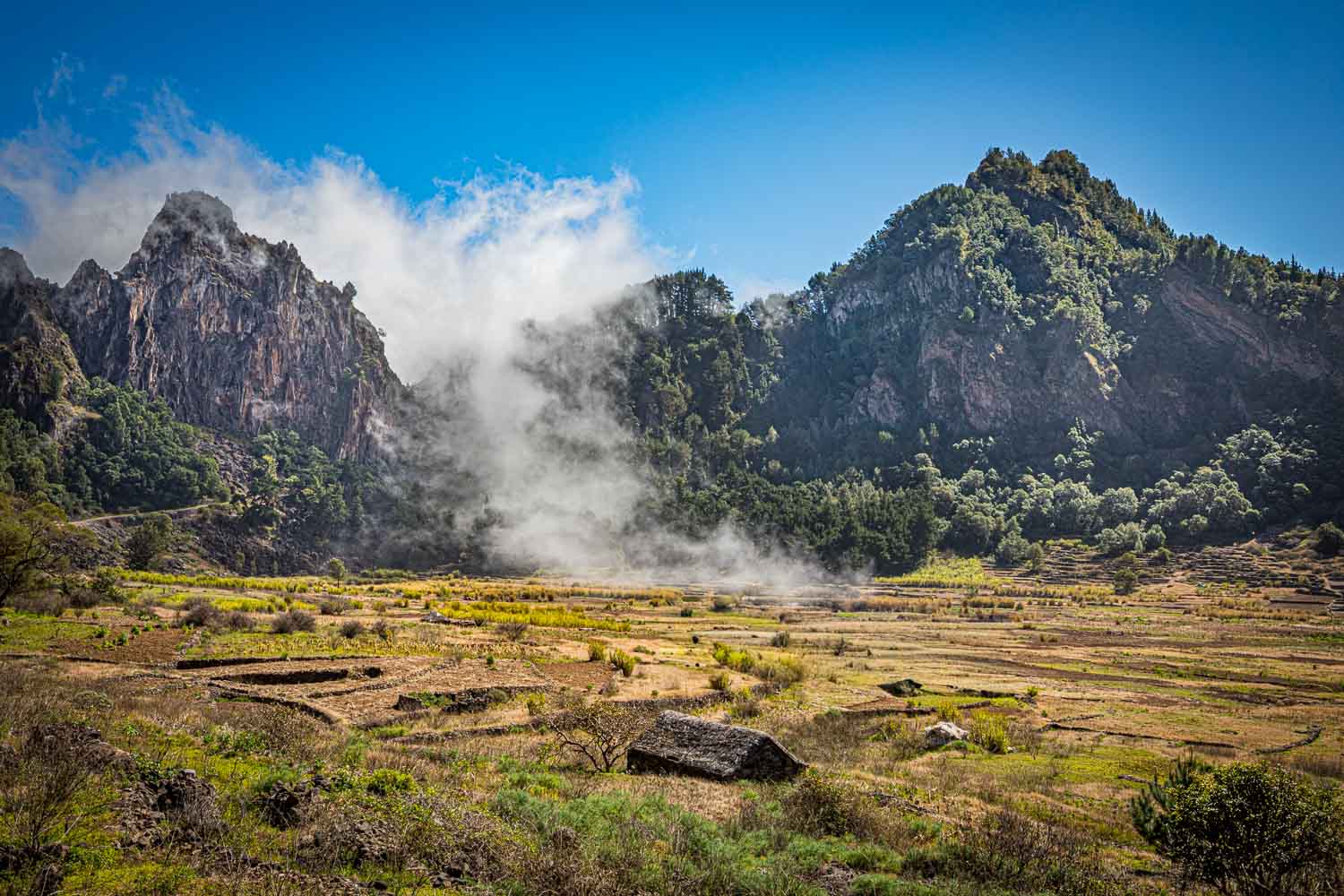
A cloud spills over the rim of the Cova crater on Santo Antão.
The descent into the valley of Paul is around a thousand metres, a little more than on São Nicolau. With every hairpin it grows greener. Agaves stand by the path, pink flower spikes glow between them, butterflies flutter. A young donkey grazes, a rope around its neck. The sugar cane is in flower, white, feathery plumes against the green basin of the valley.
In the cachupa, the maize still has bite and the beans dissolve on the tongue
For a late lunch we are guests of Margarida dos Santos Souza in Figueiral. She carries a steaming bowl out of the kitchen, and we fill our plates from it. It is cachupa, the traditional dish of the islands, a stew of pounded maize and beans.
And it is delicious. The maize still has bite, the beans dissolve on the tongue, and every spoonful tastes of the hours the pot simmered over a low flame. For dessert, camoca comes to the table, roasted and ground maize, with flambéed banana.
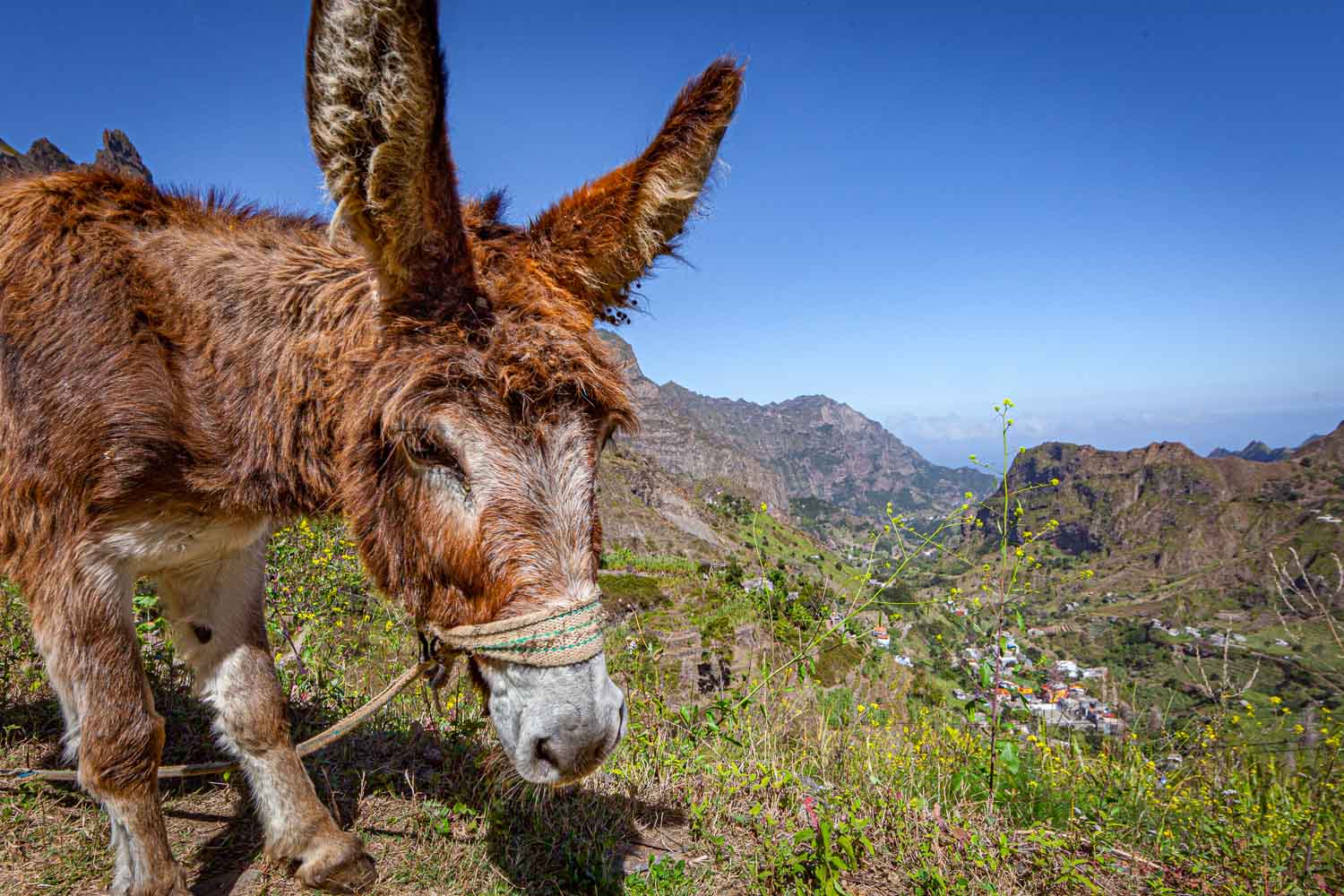
A young donkey with a rope halter beside the path into the Paul valley.
A spirit with its own law
In the valley of Ribeira da Torre, in the hamlet of Longueira, a whitewashed house with a red door waits among the sugar cane. In front of the door, a green praying mantis is eating its prey. Inside, barrels stand against walls of rough stone. Arlindo Rodrigues leans on one of them and laughs.
In front of him stand three bottles, one clear, one dark, one yellowish, all bearing the label Dona Adélia, the name of the house. This is where the cane ends up, the kind we saw flowering on the slope at midday. It is distilled into grogue, a spirit made from sugar cane and nothing else.
“Grogue isn’t only drunk when there’s something to celebrate. At a funeral too”
Santo Antão is the island of grogue. Sugar cane grows on 82 per cent of its arable land, and four fifths of Cape Verdean grogue comes from here. From 1993 on, many distillers stretched their spirit with state-subsidised sugar; in popular parlance it was called “grogue of democracy”.
Today a law governs distilling: it runs from 1 January to 31 May, when the cane is at its best for processing. After that, the authorities seal the stills.
“Grogue isn’t only drunk when there’s something to celebrate,” says Arlindo Rodrigues. “At a funeral too. Out of respect for the dead. And in their memory.”
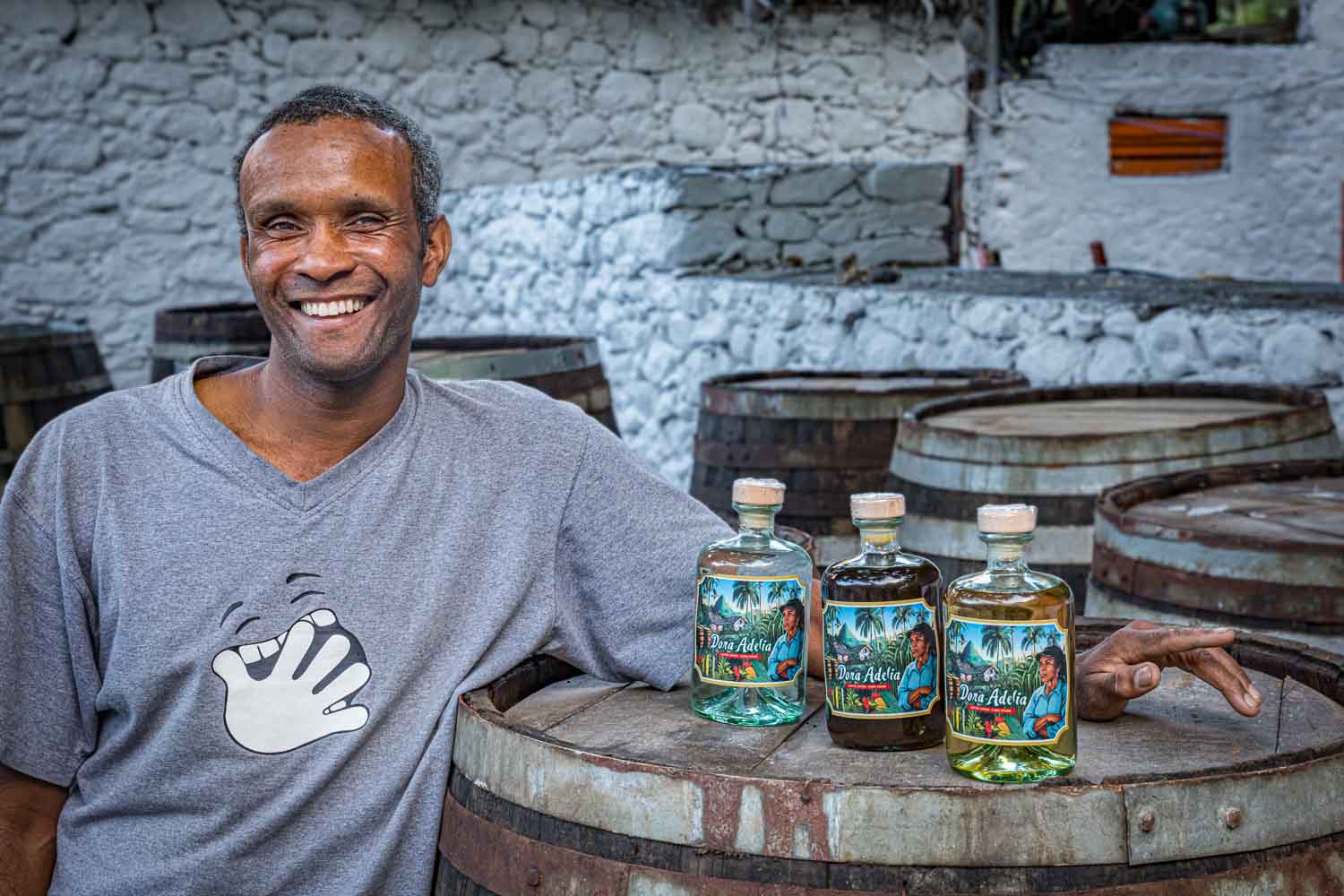
Arlindo Rodrigues in the Dona Adélia distillery in Ribeira da Torre. By law, grogue may be distilled only from sugar cane.
Between rock and water
The next morning we drive to Cruzinha on the north coast. At about nine our walk to Ponta do Sol begins: five to five and a half hours along the coast, 620 metres up and 620 back down. The cliffs stand in the haze.
For long stretches the path hangs like a balcony carved out of the rock face
Again and again the path hugs cliffs of layered basalt. Cobbled and edged with a wall, for long stretches it hangs like a balcony carved out of the rock face. Below, the sea beats against the rock.
At midday we stop at Sónia’s little restaurant in Boca de Coruja, a hamlet along the way. To let lunch settle, a few of us kick a ball about on a small concrete court between ochre-coloured houses, the terraces rising behind them.
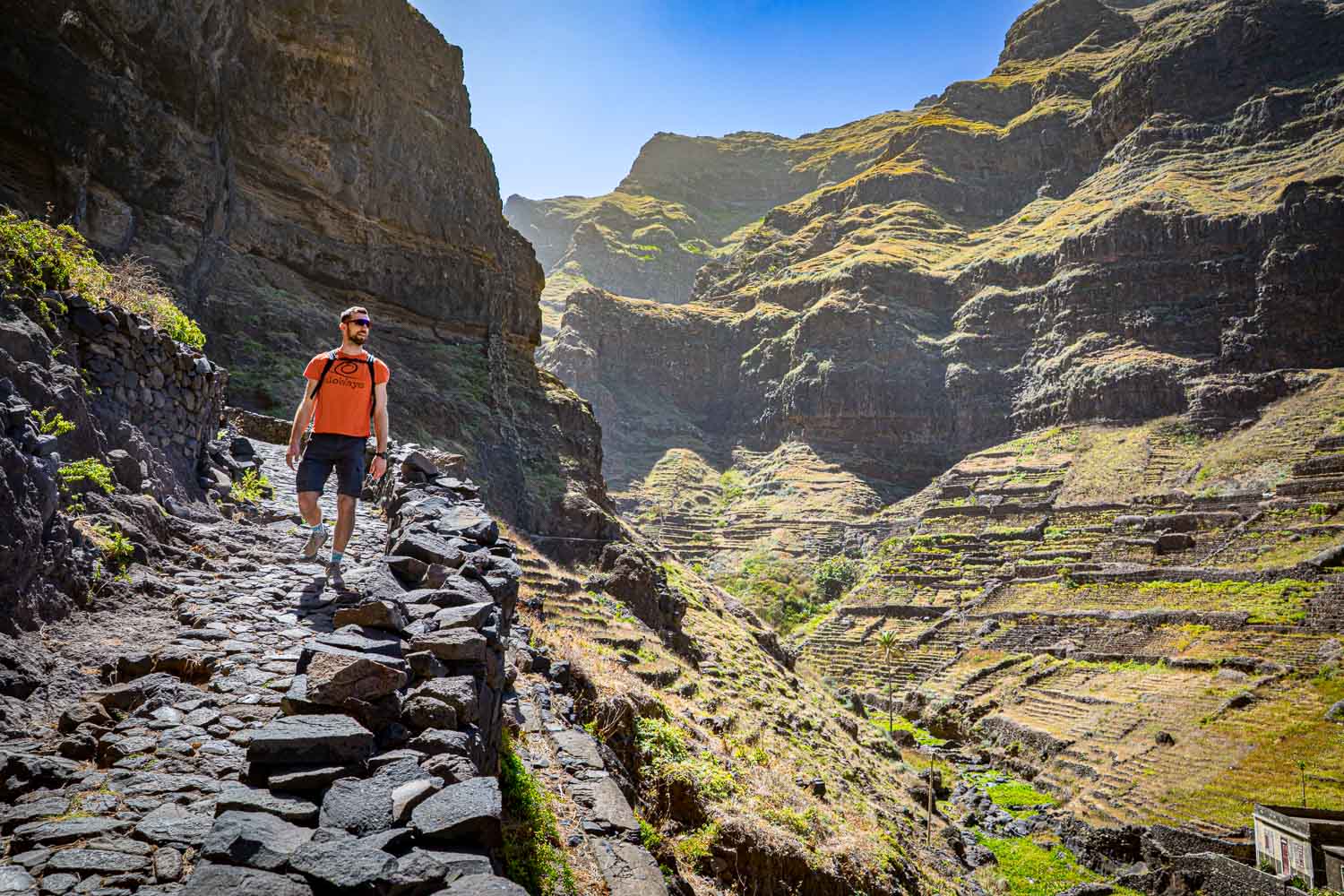
Davide Munari descends the coastal path over rough paving, with terraced fields between sheer cliffs behind him.
In the afternoon the path zigzags up once more out of a bay. Then Fontainhas lies opposite us. The village of just under three hundred inhabitants fills a narrow rocky ridge: blue, pink, yellow and white houses packed tight, terraces all around, right up to the edge. Later we reach Ponta do Sol.
A woman in flip-flops carries bananas across the cobblestones. Painted faces gaze from the walls of the houses; on the square by the sea an old man sits in the shade, a father leans against a wall with his child, a dog trots past. There is always a breeze here, they say. It is the same wind that keeps the mountain green.
By the government’s estimate, more than 1.5 million Cape Verdeans live in Europe and the United States, three times as many as on the islands
The green has not always been enough. People still leave today. At the 2021 census, 491,233 people lived in Cape Verde. By the government’s estimate, more than 1.5 million Cape Verdeans live in Europe and the United States, three times as many as on the islands.
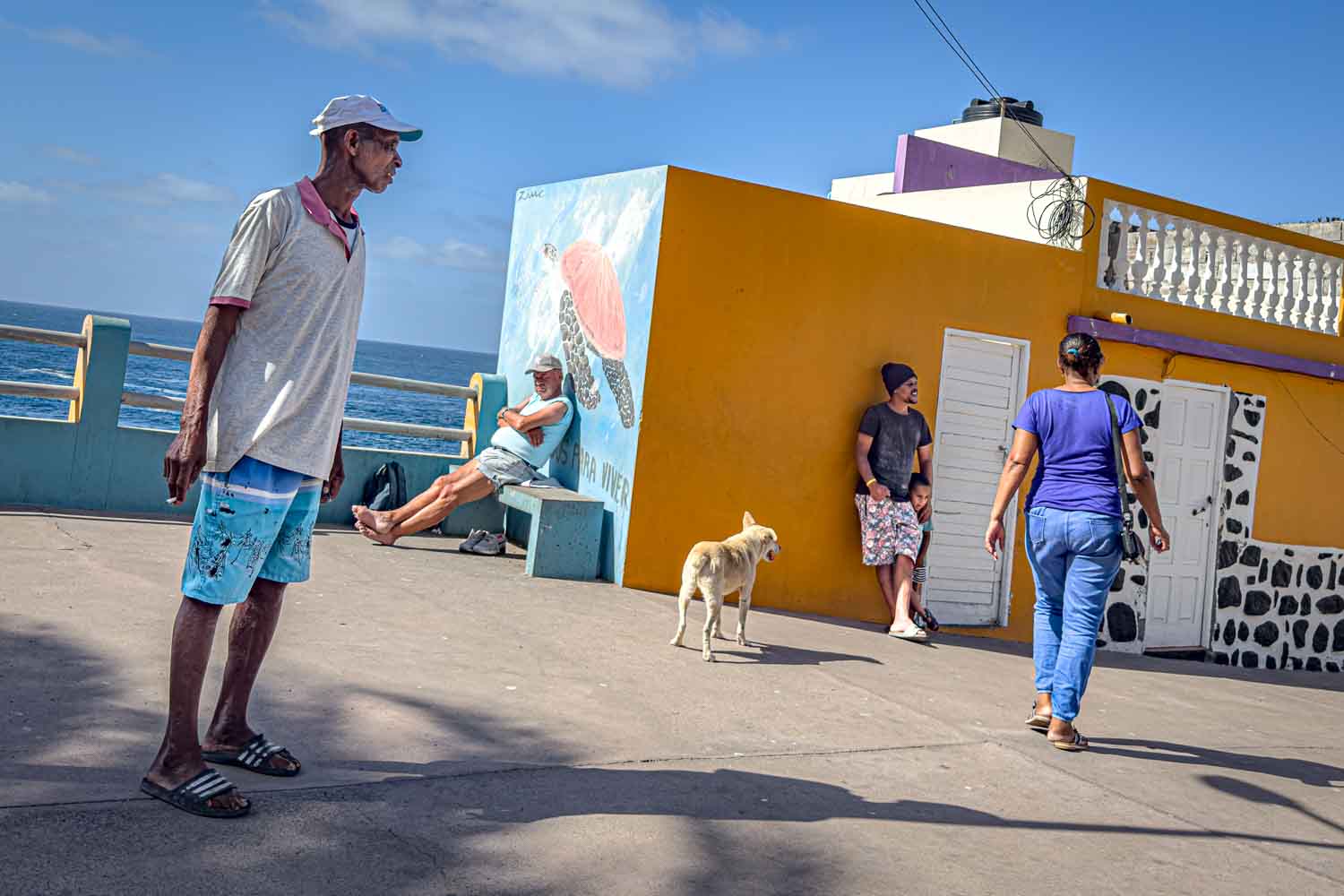
Ponta do Sol, the end of the coastal path: everyday life on the square above the sea.
On the last evening, back on São Vicente, we eat at Casa Tchicau, a restaurant above Mindelo harbour. A band is playing. Maya Duarte, one of our guides, raises her glass. “What you have experienced these past days, we call morabeza,” she says. “Hospitality. With us, the stranger sits at the family table, just as you do now.”
What do islands live on when hardly any rain falls? On the mist the mountains comb out of the trade wind, as above the dragon trees of Fajã. On the walls that hold the soil. On the sea, from which desalination plants draw drinking water. On the guests who come for the beaches of Sal. On those who left. And on those who stayed. One word binds the two: sodade. Longing.
Shortly after nine, the mist still hangs on the ridge. Below it, on the steep slope above the cobbled path, stand dragon trees.
A dragon tree looks like an umbrella someone has opened and left standing.
Dragon trees on a rocky ridge above Fajã. The largest stands of dragon trees in Cape Verde grow here.
Its thick trunk forks again and again as it rises, and every branch ends in a tuft of stiff, sword-shaped leaves.
Between them, agaves stretch their leaf rosettes into the haze.
Nowhere in Cape Verde do as many dragon trees grow as in the valley of Fajã
Our group of tour operators and journalists set out from the valley of Fajã, on São Nicolau.
Nowhere in Cape Verde do as many dragon trees grow as here and on the slopes above. That comes as a surprise.
A lone house below the massif above Fajã.
For hardly any rain falls on these islands off West Africa: a long-term average of 228 millimetres a year, almost all of it between August and October.
What do islands live on when so little water falls on them?
That is not even half as much as Berlin gets. What do islands live on when so little water falls on them?
The answer is drifting over the ridge right now, as mist. Its story begins two days earlier, on São Vicente.
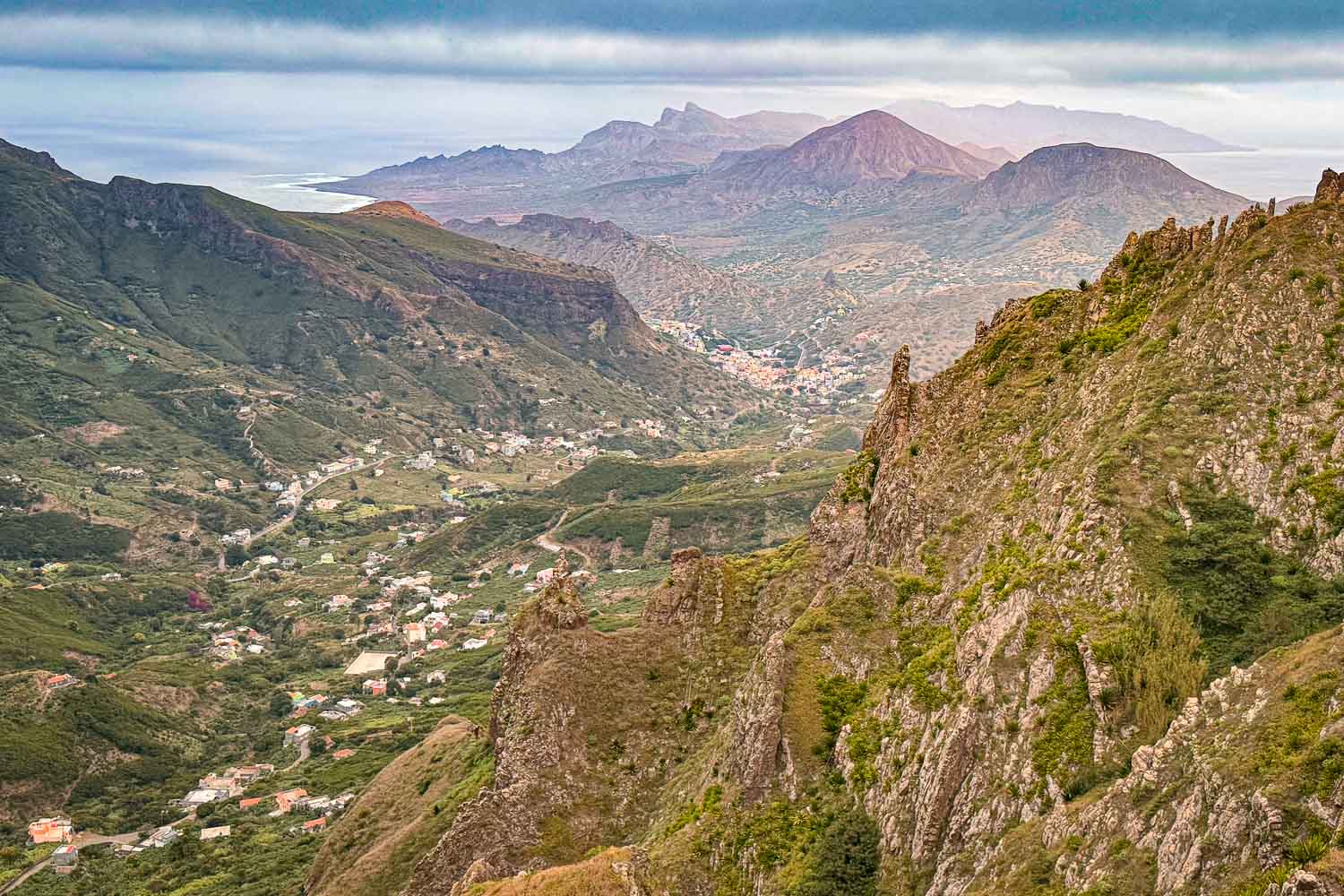
A view into a green valley west of Ribeira Brava.
Mindelo: where Cesária walked barefoot
Brown, bare ridges enclose Mindelo, the port city of São Vicente. We land in February, in the middle of the dry season.
In a workshop in town, a sheet of paper lies on the workbench: “Construindo Musicalidade”, building musicality.
Listed beneath are the instruments made here, among them the cavaquinho, the small four-stringed guitar of Cape Verdean music.
The workshop goes back to Mestre Baptista, who taught his children the craft
Smiling, Luis Baptista tightens a piece of wood in G-clamps. Guitars and empty bodies hang from wall and ceiling; egg cartons deaden the sound.
The workshop goes back to his father, Mestre Baptista, who built instruments here until his death in 1997 and taught his children the craft.
Rufino Almeida, whom everyone simply calls Bau, learned in this workshop too.
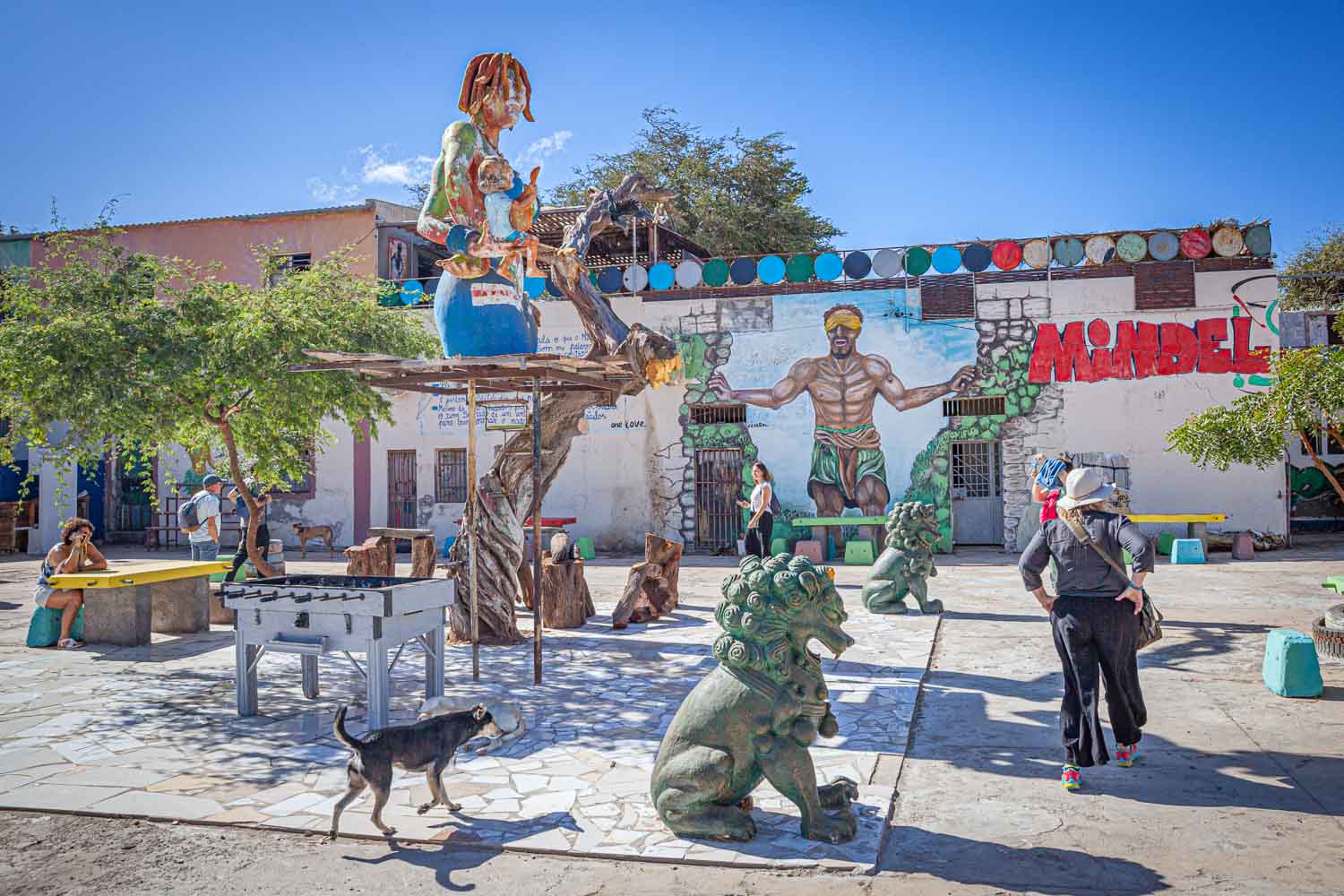
Sculptures, a table-football table and a mural spelling ‘Mindel’: a square in Mindelo on São Vicente.
He plays cavaquinho and guitar, and in the late 1990s he led the band of Cesária Évora, Cape Verde’s most famous singer.
The next morning, Cesária Évora herself gazes out over the seafront promenade, ten metres high, as tall as a three-storey building.
The Portuguese artist Vhils, who chisels portraits out of walls, carved her face into the white wall of a house in 2019. She smiles; palm fronds frame her portrait.
The world knew Cesária Évora as the barefoot diva
She was born here in Mindelo in 1941; in 2004 she won a Grammy for her album “Voz d’Amor”. The world knew her as the barefoot diva.
She performed barefoot, it was said, in solidarity with the poor women of her country. She herself saw it more soberly: “In Cape Verde, where I lived, I always went barefoot.”
Ten metres tall: Cesária Évora, carved into a house wall in Mindelo by the Portuguese street artist Vhils in 2019. The singer was born in the city in 1941.
At the fish market, red mullet and small tuna lie on the tables.
The houses beside it and in the old town, built under Portuguese and British influence, have tiled roofs and dormer windows.
Mindelo calls itself the city of music. In the evenings, bands play in many of the restaurants, with guitar, cavaquinho and often a violin.
Sodade is the Cape Verdean word for the longing for something you have lost
Their repertoire is the morna: slow, wistful songs that Cesária sang too.
Throughout these days, one of her songs accompanies me on my headphones: “Sodade”. Sodade is the Cape Verdean word for the longing for something you have lost.
The song tells of people who, in the twentieth century, had to leave their island because the rain failed and hunger came. That island is called São Nicolau.
The last colours of the day over the mountains on the horizon, with the lights of a settlement on São Vicente below.
São Nicolau: into the land of longing
The evening before, we flew over from Mindelo to São Nicolau.
Now we are walking downhill from Fajã. The stones of the path were laid by hand; walls run along either side, some so thickly overgrown that you can barely see them.
Along the way grows whatever the island yields: papaya, guava, figs, mango and tamarind, peas, broad beans and cherry tomatoes, plus coffee, ginger, cotton, aloe and tobacco.
All the land reptiles native to Cape Verde exist nowhere else in the world
The wind rustles in the bushes; cockerels crow across the valley. In a crevice of a reddish wall, a dark, finely speckled lizard basks in the sun.
All the land reptiles native to Cape Verde exist nowhere else in the world.
They are either geckos or skinks; the skinks have smooth, glossy scales. There are no snakes.
A skink on a rock beside the path from Fajã. There are no snakes on the islands, but there are endemic geckos and skinks.
We stop at a densely branched shrub. At the tips of its twigs, narrow leaves sit in rosettes, like little green stars.
It is tortolho, a spurge that grows only in Cape Verde. Its milky sap is poisonous.
Where the path steepens, dry-stone walls shore up the terraces. We pass ruined, overgrown stone houses and go through the village of Fragatona.
Armando Zeferino Soares was not recognised as the author of “Sodade” until December 2006, shortly before his death
In the early afternoon we reach Ribeira da Prata. We have descended 800 metres today.
In the neighbouring village of Praia Branca lived the trader Armando Zeferino Soares. It was there, in the 1950s, that he wrote “Sodade”.
He was not recognised as its author until December 2006, shortly before his death. Praia Branca calls itself Terra d’Sodade, land of longing.
Hikers on the stone-built path down to Ribeira da Prata.
The song has a dark history, and it is about water. In the 1940s the rains failed several times.
By the calculations of the historian António Carreira, around 45,000 people starved to death. At the time, some 180,000 people lived on the islands: roughly one in four died.
The labourers travelled to São Tomé in the ships’ holds and did not know whether they would return
Between 1903 and 1970, the Portuguese colonial administration sent around 80,000 Cape Verdeans to São Tomé and Príncipe, an island group in the Gulf of Guinea.
There they had to work on coffee and cocoa plantations. The labourers travelled in the ships’ holds and did not know whether they would return.
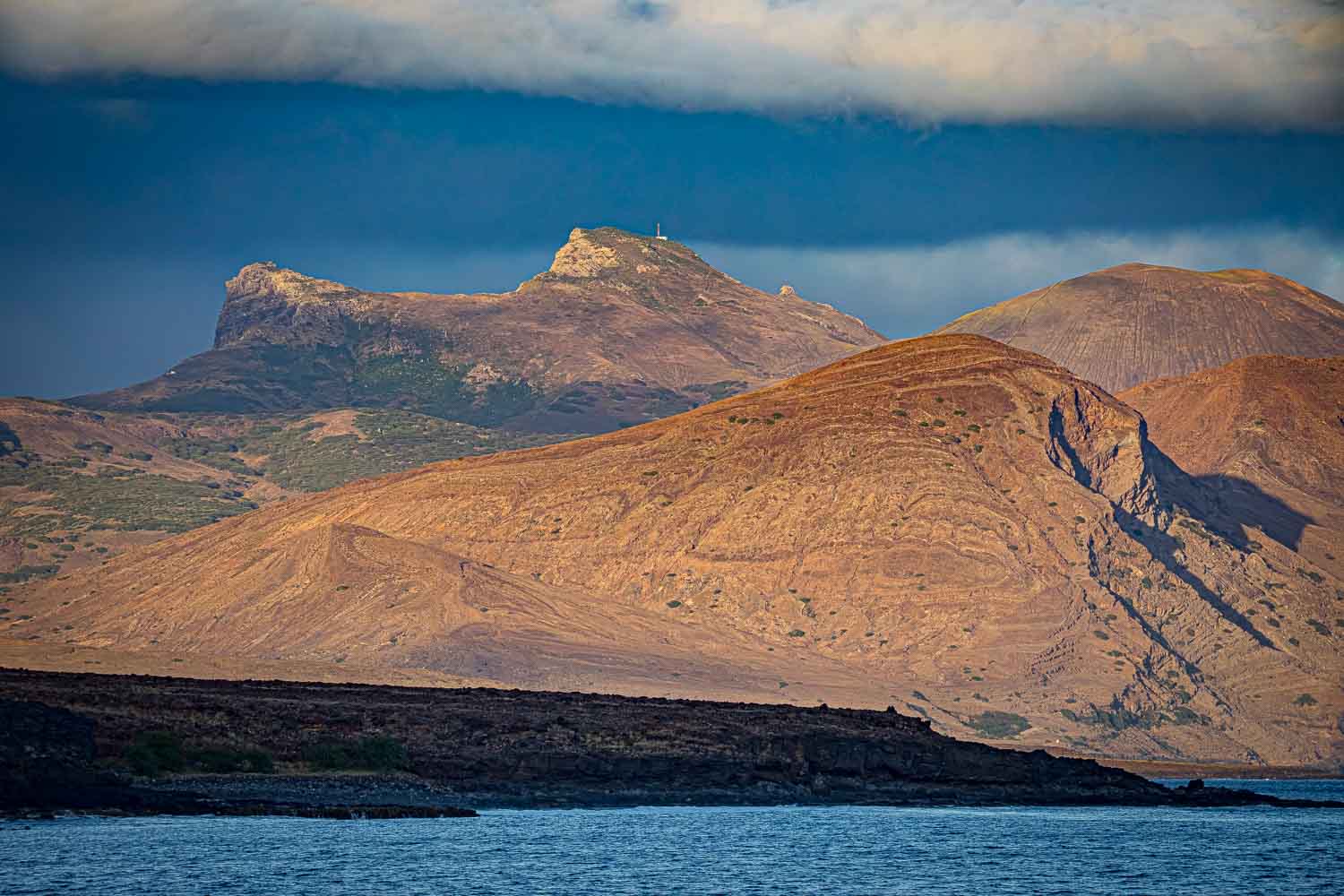
Bare brown volcanic mountains in the last light on the coast of São Nicolau.
This is what “Sodade” tells of. One line names the “caminho pa São Tomé”, the road to São Tomé.
Later the car takes us to the coast. At Carbeirinho we stand before a rock face.
Its layers lie in waves one above the other, shot through with white streaks of mineral; below it, black sand and wide, shallow pools of seawater.
The surf forces water through a cleft in the rock, and it shoots metres into the air
The surf forces water through a cleft in the rock, and it shoots metres into the air. At last, I run into the sea on the beach at Tarrafal.
Why coffee grows up on the slope while down here there is nothing but rock and sand will become clear tomorrow on Monte Gordo, the island’s highest mountain.
Emmanuelle Radzynski leans against the wavy, layered rock face at Carbeirinho on São Nicolau, black sand at her feet.
Monte Gordo: the cloud forest
The next day we climb into the Monte Gordo Natural Park. It protects 952 hectares, a good 1,300 football pitches, around the mountain of the same name.
The summit stands at 1,312 metres. One in three plant species in the park, 28 in all, grows only in Cape Verde.
The clouds come from two sides, touch, and then drift across the crest as a flat lawn
In a small valley below the ridge, the clouds meet. They come from two sides, touch, and then drift across the crest as a flat lawn.
It is the same mist that hung above the dragon trees at Fajã. The scent of eucalyptus is in the air; wild carrot grows beside the path, with white umbels.
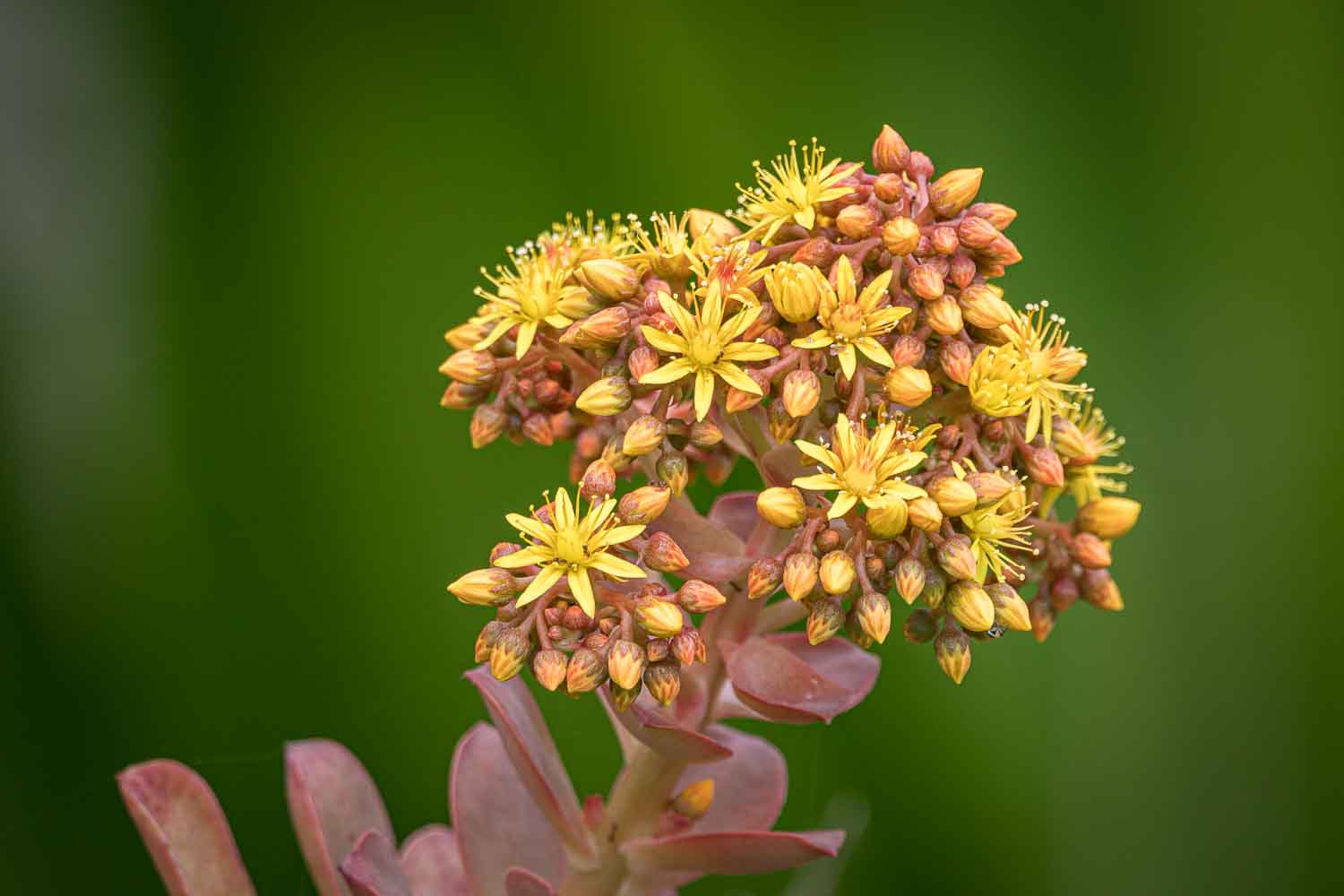
A plant of the stonecrop family in flower on Monte Gordo. The nature park is home to 28 plant species that exist only in Cape Verde.
In the forest stand mossy, twisted trunks, with rosette plants between them; a clearing blurs into the haze.
By the path blooms the língua-de-vaca, the cow’s tongue, a viper’s bugloss with rough leaves and pink and violet funnel-shaped flowers on red tubes.
The cow’s tongue is used as a medicinal plant and as firewood, which is why it is endangered
It grows only in Cape Verde and is endangered, because people use it as a medicinal plant and as firewood.
What we see obeys simple physics.
Língua-de-vaca, cow’s tongue, is the name of this viper’s bugloss on Monte Gordo. The plant is found only in Cape Verde and is considered endangered.
The trade wind, the steady north-easterly, pushes moist air against the mountains. The air rises, cools and gives up its water, as mist or as rain.
That is why the weather station at Cachaço, at 724 metres, records the most rain on the island, and the one down in the main town, at 125 metres, the least.
On the island of Brava, nets made of metal catch up to 1,500 litres of mist water a day
On other islands, people have learned to harvest this mist, with nets strung vertically, on which the droplets catch and drip into channels.
On the island of Brava, nets made of metal catch up to 1,500 litres a day, ten bathtubs’ worth.
Mossy trunks in the mist on Monte Gordo. The summit rises to 1,312 metres.
Sal: a crater full of salt
On the flight back to Mindelo we make a stopover on the island of Sal.
Its name is Portuguese and means salt. In the 2024 rainy season, a mere 30 millimetres fell here, barely two fingers’ breadth.
Even so, more than four in five of Cape Verde’s hotel guests stay on Sal and the neighbouring island of Boa Vista. They come for the beaches.
In the salt pans, the sun evaporates the brine until only salt is left
Near the village of Pedra de Lume we stop on a plain of dust and rubble. In ten minutes we climb a bare slope to the rim of an old volcanic crater.
From there we look down on rectangular basins, whitish and grey, separated by earthen banks. They are salt pans: the sun evaporates the brine until only salt is left.
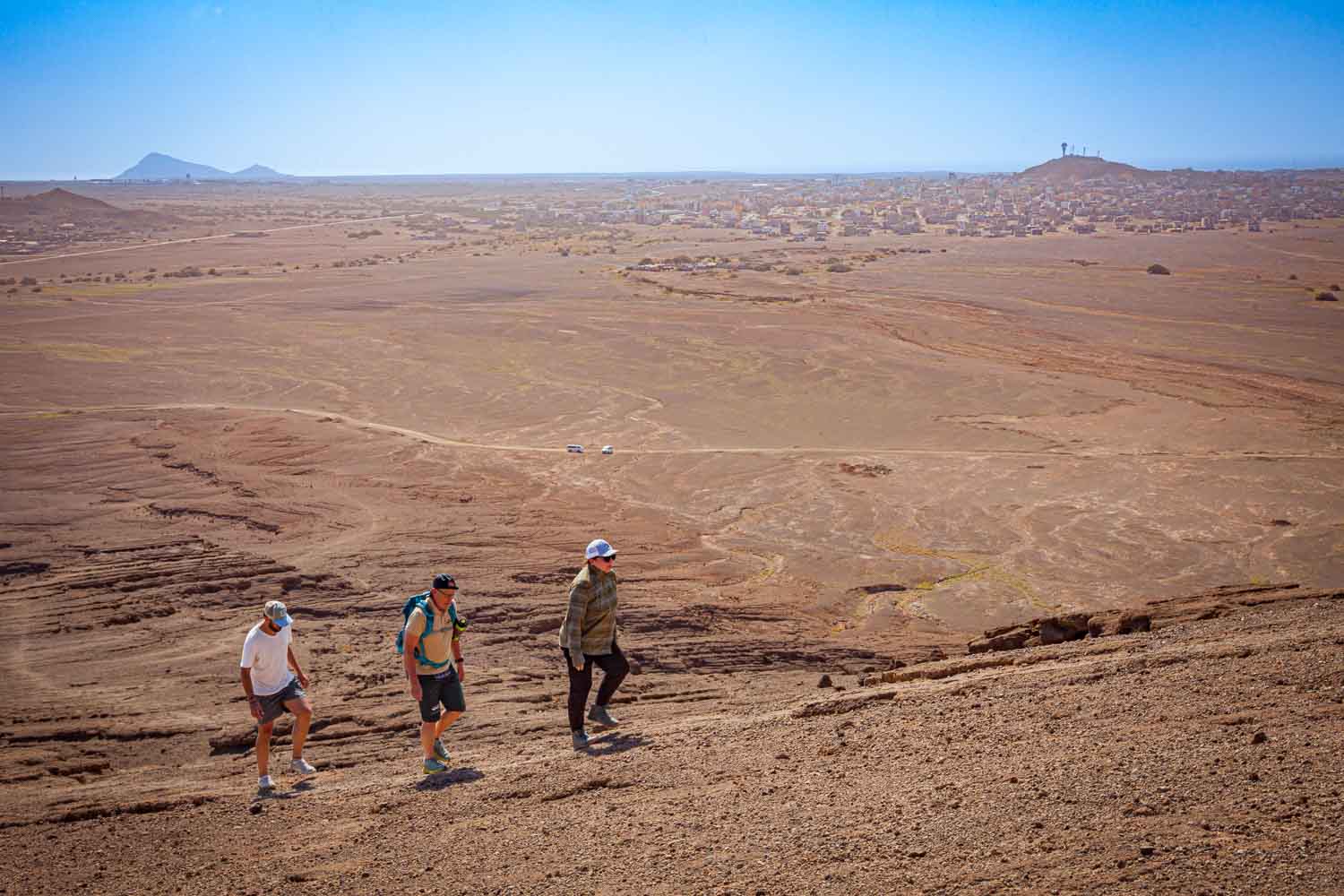
Climbing the bare slope to the crater rim at Pedra de Lume on Sal.
More than 50 million tonnes of salt lie in the crater. Until 1887, up to 30,000 tonnes a year were shipped out, mostly to Brazil.
After that the trade declined, and in 1963 it came to a virtual standstill. Today only a little salt is extracted here, mainly for cosmetics.
Visitors come to bathe in the brine. Like the Dead Sea, the brine keeps the body afloat without any need to swim.
Around 90 per cent of Cape Verde’s drinking water comes from desalination plants
Sal has salt and beaches. The trade wind blows here too, but Sal’s highest mountain, Monte Grande, stands at only 406 metres. It is too low to wring the moisture from the wind.
So the island draws its drinking water from the sea. Around 90 per cent of Cape Verde’s drinking water comes from desalination plants.
Salt pans in the crater at Pedra de Lume. Until 1887 salt went from here mainly to Brazil.
Santo Antão: fields beneath clouds
After a night in Mindelo, the early-morning ferry carries us across to Porto Novo on Santo Antão, the fourth island of this journey.
For half an hour the car climbs, through pine forests, to Água das Caldeiras at 1,300 metres. Then the Cova crater opens up.
The floor of the Cova crater is not a field of lava but a patchwork of plots
Its floor is not a field of lava but a patchwork of plots framed by stone walls. A cloud spills over the crater rim and sinks onto the fields.
The path leads over the rim and then downhill, cobbled and lined with dry-stone walls. To the left, the valley of Paul lies beneath an unbroken sea of cloud.
A cloud spills over the rim of the Cova crater on Santo Antão.
Up the rock face the clouds climb. Beside the path grows losna, a wormwood that smells sharply of vapour rub.
It is found only on Santo Antão, Santiago and Fogo, mostly above 800 metres. A falcon rides the updraught and spirals upwards.
The mountains of Santo Antão catch rain and mist from the trade wind, above all on the northern and north-eastern slopes. The southern and south-western slopes, by contrast, stay very dry.
Through stone-built water channels, some more than 200 years old, the water reaches the terraced fields
Through levadas, stone-built water channels, some more than 200 years old, the water reaches the terraced fields of the valleys.
In the 2024 rainy season, an average of 495 millimetres fell on Santo Antão, sixteen times as much as on Sal.
The descent into the valley of Paul is around a thousand metres, a little more than on São Nicolau. With every hairpin it grows greener.
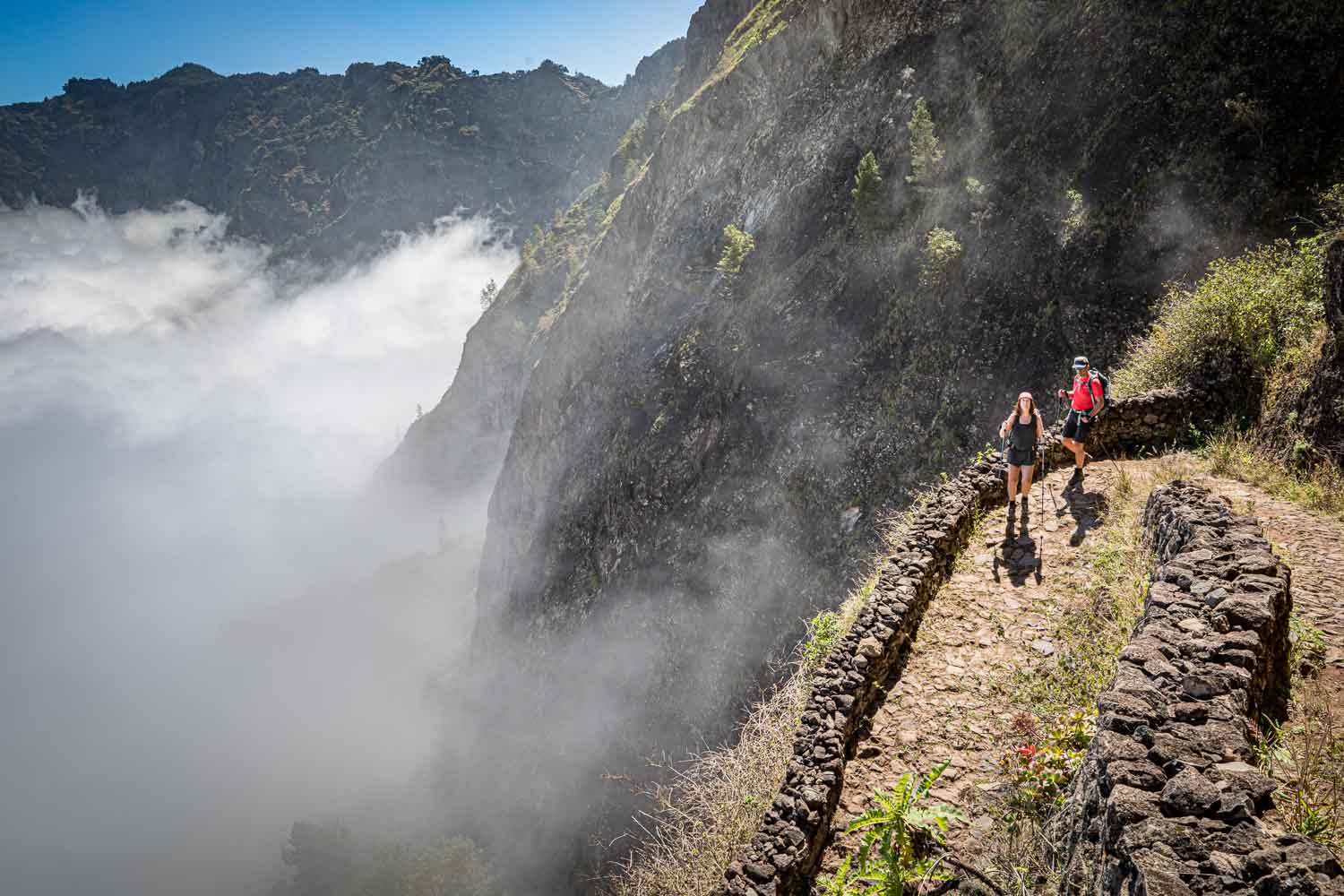
On the path from the Cova crater to the Paul valley. Clouds rise from below.
Agaves stand by the path, pink flower spikes glow between them, butterflies flutter. A young donkey grazes, a rope around its neck.
The sugar cane is in flower, white, feathery plumes against the green basin of the valley.
For a late lunch we are guests of Margarida dos Santos Souza in Figueiral. She carries a steaming bowl out of the kitchen, and we fill our plates from it.
In the cachupa, the maize still has bite and the beans dissolve on the tongue
It is cachupa, the traditional dish of the islands, a stew of pounded maize and beans.
And it is delicious. The maize still has bite, the beans dissolve on the tongue, and every spoonful tastes of the hours the pot simmered over a low flame.
For dessert, camoca comes to the table, roasted and ground maize, with flambéed banana.
A young donkey with a rope halter beside the path into the Paul valley.
A spirit with its own law
In the valley of Ribeira da Torre, in the hamlet of Longueira, a whitewashed house with a red door waits among the sugar cane.
In front of the door, a green praying mantis is eating its prey. Inside, barrels stand against walls of rough stone. Arlindo Rodrigues leans on one of them and laughs.
Grogue is distilled from sugar cane and nothing else
In front of him stand three bottles, one clear, one dark, one yellowish, all bearing the label Dona Adélia, the name of the house.
This is where the cane ends up, the kind we saw flowering on the slope at midday. It is distilled into grogue, a spirit made from sugar cane and nothing else.
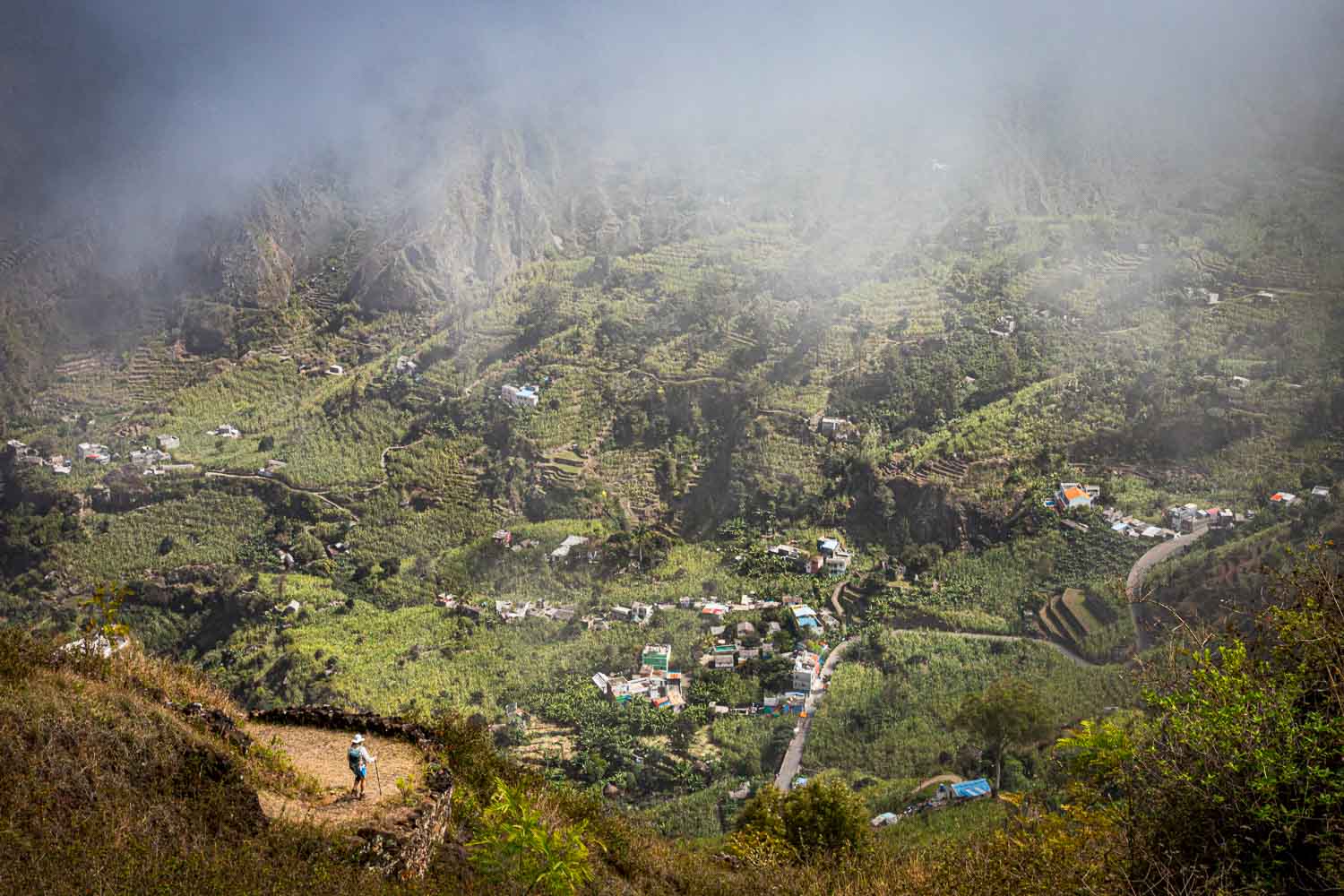
A hiker at a hairpin bend above the Paul valley.
Santo Antão is the island of grogue. Sugar cane grows on 82 per cent of its arable land, and four fifths of Cape Verdean grogue comes from here.
From 1993 on, many distillers stretched their spirit with state-subsidised sugar; in popular parlance it was called “grogue of democracy”.
“Grogue isn’t only drunk when there’s something to celebrate. At a funeral too”
Today a law governs distilling: it runs from 1 January to 31 May, when the cane is at its best for processing. After that, the authorities seal the stills.
“Grogue isn’t only drunk when there’s something to celebrate,” says Arlindo Rodrigues. “At a funeral too. Out of respect for the dead. And in their memory.”
Arlindo Rodrigues in the Dona Adélia distillery in Ribeira da Torre. By law, grogue may be distilled only from sugar cane.
Between rock and water
The next morning we drive to Cruzinha on the north coast.
At about nine our walk to Ponta do Sol begins: five to five and a half hours along the coast, 620 metres up and 620 back down. The cliffs stand in the haze.
For long stretches the path hangs like a balcony carved out of the rock face
Again and again the path hugs cliffs of layered basalt.
Cobbled and edged with a wall, for long stretches it hangs like a balcony carved out of the rock face. Below, the sea beats against the rock.
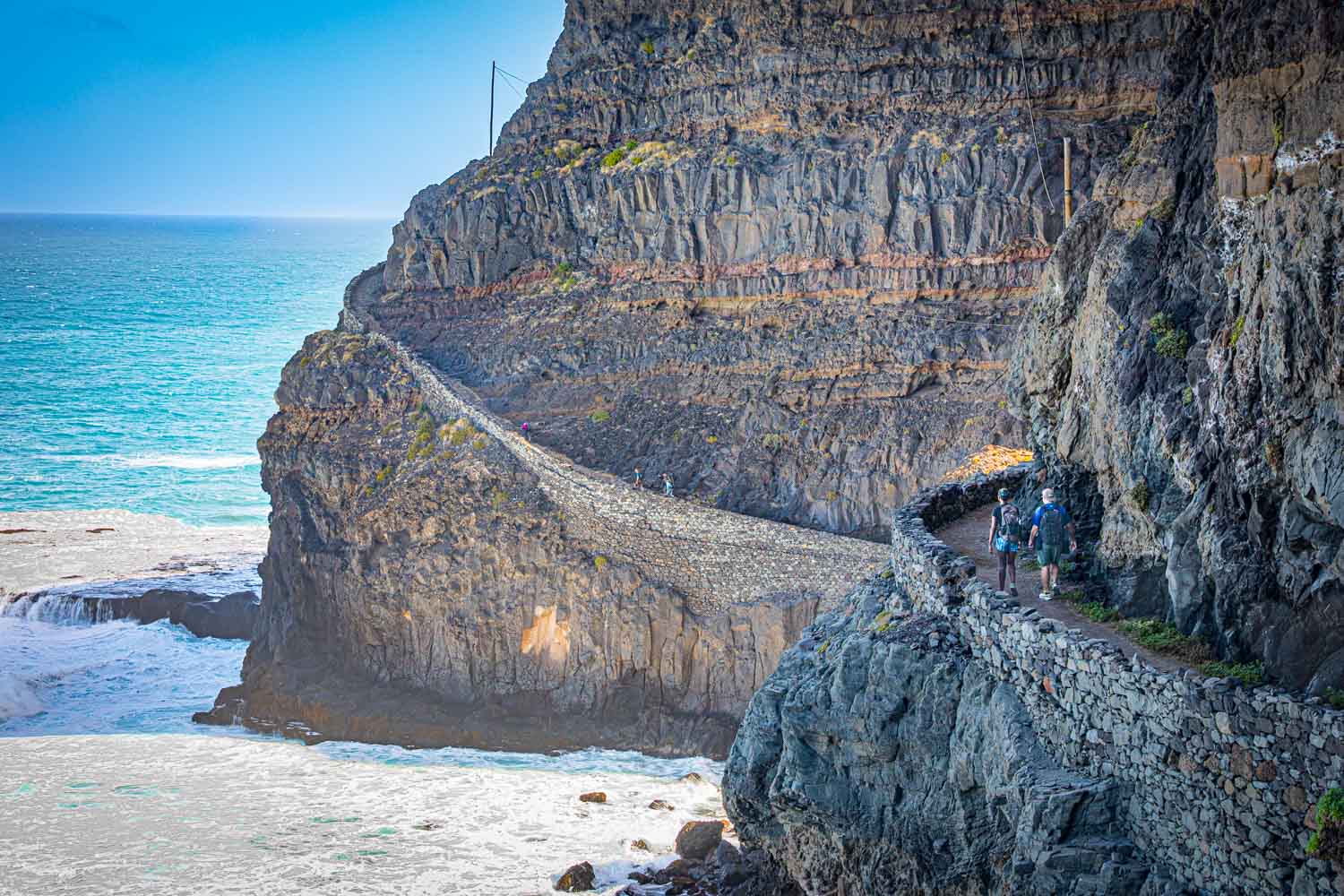
Stone-built and paved, the coastal path curves around a basalt cliff.
At midday we stop at Sónia’s little restaurant in Boca de Coruja, a hamlet along the way.
To let lunch settle, a few of us kick a ball about on a small concrete court between ochre-coloured houses
To let lunch settle, a few of us kick a ball about on a small concrete court between ochre-coloured houses, the terraces rising behind them.
Davide Munari descends the coastal path over rough paving, with terraced fields between sheer cliffs behind him.
In the afternoon the path zigzags up once more out of a bay. Then Fontainhas lies opposite us.
The village of Fontainhas fills a narrow rocky ridge, with terraces all around right up to the edge
The village of just under three hundred inhabitants fills a narrow rocky ridge: blue, pink, yellow and white houses packed tight, terraces all around, right up to the edge.
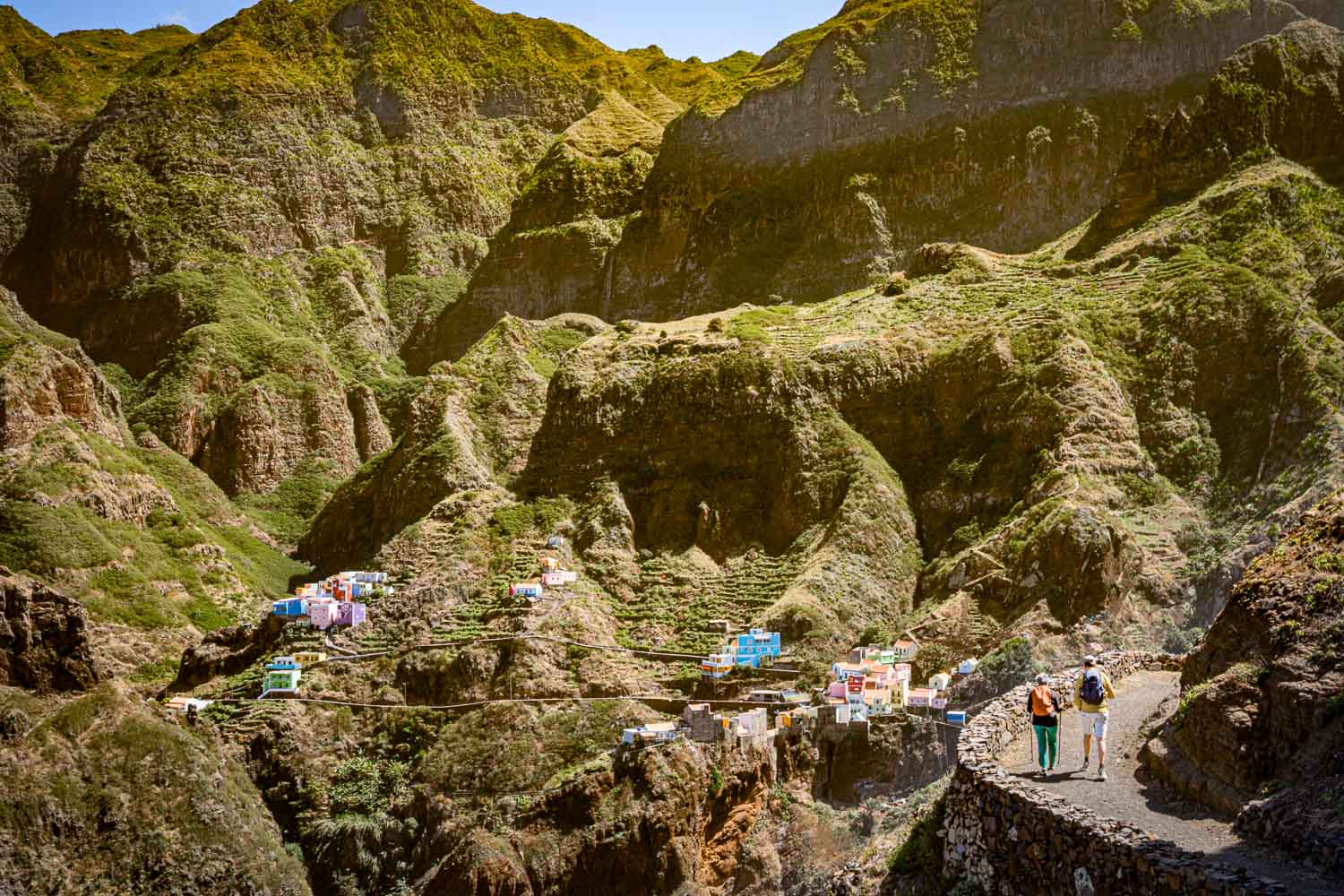
Two hikers on the coastal path of Santo Antão, the mountain village of Fontainhas opposite.
Later we reach Ponta do Sol.
A woman in flip-flops carries bananas across the cobblestones.
There is always a breeze in Ponta do Sol, they say
Painted faces gaze from the walls of the houses; on the square by the sea an old man sits in the shade, a father leans against a wall with his child, a dog trots past.
There is always a breeze here, they say. It is the same wind that keeps the mountain green.
Ponta do Sol, the end of the coastal path: everyday life on the square above the sea.
The green has not always been enough. People still leave today. At the 2021 census, 491,233 people lived in Cape Verde.
By the government’s estimate, more than 1.5 million Cape Verdeans live in Europe and the United States, three times as many as on the islands.
Morabeza – “Hospitality. With us, the stranger sits at the family table, just as you do now”
On the last evening, back on São Vicente, we eat at Casa Tchicau, a restaurant above Mindelo harbour. A band is playing. Maya Duarte, one of our guides, raises her glass.
“What you have experienced these past days, we call morabeza,” she says. “Hospitality. With us, the stranger sits at the family table, just as you do now.”
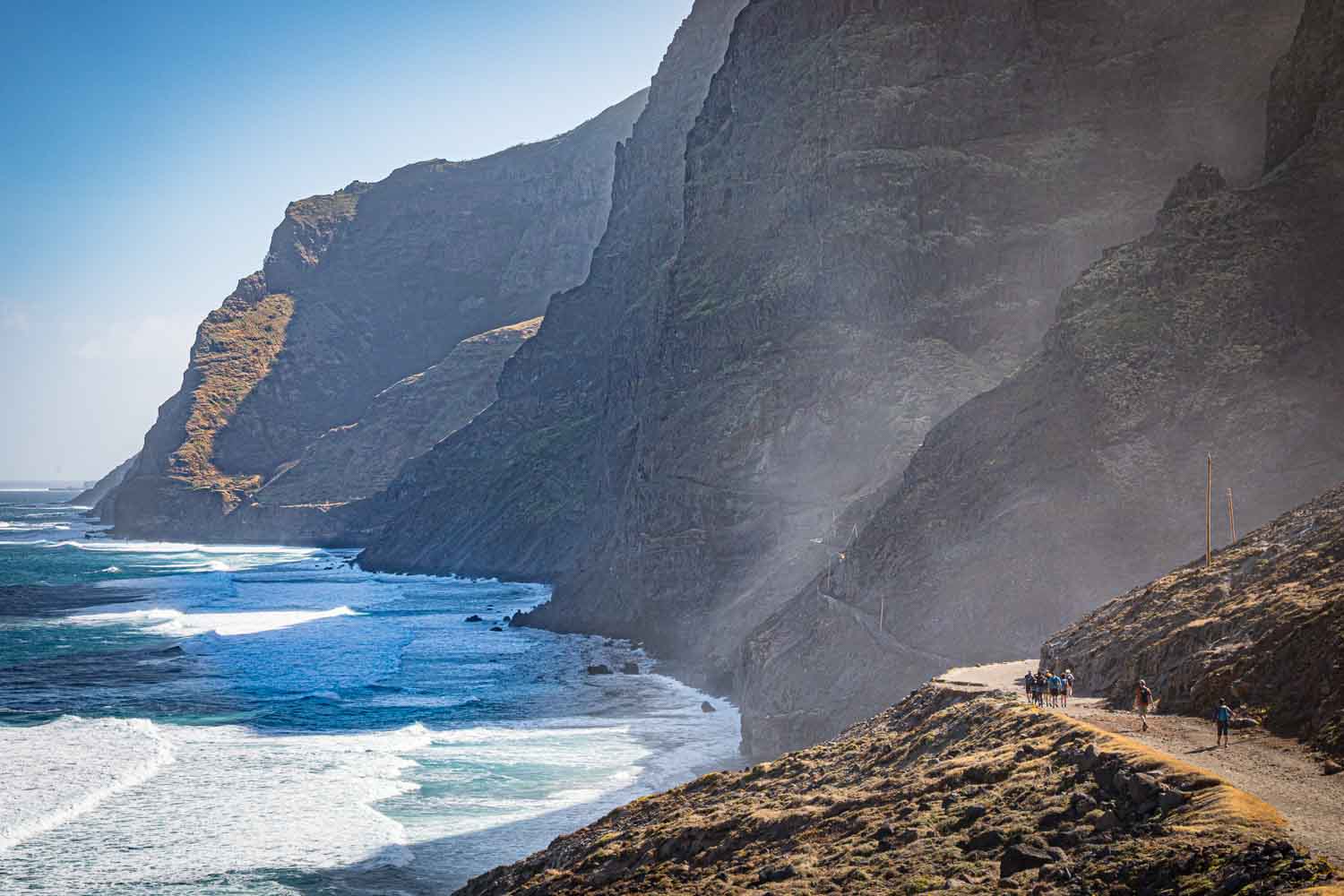
The group at the start of the coastal path from Cruzinha to Ponta do Sol – below sheer cliffs, above the surf.
What do islands live on when hardly any rain falls? On the mist the mountains comb out of the trade wind, as above the dragon trees of Fajã.
On the walls that hold the soil. On the sea, from which desalination plants draw drinking water.
On the guests who come for the beaches of Sal. On those who left. And on those who stayed. One word binds the two: sodade. Longing.
Want more of this?
My DISCOVERY LETTER brings you adventurous stories, stunning pictures and challenges to take part in.
Read now:
Crater rims, dragon trees, coastal paths
Photo gallery Cape Verde
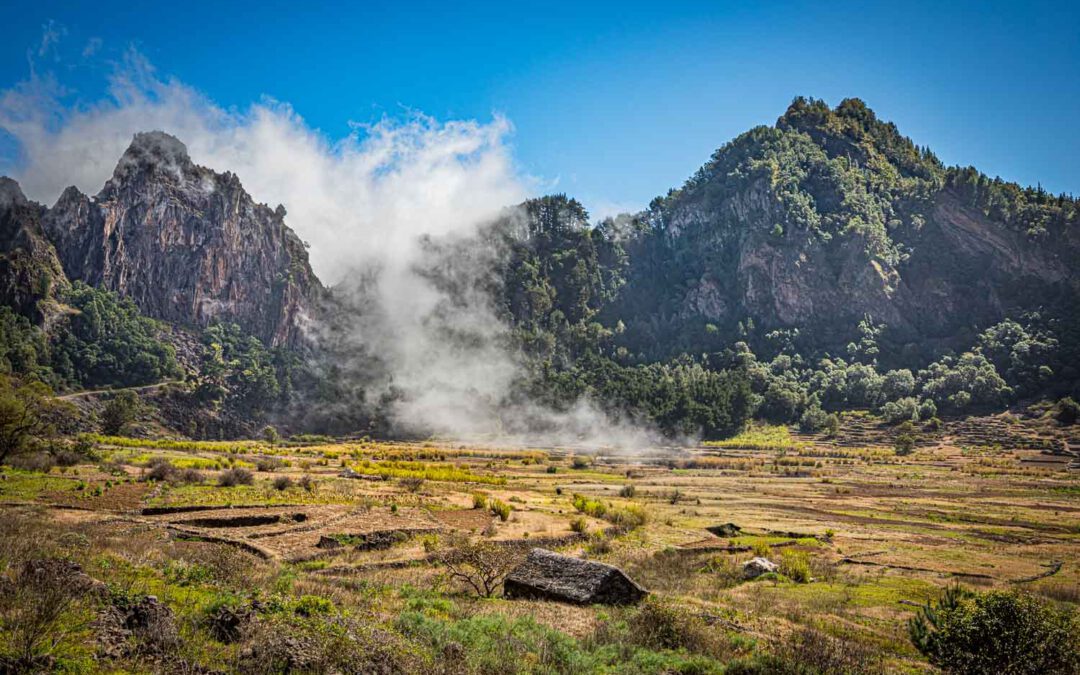
The most beautiful pictures of Cape Verde: a cloud spills over the rim of the Cova crater and fills the Paul valley like milk. Dragon trees cling to the ridges of São Nicolau, salt dries at Pedra de Lume. And on Santo Antão’s coast, a path winds around basalt cliffs.

Ice climbing, ice breaking and ice diving in the Finnish winter
Finland: Breaking the ice
From comfortable to extreme: snow-covered Finland offers some exceptional activities beyond the classic winter sports for those who like to experiment. Malte Clavin visited the only course in the world where you can learn to free dive under ice.

Where you can experience your green miracle
Madeira – 50 Shades of Green
The sister islands of Madeira and Porto Santo are each beautiful in their own way and have much to offer nature lovers: fantastically dense laurel forests, countless hiking trails of any difficulty and lush flora.