


GEO.de: This is the second time you’ve been on a big trip with the family. Wouldn’t a holiday by the Baltic Sea be enough?
Malte Clavin: A holiday by the Baltic Sea is a brilliant idea.
When we were children ourselves, we spent weeks there with our parents.
“Our curiosity about ‘foreign lands’ has grown considerably.”
However, distant lands simply hold a greater appeal for us.
Our curiosity about ‘Otherland’, as we call it, has grown considerably after almost three years in Germany.
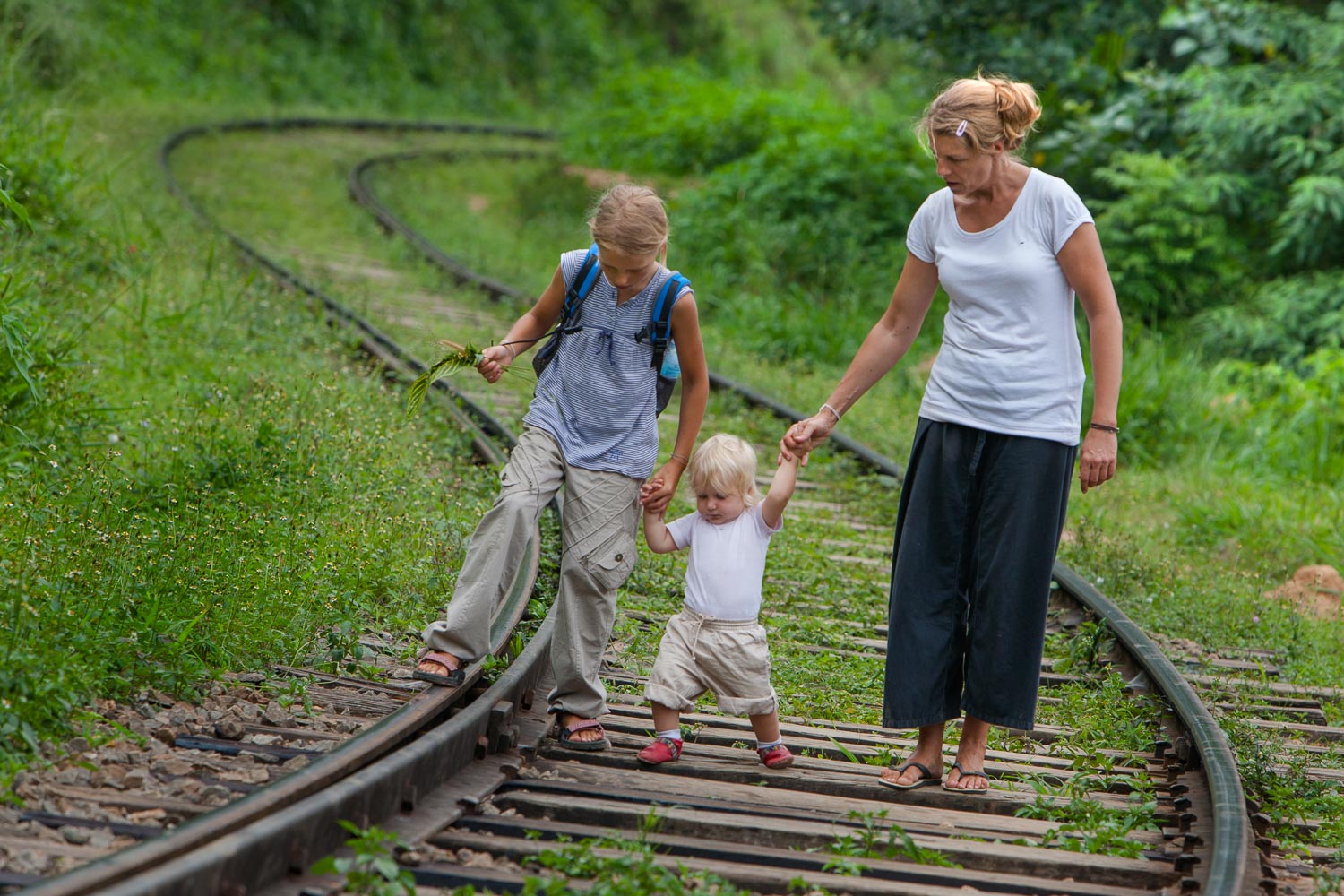
Ella: The first few kilometres of our family hike up Ella Rock follow a rarely used railway line. Even Smilla walks a few hundred metres; otherwise, she gets to watch everything from the baby carrier on Dad’s back.
GEO.de: Did the destination have to be as far away as possible?
Malte Clavin: Distant lands are often much more full of contrasts than home.
We want to test ourselves against these contrasts and see how far we’re willing to go.
Can we make it up this mountain with the baby carrier? Should I touch this animal now? Do we really want to eat that?
It’s all about courage and adventure.
Besides, faraway lands simply exude that magical charm, and then our thirst for discovery becomes unstoppable.

Travelling offers great opportunities for small and slightly bigger tests of courage: here, Annette lets a millipede crawl across her forearm.
GEO.de: When you travel with children, you have to plan a lot. How much is there still to discover on such a tightly organised trip?
Malte Clavin: We like to be surprised.
Every traveller has a certain idea of what the destination country is like. If those images then match the actual experience, it gets boring.
That’s why it’s important for us not to plan too much.
The more we go with the flow, the greater the likelihood of surprises.
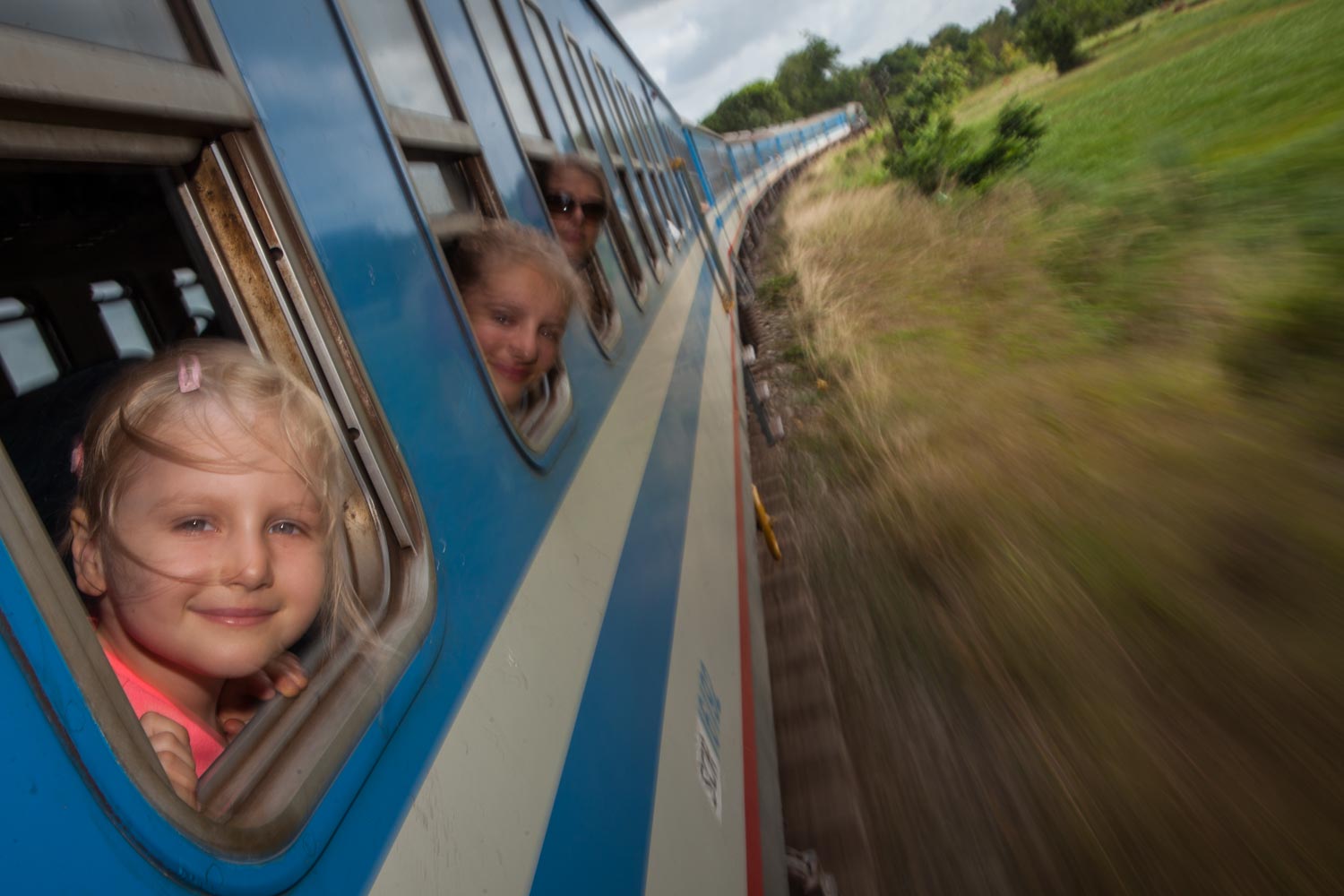
On the way from Colombo to Kandy.
GEO.de: What sort of surprises, for example?
Malte Clavin: The other day, I just went for a walk with Smilla from the hotel.
Right next to the hotel, a narrow path led to a small settlement. We were invited in for coconut milk and watched the locals harvesting.
Smilla was patiently carried from hut to hut and admired.
It was touching to see how delighted the Sri Lankans were with Smilla.

Mirissa, on the beach: Smilla flirts with the Sri Lankans. (Photo by Erik Tolman)
GEO.de: What is the main difference between travelling alone as a backpacker and travelling the world with children?
Malte Clavin: Preparing for a trip with children is very time-consuming.
For example, you have to ask yourself: Are the destination, the climate and the accommodation suitable for the children?
Do we want to put our children through the vaccinations? Which child seat shall we take with us? How will I get the dummies sterilised whilst on the move?
You have to think of everything.

Arugam Bay: Smilla settled herself into her car seat for her afternoon nap, and we then stowed the seat under the mosquito net.
GEO.de: What was the biggest challenge when planning the trip?
Malte Clavin: We spent a long time thinking about how we could protect the children from potential illnesses.
That’s why we made several appointments for consultations and vaccinations with a tropical medicine specialist
Incidentally, Amelie’s five-month leave of absence from school ahead of our trip to Sri Lanka wasn’t a problem.
The teachers saw the extended stay abroad as a great opportunity and an exceptional learning experience.

Unawatuna: Learning together is much more fun anyway.
GEO.de: When the trip finally got underway, how did you, as parents, experience it?
Malte Clavin: We’re not as flexible as we were back when we were only responsible for ourselves.
We’re also much less willing to take risks. It’s no longer about seeing as much as possible in the shortest possible time.
Our children set the pace; they are the priority in every decision.
In return, we experience the trips much more intensely and have far more time to get a glimpse into the everyday life of the country.

Smilla delights the workers in a tea factory.
GEO.de: And how did your children find the trip – a great adventure or a gruelling tour?
Malte Clavin: Definitely as a great adventure. Every day brings new experiences for our little ones.
As we stick to our children’s pace, there haven’t been any problems so far.
We never travel for more than three to four hours, in an air-conditioned vehicle where possible.
After a day’s travel, we take a break for two to seven days.
There’s always something interesting for the children to see or do when we’re there: hiking, swimming, collecting shells, marvelling at ruins, watching animals, exploring hotel rooms or peeling young coconuts.

Kosgoda, turtle breeding centre. This is one of my favourite photos. Because Amelie’s face shows a mix of fascination and caution. “Oooh, how cute!” and “Uuuh, slimy thing!” After a bit of a struggle, she plucks up the courage to touch it. Once again, she has grown a little beyond herself
GEO.de: Has anything ever happened to you on your travels that wouldn’t have happened without your children?
Malte Clavin: Smilla, in particular, is a door- and heart-opener.
That’s how we’re sometimes served food outside restaurant opening hours, or the children are given gifts without anything being expected in return.
We’ve been invited to locals’ homes several times, and at the airport they let us skip the queue.
It’s truly amazing – and we’ve never experienced anything like it in any other country – no matter where we go, with Smilla we’ve almost always been the centre of attention.
Want more of this?
My DISCOVERY LETTER brings you adventurous stories, stunning pictures and challenges to take part in.
Read now:
Extreme activities in winter
Finland photo gallery
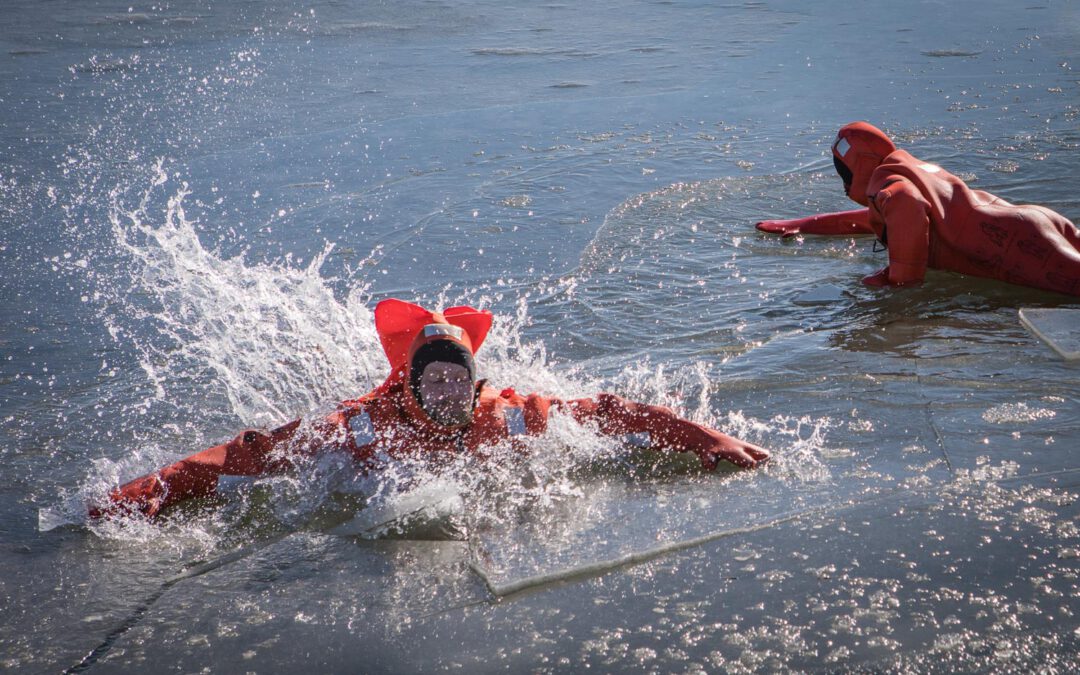
Attention: Extreme! Under-ice-diving-in-Badebüx. Plus pictures of ice climbing and ice breaking from wintry Finland.

A journey with the Royal Canadian Geographic Society
Arctic – Ship expedition from Canada to Greenland
Aboard the research vessel ‘Resolute’, I lent a hand as a temporary scientist and helped collect data. The expedition took us through the Canadian Arctic to the breathtaking fjords of Greenland.

Publication in the Globetrotter-Magazine
Borneo – family adventure in the jungle
Together with my wife Annette and our daughters Amelie and Smilla, we are looking for big adventures and discoveries off the beaten track on Borneo. And indeed, for weeks we can hardly stop being amazed.